


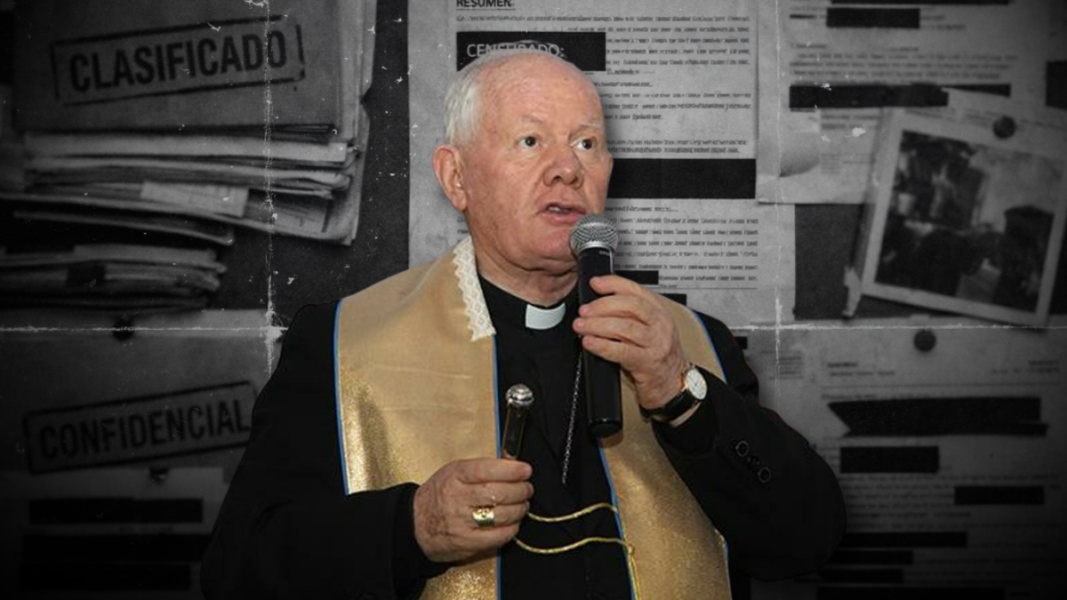
The Bishop of Huacho, under investigation for sexual abuses following the complaint published by Infovaticana, convened all his clergy last Tuesday in a parish hall, where he publicly identified his own victims in front of them and promoted the signing of a document of support regarding his innocence. The described facts not only contravene current canon law, but may also fit into criminal types provided for in the Peruvian legal system.
Antonio Santarsiero, Bishop of Huacho and until last Friday secretary general of the Peruvian Episcopal Conference, is under investigation for complaints of sexual abuses supported by consistent testimonies that appear solid. In that context, last Tuesday the prelate convened the entire diocesan presbytery to an in-person meeting. During the meeting, according to several witnesses, he illegally revealed the identity of the victims in front of the gathered priests and promoted the subscription of a document of adhesion to his person.
Revelation of secrets: possible criminal liability
The explicit identification of the victims before the entire presbytery constitutes the most serious element that transcends canon law. The Peruvian Penal Code typifies the violation of professional secrecy, and the procedural system establishes the obligation to preserve the identity of victims in proceedings for sexual offenses.
The public protection of identity is an essential mechanism to avoid reprisals, preserve the integrity of the complainants, and ensure the viability of the investigation. Its violation, especially in a hierarchical institutional environment, may constitute a crime. A meeting that gathers the entire clergy of a diocese, presided over by its bishop, has sufficient institutional character to consider the revelation made as public.
The exposure of the victims before dozens of priests cannot be framed as a pastoral act. It is a conduct susceptible to criminal reproach, regardless of the ecclesiastical status of the person who carries it out. It is up to the competent prosecutor’s office to assess this aspect.
Interference in the ongoing procedure
The convening of the presbytery under these circumstances introduces a second legal problem: direct interference in an ongoing procedure. The priests of the diocese are not neutral observers. They may be witnesses, sources of information, or even complainants.
Gathering them under the authority of the investigated person himself, to address the content of the accusations, alters the conditions of independence necessary for the development of the investigation. No explicit threat is necessary for pressure to exist. In a hierarchical structure, the mere convening and the direct exposure by the bishop generate an objective deterrent effect on any possible testimony.
The result is a contamination of the evidentiary environment that compromises the integrity of the process.
The adhesion document: appearance of consensus under pressure
The support document promoted during the meeting lacks probative value favorable to the investigated party. No judicial, civil, or canonical instance can grant credibility to an adhesion obtained in a context of direct hierarchical dependence and linked to the object of the investigation.
On the contrary, its existence evidences the use of institutional authority to build an appearance of support. The signing of a document under these conditions does not reflect a free position, but an act conditioned by the context. Its eventual public or procedural use would aggravate the situation already created.
Violation of canon law
The normative framework of the Church is clear. The motu proprio Vos estis lux mundi and the protocols of the Dicastery for the Doctrine of the Faith impose the protection of the identity of victims, prohibit any form of pressure or reprisal, and oblige the investigated party not to interfere in the procedure.
Santarsiero’s conduct directly and simultaneously infringes these three mandates. This is not a matter of debatable interpretations, but of verifiable facts that immediately fit into express prohibitions of current law.
The necessary institutional response
In the canonical sphere, the Apostolic Nunciature in Peru and the competent dicasteries, particularly the Dicastery for Bishops and the Dicastery for the Doctrine of the Faith, must assess the adoption of very urgent precautionary measures. The provisional removal of the bishop from the exercise of his office does not constitute an anticipated sanction, but an essential measure to guarantee the integrity of the procedure given the abuse of power he is exercising and the irreparable damage to the victims he is causing with this erratic and delusional behavior.
In the civil sphere, it is up to the Peruvian prosecutor’s office to analyze whether the described facts, especially the revelation of the victims’ identity, fit into the applicable criminal types and whether there has been relevant interference in an ongoing investigation.
What occurred cannot be interpreted as the exercise of the right to defense. It involves the use of a position of authority to influence the process itself. That difference is legally determinative.
The absence of a swift institutional response weakens the investigation, increases the exposure of the victims, and favors scenarios of impunity.