


By Michael Pakaluk
«And it came to pass, when Moses came down from mount Sinai with the two tables of testimony in his hand, as he came down from the mount, that Moses wist not that the skin of his face shone while he talked with him». (Exodus 34, 29-30)
This is the best translation I can find of these verses from the 1917 Jewish Publication Society: The skin of his face sent forth beams.
It is a great translation because it leaves open an ambiguity of the Hebrew. Were these beams of light or of something else?
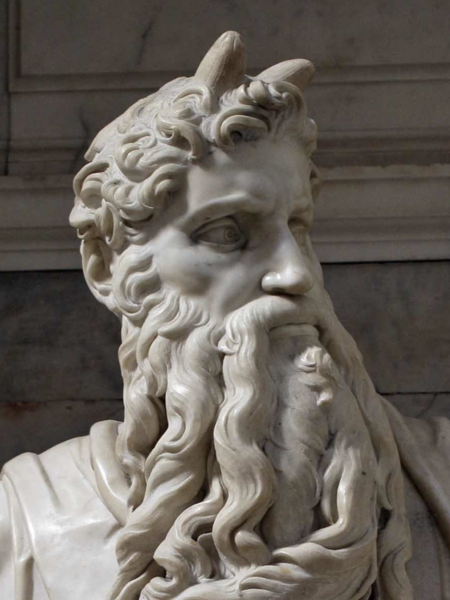
It is famous that St. Jerome, in the Vulgate, translated the word for «beams» with extreme literalness as «horns»: «And when Moses came down from mount Sinai, he held the two tables of the testimony, and he knew not that his face was horned from the conversation of the Lord». (Douay-Rheims). That is why Michelangelo’s Moses has horns.
But other venerable translators rendered the text differently, as for example the Septuagint: «Moses did not know that the appearance of the skin of his face was glorified». The skin of Moses’ face was radiant with an unreflected light, anticipating, then, how he would appear in the Transfiguration.
It is not a foolish mistake to suppose that horns grew on Moses. In the ancient world, even throughout the Hebrew Bible, horns were an image of power and honor. And yet, the fact that the Hebrew places the beams explicitly on the skin of Moses’ face tips the balance decisively, in my opinion.
Horns, after all, must grow from the skull, on the top of the head, not from the skin of the face. Try to imagine Michelangelo’s statue with horns growing all over Moses’ face.
But I say all this by way of preface. Suppose that Moses’ face did indeed radiate powerful beams of light. Such was the effect of being in the presence of God.
Then the question arises for us: Should Catholics expect that attendance at Mass, where God becomes truly present, have a similar effect on them?
At Mass, we have not «approached a mountain that can be touched, nor a blazing fire» (Hebrews 12, 18), but something much greater.
Let us make the question more specific. The Paschal Triduum, which we have just celebrated, comprises the holiest days and the greatest liturgies of the year. Did our presence at these liturgies leave an impression of holiness on us?
What I have in mind is a generalized effect that is independent of our will, our actions, our emotions, or our merit. I am thinking of an effect that operates in a way not very different from a physical cause. The effect I have in mind would not come from our «participation» in these liturgies; that is, what we sing or say, or our standing or kneeling. The reception of Our Lord in Holy Communion, of course, involves a spring of innumerable graces.
But I am not interested here in that effect, but in something more. I refer, rather, to this logic: you are in the presence of holy things and, as a result, you become holy.
Plato thought that punishment worked that way. Punishing someone justly, he said, is imposing the formal character of justice on his soul, regardless of whether the sufferer wishes to be made just or not. For this reason he thought that punishment is medicinal. Someone treated with justice will become more just as a result.
We clearly believe that nature works that way. We go out into the wilderness for a few days, hiking and camping, in part because we believe we are improved by being «in nature», because we resemble more the purity and strength we find there.
We think the same happens with children. We spend time with them, in part, because we think that by being in their presence we become more youthful, more full of life and more innocent. They «leave an impression» on us.
We use clothing to bear witness to an effect like that: we place a white garment on a newly baptized child to signify the holy effect of Baptism. People used to dress elegantly to go to church, yes, to show respect, but also to show what they believed the sacred liturgy did to them.
Some friends walk down a busy street in Rome, laughing, posing, eating gelato and trying on clothes in the shops. Then they enter a dark but beautiful church—say, Santa Maria sopra Minerva—. When they come out again onto the streets, they feel that they have been transformed; perhaps only for a short time. But the holy place has changed them, nonetheless. They feel that they have become more sober, lucid, and (in some way) holy.
An effect like the one I am thinking of is called, in other religions, «purification». It is said that followers are purified by participating in the mysteries, and they wear white clothes to demonstrate it. Surely Catholicism captures and elevates this phenomenon to a higher level rather than discarding it.
In summary, I ask whether the Exsultet of the Easter Vigil is proclaiming a literal truth:
This is the night that today, throughout the world, for those who believe in Christ, snatching them from the vices of the world and the darkness of sin, restores them to grace and joins them to the saints. […] The sanctifying power of this night drives away sins, washes away guilt, restores innocence to the fallen and joy to the sorrowful, expels hatred, brings concord, and humbles the mighty.
What the Exsultet proclaims seems to be true for any Mass or any visit to the Blessed Sacrament: the very presence of the Thrice-Holy God serves to make us holy.
Undoubtedly, a principal intuition of «traditionalism» is that we should show that this is so in our churches, liturgies, and behavior. The command: «Be holy, for I, the Lord your God, am holy» (Leviticus 19, 2; 1 Peter 1, 16), speaks as much to our witness and self-understanding as to our acts of will.
About the author
Michael Pakaluk, scholar of Aristotle and Ordinarius of the Pontifical Academy of St. Thomas Aquinas, is Professor of Political Economy at the Busch School of Business at the Catholic University of America. He lives in Hyattsville, Maryland, with his wife Catherine, also a professor at the Busch School, and their children. His collection of essays, The Shock of Holiness (Ignatius Press), is now available. His book on Christian friendship, The Company We Keep, is available from Scepter Press. He contributed to Natural Law: Five Views (Zondervan, last May), and his most recent book on the Gospels appeared in March with Regnery Gateway, Be Good Bankers: The Economic Interpretation of Matthew’s Gospel. You can follow him on Substack at Michael Pakaluk.