


By Daniel B. Gallagher
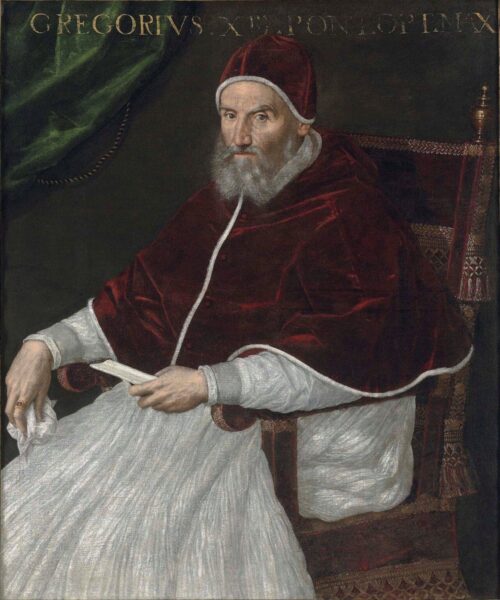
Around the corner from my old office in the Apostolic Palace is the Torre dei Venti, a 16th-century tower that houses the sundial that Pope Gregory XIII used to correct the Julian calendar. Assisted by a team of brilliant Jesuits, Gregory tracked the movement of sunlight across the floor to determine the precise moment of the spring and autumn equinoxes. This led to the elimination of ten days from the month of October in 1582. With very few exceptions (Iran being one of them), the «Gregorian calendar» has since been the standard way of computing the annual cycle.
Few know that the Vatican continues to diligently collect astronomical data for the international scientific community. Its main instrument is the Vatican Advanced Technology Telescope (VATT), located in southeastern Arizona, which observes light in the optical and infrared ranges. Among the notable discoveries made by the VATT are astronomical bodies in our neighboring Andromeda galaxy called Massive Compact Halo Objects (MACHOs), which may help explain the presence of the mysterious and controversial «dark matter» that holds our galaxy together; «dark» because it neither emits, absorbs, nor reflects light and is therefore invisible to telescopes.
As a product of the public schools of the 1970s, I had never heard of Gregory XIII nor knew of the existence of the Vatican Observatory. My fourth-grade teacher taught me that Columbus set sail to prove that the Catholic monarchs were wrong to believe the world was flat, and that Galileo was imprisoned for thinking that the sun was at the center of the universe. The first is manifestly false, and the second is an oversimplification.
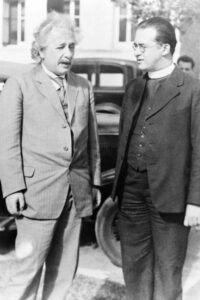
Georges Lemaître, the 20th-century priest and astronomer, was also completely unknown to me until I took an astronomy class in college. It was Fr. Lemaître who first proposed the hypothesis that the universe formed from a single particle that exploded at a defined moment in time. His hypothesis of the «primeval atom,» generally associated with the «Big Bang» theory, continues to emerge as the best cosmological model to explain the expansion of the universe.
I have been obsessed with space exploration since I watched the development of the Apollo 17 mission on television, an event I am barely old enough to remember. For that reason, I listened with great enthusiasm when NASA recently announced plans for a permanent lunar base. The Artemis II mission is, even as this column appears, transporting a crew around the Moon. If all goes as planned, we will see humans walking on the Moon again in 2029.
In 1969, Pope St. Paul VI hailed the famous Apollo 11 mission for opening «a threshold to the vast expanse of unlimited space and new destinations.» The holy Pontiff entrusted a handwritten copy of Psalm 8 to astronauts Armstrong, Aldrin, and Collins to leave on the Moon. It remains there, silently proclaiming: «From the mouths of children and infants at the breast I shall have praise for your majesty over the heavens.»
How easy it is to forget the primacy of «singing the majesty of God» in the Christian life. «Praise,» we read in the Catechism, «is the form of prayer that recognizes most directly that God is God.» (2639) If we know God mainly through his works and praise him for them, how much more exalted should our praise be when we recognize the greatness of his works.
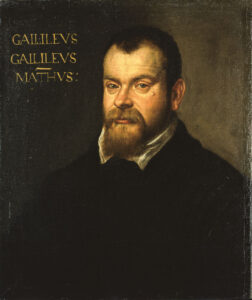
In Dante’s Paradiso, Beatrice directed the pilgrim’s gaze toward the Moon to demonstrate the insufficiency of man’s sensory and intellectual faculties to comprehend Paradise. Three centuries later, Galileo pointed his telescope at the Moon and found it irregular and mountainous, something that deeply unsettled the prevailing opinion that the Moon was perfectly smooth and reflective of the Earth’s surface. In a famous letter to the Grand Duchess of Tuscany, Galileo lamented that his detractors «seemed to forget that the increase of known truths stimulates investigation, the establishment, and the growth of the arts; not their diminution or destruction.»
By «the arts,» Galileo meant everything that contributed to the improvement of humanity and its capacity to express the beautiful and the good. In Galileo’s mind, the sciences were no less equipped than the arts to glorify God. Quoting Tertullian, he wrote that «God is known first through nature, and then, more particularly, by doctrine; by nature in his works, and by doctrine in his revealed word».
Theologians may debate the subtlety of Galileo’s distinction, but today we have more need than ever to know God through his works. Debates about technology are increasingly framed in terms of power rather than discovery. AI entrepreneur Ray Kurzweil strives to «improve» the human body by fusing it with nanotechnology to reverse the aging process. Aiming a rocket at the Moon may refocus our attention on discovering nature rather than dominating it, something very different from «subduing» it. (Genesis 1:28)
It cannot be denied that NASA wants to return to the Moon and establish a base there before anyone else. The «Ignition» initiative is aimed at securing «American leadership in space.» «The clock is ticking in this great power competition,» said NASA Administrator Jared Isaacman, «and success or failure will be measured in months, not years.»
Simply put, politics will drive the Artemis program no less than it did the Apollo program in the 1960s. But the final message of the latter was not «we won.» It was rather: «May the spirit of peace in which we came be reflected in the lives of all mankind,» as the commemorative plaque left on the Moon by the Apollo 17 crew reads.
Politics did not detract from the sense of adventure and discovery that surrounded the Apollo missions. Catholics are free to dismiss NASA’s current goals as a senseless waste of resources or to welcome them enthusiastically as the next chapter in the story of Gregory XIII, Fr. Lemaître, and the wonderful team of Jesuits from the Vatican Observatory. Maximus the Confessor already recognized the cosmic dimension of the Sacred Liturgy in the 7th century. Continuing to explore the mysteries of the cosmos can only increase our awe at Holy Mass.
About the author
Daniel B. Gallagher is a professor of philosophy and literature at Ralston College. Previously, he was the Latin secretary to Popes Benedict XVI and Francis.