



By Brad Miner
Yes. But so have many people throughout history. And now some good news, though it’s the only one.
The Pew Research Center recently published a report titled What Do Americans Consider Immoral? (We should be cautious with that verb, consider. I suppose the pollsters can’t really ask the more direct question: «What actions does you engage in that you know are morally wrong?»).
And the good news is that an overwhelming 90% of Americans believe that adultery («married people having an affair») is wrong. Let’s look at the Pew chart:
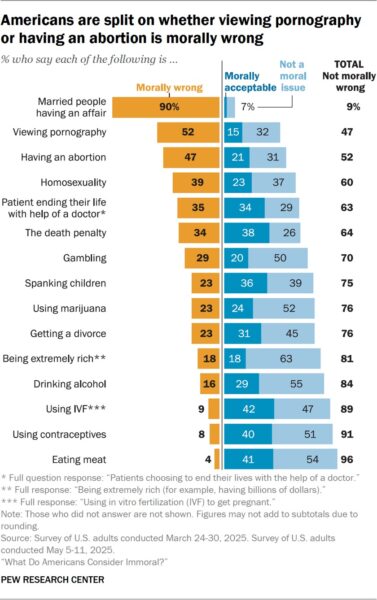
As I say, good news. However, we could compare this with recent reports from the General Social Survey and the Institute for Family Studies that claim that 20% of married men and 13% of married women have cheated on their spouses, and that these figures have been constant for three decades. Of course, opinion doesn’t always match behavior. This is called hypocrisy.
And the figures represent an upward trend, though not dramatically so, and the increase is being driven by men and women over 55 years old. Does this suggest that the old notion of the «seven-year itch» has become the 27-year itch? In any case, this deviation from the 90% opposition to adultery is significant. But, perhaps, it means nothing more than that only 70% of men really think adultery is immoral, compared to 87% of women. I’m not a statistician, so I can’t vouch for those figures.
But hypocrisy is certainly present here, and some of those who declare their opposition to adultery may cross the line into an affair if tempted by the right person—or by the Tempter himself—.
The old joke about economists (and it could apply to statisticians) is that they should have one hand cut off so they can’t say: «But, on the other hand…».
But, on the other hand (I can use the phrase because I’m not an economist), the Pew report’s index notes that, regardless of a person’s religion, 90% oppose adultery. Religion matters.
The most discouraging data from the chart are those related to abortion. The response «it is not morally wrong» to the fact of «having an abortion» stands at 52%, which is a nauseating reminder that the majority of people have been deceived into believing that that being in the womb is not their son or daughter. Another chart on the Pew website indicates that «Republicans are 3 times more likely to say that having an abortion is morally wrong.» Republican Party members oppose it at 71%; Democrats only at 24%. Not to get into politics…
The overall tone of the report is depressing. One can’t help but think that «tolerance» in the United States is on a slippery slope toward perdition. Regarding pornography, for example, only white evangelical Protestants firmly oppose it (80%), while among Catholics (white and Hispanic), only 56% think that naked frolicking in videos is morally wrong. Could it be that we Catholics have become desensitized with all those naked figures on the ceiling of the Sistine Chapel? I doubt it.
Only 23% of Jews think that pornography is morally wrong, and that may be because those good people are Republicans. 65% in the Republican Party think pornography is wrong; only 39% of Democrats believe so.
Twice as many Republicans as Democrats oppose marijuana, but that doesn’t say much, since approval in both parties is very high: 69% versus 84%.
But I’ll tell you something: what really struck me is what the report’s data say about contraception. This would seem to be a battle that the Roman Catholic Church has lost. Only 9% of Americans believe that artificial birth control is wrong; among Catholics, it’s only a little better, at 13%. No doubt, this is a measure of failed catechesis and biblical ignorance. After all:
God blessed them and said to them: «Be fruitful and multiply, fill the earth and subdue it; have dominion over the fish of the sea, the birds of the air, and all the living things that move on the earth.» (Genesis 1:28)
That’s, you know, in the beginning, just two verses after the creation of humanity!
There’s no positive aspect here, but I’ll point out that only Catholics and black Protestants have moral opposition figures to contraception in the double digits.
Shortly after converting to Catholicism at age 25 (1973), I was deeply shaken by reading St. Paul VI’s Humanae vitae (1968). Being somewhat familiar with the so-called Sexual Revolution, the logic of St. Paul VI’s great encyclical was shocking. He writes: «… it is a grave error to think that a whole conjugal life of normal relations can justify the sexual act deliberately made infecund and, therefore, intrinsically reproachable.»
Today, in Germany and elsewhere, some Catholics seek to relax the perennial restrictions not only on contraception (which seems to be, de facto, a done deal), but also on sexual behavior in general. Doing so is, of course, surrendering to secular immorality. And these figures may suggest caution about the recent influx of converts and re-entries into the Church. Are they fully catechized? If not…
St. Paul VI notes that it is not «valid to argue, as a justification for deliberately infecund conjugal relations, that one should choose the lesser evil [contraception] rather than the greater [for example, too many mouths to feed], or that such relations would merge with the procreative acts of the past and future to form a single entity, and thus be qualified by the same moral goodness as these.»
And more than this, the Pope offered a very valid and sensible way to address family formation:
The Church is coherent with herself when she considers licit the recourse to the infertile periods, while condemning as always illicit the use of means directly contrary to fertilization, even if done for reasons that may seem honest and grave. In reality, there is an essential difference between the two cases: in the first, the spouses make legitimate use of a faculty that nature has given them; in the second, they impede the development of natural processes.
It’s remarkable, isn’t it?, that liberals insist they want to protect nature, while frustrating it with contraception, abortion, puberty blockers, and «gender» reassignment surgery.
About the author
Brad Miner, husband and father, is editor-at-large of «The Catholic Thing» and a senior fellow of the Faith & Reason Institute. He was literary editor of «National Review» and had a long career in the book publishing industry. His latest book is «Sons of St. Patrick», written with George J. Marlin. His bestseller «The Compleat Gentleman» is available in a third revised edition and also in audiobook format (narrated by Bob Souer). Mr. Miner has been a member of the board of Aid to the Church In Need USA and also of the Selective Service System draft board in Westchester County, New York.