


By Stephen P. White
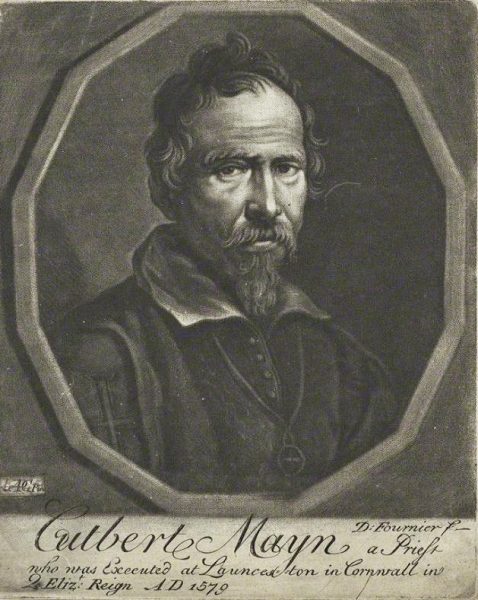
In June 1577, an Englishman named Cuthbert Mayne was arrested by the High Sheriff of Cornwall and imprisoned in Launceston Castle, awaiting trial for high treason. Mayne had been born in Devon, in southwest England, and as a young man was a Protestant clergyman. But during his later studies at Oxford, he converted to Catholicism.
Mayne had already narrowly escaped an arrest, and in 1573 he fled England for northern France. There he joined the new English College at Douai, where he would receive priestly ordination and complete his studies.
The English College at Douai (or Douay, as it appears in the Bible translation produced by the college itself) was founded in 1568 by William Allen. Initially, it was intended to be a center of studies for exiled Catholics from English schools, but it soon became a seminary to train priests who—according to Allen—would lead the reconversion of England and Wales. From the Crown’s point of view, however, the college was a training center for traitors and foreign agents, ready to overthrow Queen Elizabeth at the Pope’s command.
Suffice it to say that the priests trained at Douai did not expect a warm welcome upon returning to their native lands. The treatment given to Cuthbert Mayne demonstrated this clearly. He was found guilty and sentenced to be hanged, drawn, and quartered. Upon hearing his sentence, he simply replied: Deo gratias. Mayne was the first of the Douai graduates executed for treason, but he would not be the last.
Between November 1577, when Mayne was martyred, and October 1680, with the execution of Thomas Thwing, 158 men trained at Douai were executed by the English authorities. Most were beatified, and twenty canonized (along with other martyrs of England and Wales) in 1970 by Paul VI.
Among the canonized from Douai, the most famous was undoubtedly Edmund Campion, martyred at Tyburn along with his fellow Jesuit Alexander Briant and Ralph Sherwin. Both Briant and Sherwin were canonized by Paul VI, as was Cuthbert Mayne.
Saint Cuthbert Mayne was executed in Launceston, in Cornwall. Most of the other Douai martyrs met their horrific fate at Tyburn, as London’s gallows were known, located at the northeast corner of the present-day Hyde Park. In the sixteenth century, Hyde Park was a royal hunting ground, and the condemned were taken there in procession from the prisons of Newgate or the Tower of London.
For his part, William Allen, who would later be created a cardinal by Sixtus V, founded an English College in Rome, modeled on the one at Douai. Many of the Douai martyrs—including Campion and Sherwin—also studied at the present-day Venerable English College in Rome.
The Douai college survived until 1793, when, like so many other Catholic centers, it fell victim to the French Revolution. Its property was confiscated and its students imprisoned for several months before being released and returning to England. By then, fortunately, restrictions on Catholics had eased, and the Douai seminary moved to the newly founded St. Edmund’s College, in Hertfordshire. The college had come home, and English priests were once again being trained on English soil.
The next fifty years saw the approval of the Catholic Relief Acts and the restoration of the English hierarchy by Pius IX. In 1869, Cardinal Manning established a new seminary separate from St. Edmund’s. His successor moved it again, and the next returned it to St. Edmund’s in 1904.
Almost at the same time, in the early twentieth century, a young community of nuns dedicated to perpetual Eucharistic adoration was expelled from France. They crossed the English Channel and settled near Tyburn, where they remain to this day. In addition to perpetual adoration, they maintain a shrine to the Tyburn martyrs, with numerous relics. A place of death and torture for centuries was transformed into a place of devotion and perpetual adoration of the Lord.
Years after the sisters’ arrival at Tyburn, a young American priest and scholar, Fulton J. Sheen, came to England and taught for a time at St. Edmund’s.
In the 1970s, shortly after the canonization of so many Douai martyrs, the seminary moved to its current location in Chelsea, occupying a convent built on the site of the great house of St. Thomas More. The seminary, named Allen Hall in honor of the founder of the Douai College, serves the Archdiocese of Westminster today.
More than twenty years have passed since I last set foot in Allen Hall. But I still remember the list of names engraved high on the refectory wall, overlooking the tables where seminarians eat and receive their guests. They were the names of the Douai martyrs. A list that was sober and inspiring, a powerful—though not subtle—reminder to the current seminarians of the courage and devotion of the men who preceded them.
Cardinal Allen’s dream—that the men of his Douai College would return to England and restore it to the Catholic faith—did not come true… or has not yet come true. The Church thinks in centuries, and God in even longer times. In the meantime, King Charles was in the Vatican last week to meet and pray especially with Pope Leo. As the motto of Allen Hall seminary reads: vivamus in spe (“Let us live in hope”).
England and Wales celebrate the feast of the Douai Martyrs on October 29. Orate pro nobis.
About the author
Stephen P. White is executive director of The Catholic Project at the Catholic University of America and a member of the Ethics and Public Policy Center, specializing in Catholic studies.