


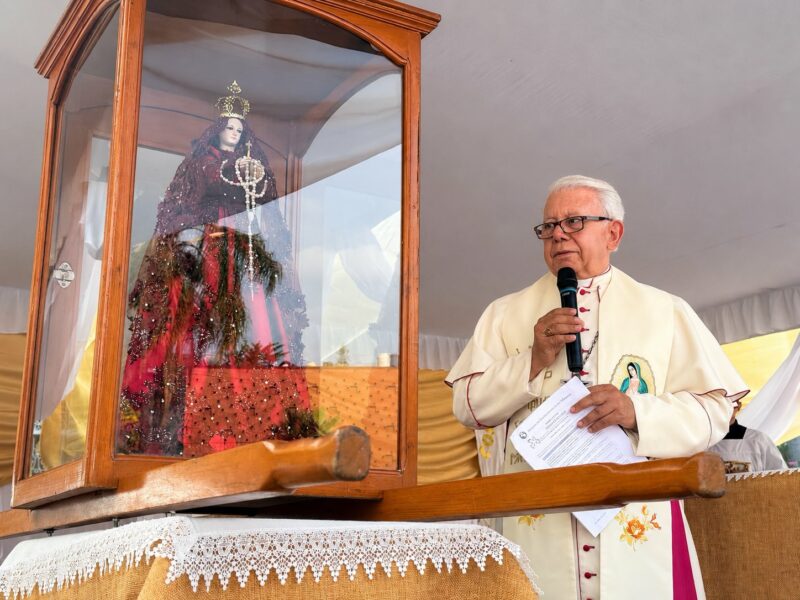
Milhares de morelenses, famílias inteiras, mães buscadoras, jovens, transportistas, comerciantes, religiosos, leigos e pessoas de boa vontade, tomaram as ruas de Cuernavaca no sábado, 16 de maio de 2026, na XII Caminata por la Paz convocada pela diocese de Cuernavaca. Liderados por o bispo Ramón Castro Castro, caminharam de forma pacífica, ordenada e decidida. Não era apenas mais uma marcha. Era a expressão concreta de um povo que, após doze anos consecutivos de sair às ruas, continua se recusando a se acostumar ao medo e à violência como destino inevitável.
A participação foi massiva. Ali não estavam apenas aqueles que alegravam com seus cantos, mas também as mães buscadoras, todos que carregam uma cruz, a da violência encarnada que mudou para sempre suas vidas; no entanto, longe da resignação, acompanhados por um povo em marcha, vindos de todos os cantos da diocese, chegaram paróquias, escolas, comunidades religiosas e associações, crentes ou não, que se convergiram em um objetivo comum. O número de participantes superou de longe as edições anteriores. Em um estado onde nove em cada dez cidadãos se sentem inseguros, aquela multidão pacífica que ocupou as principais avenidas foi, por si só, um ato de coragem cívica e de fé. Desafiou,无暴力地, aqueles que —de certos círculos políticos até o crime organizado— desejavam silenciar a voz da Igreja e de milhares de crentes. Não conseguiram. A caminhada demonstrou que a rua é ágora de cidadania, que a verdade também é uma forma de justiça.
In his message, the bishop Ramón Castro Castro did not sugarcoat the reality. Forged and tempered by thirteen years of pastoral work in the diocese that was also that of Méndez Arceo and of Posadas Ocampo, with the authority of someone who walks with his people, he contrasted the official figures that celebrate triumphally the decrease of crime with the brutality of what is experienced in the territory. Morelos occupies the first national place in perception of insecurity, the second in intentional homicide, the first in feminicides and in political violence, and the tenth in recruitment of minors by the organized crime. “Lying about the reality is also a form of violence”, he stated with clarity. And he gave concrete names and places. He denounced the extortion that forces merchants of the eastern part of the state —Huautla, Yecapixtla, Cuernavaca— to pay “derecho de piso” to two different criminal groups just for surviving. He recalled the murder of the activist afroamerican Sandra Rosa Camacho, municipal delegate in Temoac, who had denounced networks of extortion and was murdered despite having publicly warned about the danger.
But the most heartbreaking denunciation was that of Huautla. In one of the poorest and forgotten corners of Morelos, the organized crime not only charges a quota “for living”, but also threatened the death of the priest of San Francisco de Asís. The priest had to abandon the community to save his life. Today Huautla is without a pastor, without Eucharist, without accompaniment to the sick, without baptisms or funerals. “The organized crime not only has extorted that people, has extinguished the last light that they had left, has tried to erase even the presence of God in the midst of them”, denounced the bishop with the force of a pastor who does not stutters. That is the reality that the official narratives of “peace” and “progress” —especially in a year of World Cup football that wants to sell us that “everything is very good”— when they want to cover this face, as when they cover the face of a dead person that appears to sleep.
Front to this pain, the Church did not limited itself to lamenting. Proposed concrete paths to build the peace, resuming the guidelines of the Núcleo por la Paz arisen from the meeting of Guadalajara, putting the victims always in the center, not as statistics, but as people with name and face, assuming social corresponsibility, recognizing that the violence is not only the fault of the government nor only of the crime, committing to long-term processes, not silencing before injustice and cultivating an organized and perseverant hope.
The bishop was even further. Addressing the state, municipal and federal authorities, he said without ambiguity: “This walk is not a march against you, it is a walk with you”. He asked them not to abandon Huautla, that they protect the mothers searching, that they give security to transportists and merchants, that they offer to the young people real alternatives of education and honorable employment. And he reminded them that governing has the responsibility to guarantee security and wellbeing.
But the deepest call was to the conversion. Not to a mere “transformation” administrative or of image, but to a radical metanoia, a total change of mentality and of heart. “I ask Mary to intercede for the conversion of so many brothers who with their attitudes and decisions generate the violence”, said the pastor. Conversion for the criminals who extort and kill; conversion for the authorities who cover figures or cross their arms; conversion also for the own Church, that must recognize its omissions and leave the temple to accompany the pain because the peace, insisted, not born from optimistic discourses nor from covered statistics, but from the courage of looking front the wounds and of recovering the consciousness of that “no one can save himself alone”.
Front to all this, the clamor rose clear and unanimous: ¡Basta ya! Enough already of so much violence! Enough already of charging floor for living in your own land! Enough already of so many feminicides and so much impunity! Enough already of so much corruption! Enough already of stealing from our young people their future! Enough already of expelling the pastors from their communities!
At the end of the walk, the bishop Ramón Castro Castro invoked the prayer for the peace and remembered that Christ resurrected is our only secure foundation. That day of 16 of May was, in the full evangelical sense, a kairós citizen, a moment of grace in which the Spirit Holy became visible in the streets of Morelos… kairós that allows to heal, restore and recommence… Kairós that, in a Mexico that for the World Cup wants to appear that everything marches well, catalyzes the accumulated pain and converts it into prophetic force that takes the streets.
While there are men and women ready to walk together, the darkness does not succeed to extinguish the light completely. The XII Caminata por la Paz was the manifestation of the Spirit that continues blowing for that, as says the bishop, in Him “our people have a dignified life”. ¡Mucho ánimo! The peace is possible. And Morelos already started to build it with its own feet, walking in this time of God.