


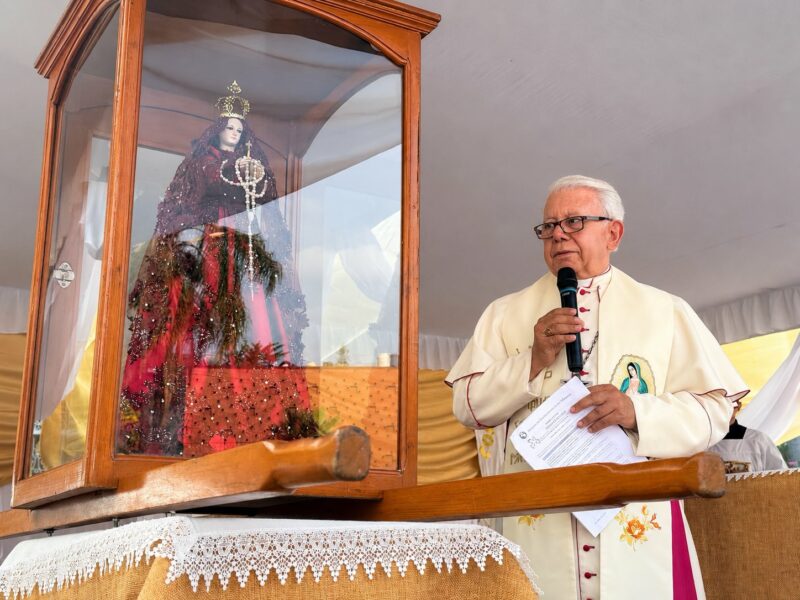
Thousands of Morelenses, entire families, searching mothers, young people, transport workers, merchants, religious, laypeople and people of goodwill, took to the streets of Cuernavaca on Saturday, May 16, 2026, in the XII Walk for Peace called by the Diocese of Cuernavaca. Led by Bishop Ramón Castro Castro, they walked in a peaceful, orderly and determined manner. It was not just another march. It was the concrete expression of a people who, after twelve consecutive years of taking to the streets, continue to refuse to become accustomed to fear and violence as an inevitable destiny.
The participation was massive. Not only were there those who brought joy with their songs, but also the searching mothers, all those who carry a cross—the cross of violence made flesh that changed their lives forever; yet, far from resignation, accompanied by a people on the move, parishes, schools, religious communities and associations from every corner of the diocese, believers and non-believers alike, converged on a common objective. The number of attendees far exceeded previous editions. In a state where nine out of ten citizens feel unsafe, that peaceful multitude that occupied the main avenues was, in itself, an act of civic courage and faith. They defied, without any violence, those—from certain political circles to organized crime—who would silence the voice of the Church and thousands of believers. They did not succeed. The walk demonstrated that the street is an agora of citizenship and that the truth is also a form of justice.
In his message, Bishop Ramón Castro Castro did not sugarcoat reality. Tempered and strengthened by thirteen years of pastoral ministry in the diocese that was also that of Méndez Arceo and Posadas Ocampo, with the authority of one who walks with his people, he contrasted the official figures that triumphantly celebrate the reduction of crime with the harshness of what is lived in the territory. Morelos ranks first nationally in perceived insecurity, second in intentional homicide, first in feminicides and political violence, and tenth in the recruitment of minors by organized crime. “Lying about reality is also a form of violence”, he stated clearly. And he named specific names and places. He denounced the extortion that forces merchants in the eastern part of the state—Huautla, Yecapixtla, Cuernavaca—to pay “floor fees” to two different criminal groups just to survive. He recalled the murder of the Afro-American activist Sandra Rosa Camacho, municipal delegate in Temoac, who had denounced extortion networks and was murdered despite having publicly warned of the danger.
But the most heartbreaking denunciation was that of Huautla. In one of the poorest and most forgotten corners of Morelos, organized crime not only charges a quota “for living”, but also threatened the parish priest of San Francisco of Assisi with death. The priest had to leave the community to save his life. Today Huautla is without a pastor, without the Eucharist, without care for the sick, without baptisms or funerals. “Organized crime has not only extorted these people, it has extinguished the last light they had left, and has tried to erase even the presence of God in their midst”, denounced the bishop with the force of a pastor who does not remain silent. This is the reality that the official narratives of “peace” and “progress”—especially in a year of the World Cup that wants to sell us that “everything is going very well”—when they try to cover up this face, as when they cover up the face of a dead person who appears to be sleeping.
In the face of this pain, the Church did not merely lament. It proposed concrete paths to build peace, drawing on the guidelines of the Core for Peace that emerged from the meeting in Guadalajara, placing victims always at the center, not as statistics but as people with names and faces, assuming social co-responsibility, recognizing that violence is not only the fault of the government or only of crime, committing to long-term processes, not remaining silent in the face of injustice and cultivating organized and persevering hope.
The bishop went even further. Addressing state, municipal and federal authorities, he told them without ambiguity: “This walk is not a march against you, it is a walk with you”. He asked them not to abandon Huautla, to protect the searching mothers, to give security to transport workers and merchants, to offer young people real alternatives of education and dignified employment. And he reminded them that governing carries the responsibility to guarantee security and welfare.
But the deepest call was to conversion. Not to mere “transformation” administrative or of image, but to a radical metanoia, a total change of mind and heart. “I ask Mary to intercede for the conversion of so many brothers and sisters who with their attitudes and decisions generate violence”, said the pastor. Conversion for criminals who extort and kill; conversion for authorities who paint over figures or turn a blind eye; conversion also for the Church itself, which must recognize its omissions and leave the temple to accompany the pain because peace, he insisted, does not arise from optimistic speeches nor from painted-over statistics, nor from the courage to look the wounds straight in the face and to recover the consciousness that “no one can be saved alone”.
In the face of all this, the clamor rose clear and unanimous: Enough! Enough of so much violence! Enough of charging floor fees for living in your own land! Enough of so many feminicides and so much impunity! Enough of so much corruption! Enough of stealing our young people’s future! Enough of expelling pastors from their communities!
At the end of the walk, Bishop Ramón Castro Castro invoked the prayer for peace and recalled that the resurrected Christ is our only secure foundation. That day of May 16 was, in the fullest evangelical sense, a citizen kairós, a moment of grace in which the Spirit of God became visible in the streets of Morelos…kairós that allows healing, restoration and new beginnings… Kairós that, in a Mexico that wants to appear, through the World Cup, that everything is going gut, catalyzes the accumulated pain and converts it into prophetic force that takes the streets.
While there are men and women who are prepared to walk together, the darkness does not ganzly extinguish the light. The XII Walk for Peace was the manifestation of the Spirit that continues to blow so that, as said the bishop, in Him “our people have dignified life”. Take heart! Peace is possible. And Morelos already began to build it with its own feet, walking in this time of God.