


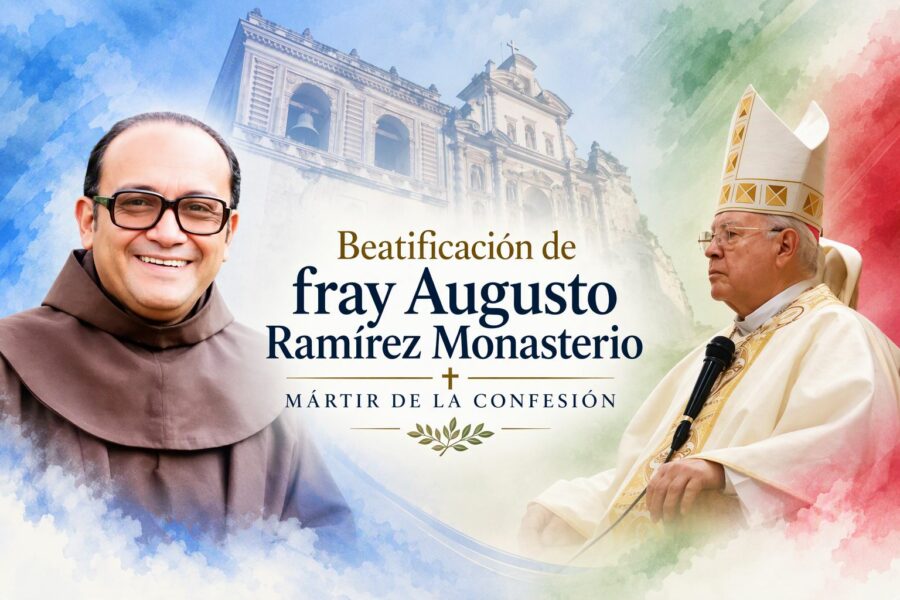
This Saturday November 7, 2026, while Pope Leo XIV carries out his first apostolic visit to Latin America, which began on Friday in Uruguay, with an agenda in Montevideo, Paysandú and other localities before continuing on to Argentina and Peru, in Central America a Mexican-born pontifical delegate presides over the elevation to the altars of a Guatemalan martyr. Cardinal José Francisco Robles Ortega, Archbishop of Guadalajara, acts in the name of the pontiff in the beatification of Friar Augusto Rafael Ramírez Monasterio, OFM, exactly 43 years after his murder for defending the sacramental seal of confession.
The Eucharistic ceremony is celebrated at 10:00 a.m. (local time) at the Finca Municipal Florencia, also known as Florencia Ecological Park, in Santa Lucía Milpas Altas, Sacatepéquez department, about 35 kilometers from Guatemala City and near Antigua Guatemala. Attendance of more than 15,000 people is expected (some estimates reach 25,000), including 27 bishops, two cardinals and around 300 priests, as well as family members, Franciscan religious, indigenous and rural communities. Admission is free and open to the public. After the Mass, at 12:00 p.m., the relic of the new blessed leaves the estate toward Antigua Guatemala, where between 12:00 and 1:30 p.m. a processional walk begins from the Matasano bridge, passes through historic streets and concludes at the Sanctuary of San Francisco el Grande, the church where the Franciscan exercised his ministry and which many faithful call “the sanctuary of mercy.” Prior to this, the friar’s clothing and mementos were displayed. The date coincides day by day with the anniversary of his martyrdom, recognized by Pope Leo XIV through a decree of January 22, 2026, which declared him a martyr in odium fidei, allowing the beatification without the need for a miracle. He will be the first Guatemalan priest elevated to the altars.
Augusto Rafael Ramírez Monasterio was born on November 5, 1937 in Guatemala City, the youngest son of a large Catholic family of nine siblings, formed by Valerio Z. Ramírez and María Trinidad Monasterio. He completed primary school in Guatemala and secondary school at the Seraphic College of the Friars Minor in Diriamba, Nicaragua. He entered the Order of Friars Minor, completed his novitiate in Jumilla, Spain, studied philosophy and theology in Hellín, Orihuela and Teruel, and was ordained a priest on June 18, 1967 at the church of San Francisco in Teruel. After serving in Nicaragua as a formator and completing studies in Salamanca, he returned to Central America. In 1978 he was appointed guardian and pastor of San Francisco el Grande in Antigua Guatemala, where he dedicated his ministry to the poor, peasants, indigenous people and youth, promoting social works and pastoral accompaniment amid the internal armed conflict (1960-1996).
In June 1983, after confessing and accompanying a peasant linked to the guerrilla who sought to avail himself of an amnesty (helping him regularize documents), he was detained by security forces at the Chimaltenango military base. He was tortured—hung, beaten and burned on his hands and feet—to make him reveal the content of the confession. He firmly refused, invoking the sacramental seal. Released under threats and surveillance, he refused to leave the country: “I owe nothing to anyone, I am not leaving. A precedent must be set.” On November 7, 1983, two days after turning 46, he was kidnapped again. His body, showing signs of torture and multiple bullet wounds, was found after an attempted escape on the outskirts of the capital. The Church recognized that he died out of hatred for the faith while defending the sacrament of Reconciliation.
In a video message released on the occasion of the beatification, Cardinal José Francisco Robles Ortega highlighted that Friar Augusto “dedicated his ministry to the service of God and the most needy, especially peasants and the poor.” He emphasized that “amid a context of violence and persecution, he remained faithful to his priestly vocation, even in the face of the threats and tortures he suffered for defending the secrecy of Confession.” For the Mexican cardinal, this martyrdom “reminds us of the sacred value of this sacrament in which each person can encounter the mercy and forgiveness of God.” He invited the faithful to join the celebration spiritually and to thank the Lord for the witness of the new blessed: “May his example strengthen our faith, renew our love for the sacrament of Reconciliation and encourage us to live our Christian vocation with courage and fidelity.”
Robles Ortega, who in August received the vice-postulator Friar Edwin Alvarado in Guadalajara and expressed that this will be the first time he performs an office of this nature, considering it an honor, will read the apostolic letter, preside over the Eucharist and proclaim the blessed with the authority delegated by the Pope. His appointment is part of a line of Mexican cardinals called to represent the Roman Pontiff outside their dioceses.
The Episcopal Conference of Guatemala has prepared the event “with joy,” recalling that the blood shed in fidelity, which 43 years ago caused shock and pain, is today a cause for joy, evoking Psalm 126: “those who sowed in tears reap with songs of joy.” The bishops present him as an example of the commitment of many priests who defended human dignity and rights during the years of violence. Pope Leo XIV himself recalled these beatifications, that of Guatemala and that of 80 martyrs in Santander, at the general audience on November 4, before departing for Uruguay.
In a regional context marked by the papal visit to the Southern Cone and by the memory of violence in Central America, the beatification of Friar Augusto Ramírez Monasterio renews the testimony of the inviolability of the confessional and of charity that gives itself to the end. While the Pope travels through Uruguay, the Mexican delegate elevates in Guatemala the first priest of the country to the altars, offering the universal Church a model of sacramental fidelity and service to the poorest. The procession of the relic to San Francisco el Grande will close a day that turns the anniversary of the martyrdom into a feast of hope.