


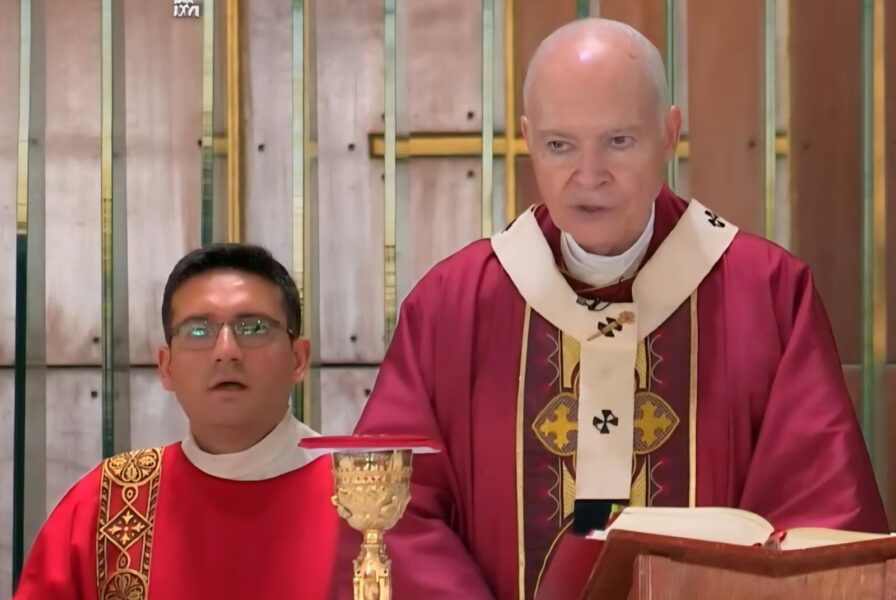
A shady, disloyal, and anything-but-synodal maneuver. That is how those who, on the morning before the celebration of Pentecost, could hardly contain their surprise at seeing canon Efraín Hernández Díaz reinstated viewed the move. This Sunday, May 24, during the midday Mass held at the Insigne y Nacional Basílica de Guadalupe, one of the most controversial turns in the recent history of Mexico’s principal Marian shrine was consummated. Removed from his post as rector in September 2025 following serious accusations from the Guadalupe chapter, he returned to the rectory without any convincing public explanation or documentation to support the clean closure of the canonical investigation opened against him.
Yet the dismal scene presented at the main celebration of the feast was the result of a prior meeting that, in just 15 minutes, carried out what had been anticipated. The Guadalupe chapter was summoned with only a few hours’ notice to announce the return of the ousted and apparently rehabilitated canon. The haste of the call not only caused bewilderment but also underscored the style of opaque pastoral leadership with which the Archdiocese of Mexico has handled this case from the outset.
What in September 2025 was presented as a decision to safeguard the administration of the shrine became a sudden reversal that raises more questions than answers. The facts that led to Hernández Díaz’s removal are extensively documented. The Guadalupe chapter, in an act of pastoral responsibility, sent a formal letter to Archbishop Aguiar Retes detailing serious irregularities in the rector’s pastoral and administrative management, including possible cases of corruption bordering on the unthinkable. The letter was delivered to the archbishop’s private residence, warning of the urgency of removing Hernández Díaz and immediately opening a preliminary canonical investigation.
Aguiar Retes, who until then had placed Efraín Hernández as a trusted man and had covered for his administration, at the time accepted the credibility of the accusations. On September 20, 2025, he communicated the decision to remove him through protocolized decree number 817/2025, signed by the archbishop himself and authenticated by the chancellor, María Magdalena Ibarrola y Sánchez. The decree removed him from the rectory and ordered that he “cease to belong to the Guadalupe chapter,” although he retained the faculties to exercise priestly ministry.
At the same time, by protocolized decree 890/2025, Aguiar appointed the vicar-rector and archpriest of Guadalupe as interim rector (whom he called “substitute”). The measure seemed to respond to the gravity of the reported facts: alleged administrative irregularities, risks to the safety of employees and canons, and the existence of a network of “advisers” with questionable conduct, among other issues that the chapter considered a scandal both ad intra and ad extra of the Church. Everything escalated to the Mexican Episcopal Conference and the Apostolic Nunciature. Moreover, it is also on record that Pope Leo reportedly had in his possession a dossier documenting how the Basilica was being plundered by a few individuals.
Although it was known that a forthcoming canonical sentence was to resolve the case, Aguiar’s early-morning reversal overturned everything that had been done. In that morning meeting with the full body of canons, Aguiar justified the reinstatement of Efraín Hernández without presenting any document showing that each of the arguments set forth in the chapter’s letter had been dismissed in the investigation. The only argument offered was that the archbishop “had already informed the apostolic nuncio” of the results—that is, that nothing serious had been found. There was no formal sentence addressing point by point the extensive letter sent to the archbishop and the judicial vicar. As far as is publicly known, there is no objective and conclusive judicial evidence declaring the non-existence of the facts that motivated the canon’s initial removal and annulling the decree that vindicated the questioned cleric.
Worse still, the removal decree (817/2025) exists and was protocolized. However, there is no record of another decree that Aguiar delivered to the chapter this Sunday morning nullifying the provision that ordered Efraín Hernández to cease belonging to it. The reinstatement therefore takes place in a limbo that generates more doubts than certainties.
In the same meeting, Aguiar acknowledged that the Basilica had been under audit by the firm Deloitte. Nevertheless, the results of that audit and the details of the aspects reviewed—including specific allegations of misappropriation of funds—remain unknown. According to information from Deloitte, any audit it is commissioned to perform aims to provide an opinion on the Basilica’s financial statements and whether they present a true and fair view in all material respects, in accordance with the identified financial reporting frameworks. All such audits involve rigorous procedures that yield data on compliance even with tax obligations and are not merely stated verbally; they are reported in a detailed report that carries costs to be paid. Aguiar presented no results.
If, as Aguiar claims, both the apostolic nuncio and the Pope are aware of the results of the canonical investigation and the audit conducted by Deloitte, there is no reason not to disclose to the chapter and the archdiocesan clergy the specific arguments by which the chapter’s letter, the evidence gathered, and the witnesses’ statements “lacked substance.” Nor is it understandable why the findings of the private firm that supposedly exonerated the rector of irregularities are not made public.
Further suspicions arise, on the other hand, because the meeting this Pentecost Sunday was held without the presence of other relevant interlocutors who had participated in previous encounters, such as the apostolic nuncio Joseph Spiteri—who, to date, is in Malta—nor the president of the Mexican Episcopal Conference, who is now attending to particular pastoral situations following the Walk for Peace on May 16, a crafty move by Aguiar to take advantage of that juncture and impose his decision without greater counterweights.
Demonstrating with facts and documents that there is no suspicion of misappropriation of funds and that Efraín Hernández Díaz is not a useful front for keeping the Basilica under absolute opacity is a minimum requirement of honesty and episcopal responsibility. Throughout his archiepiscopal administration, Aguiar Retes has rendered clear accounts to no one. He has devastated the college of consultors; no one knows the real control of collections; and, worse still, there is no certainty regarding the patrimony of the Archdiocese of Mexico, nor any evidence of financial reports. This would make Aguiar an offender against the canons of the Church, and his purported synodality has become a cliché repeated ad nauseam, while the refrain of “I already informed” serves to evade responsibilities and maintain suspicious control over the management of one of the most important religious sites in the world.
If Aguiar does not render accounts of Rector Hernández’s administration, he not only raises legitimate questions about his own interests in the Basilica, but also commits an error whose consequences have yet to be discovered. Betting on opacity and personal loyalties instead of truth and transparency could lead him to go down in history not as the synodal pastor he claims to be, but as the Archbishop of Mexico who played Russian roulette against himself.
As if that were not enough, Aguiar also revealed his ambitions regarding the Basilica and absolute control of the chapter. His intention to reconfigure the collegiate body until it reaches 18 canons seeks to open the door to members from other dioceses. At the same time, he would immediately begin separating those who have already reached canonical retirement age. This move aims to place in key positions canons loyal to the archbishop, even from dioceses where he still retains unconditional supporters.
And this under the claim that Aguiar told Pope Francis himself that “the chapter wanted” him to be present at the main Sunday celebration, yet there is no document or testimony confirming that such a request was made upon his arrival as Primate of Mexico.
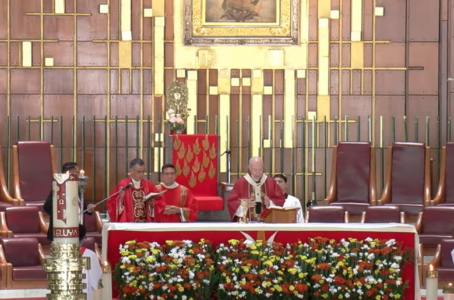
The reinstatement of May 24 does not close a chapter. It opens one. And nothing is more eloquent than the diminished and sad image of the Pentecost celebration. The pairing of a master and his vassal. The archbishop alone and a manipulable canon convinced that only his patron can save him. They intoning the deepest hymn of this feast. And perhaps, among all its verses, one in particular resonated to the core, in their psyche and soul: “… Sin rules over us. Wash away our impurities and heal our wounds.”