


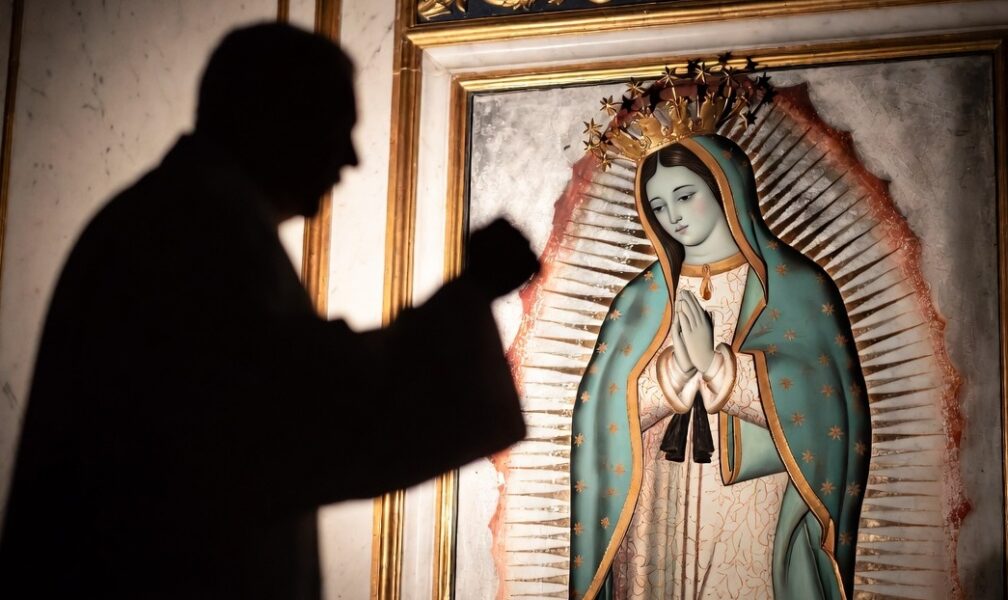
The Virgin of Guadalupe’s sacristy is not a simple room. It is the most sacred and protected vault in Mexico, a secure space where, for more than fifty years, the original tilma of Juan Diego has been kept, the nearly five-hundred-year-old ayate garment that bears the miraculous image. Millions of faithful make the pilgrimage to the Basilica each year, but only a handful have ever stood mere centimeters from the Mother of God. That privilege, for decades, was subject to strict rules of reverence and conservation. Until, according to the formal complaint of the Guadalupan chapter, everything changed.
The information gathered by this blog on Infovaticana reveals a pattern of indiscriminate openings, large groups, discretionary lists, and alleged “donations” in exchange for access. What was once a reliquary appears to have become, under the rectorship of Father Efraín Hernández Díaz and with the approval of the Primate Archbishop, Carlos Aguiar Retes, a kind of “mine of spiritual resources.”
The sacristy is a security vault approximately 4.15 by 2.55 meters and five meters high, built to protect the image even in the event of serious incidents. Its main access consists of a thick double-knob security door, similar to bank safes, followed by a grille. From the outside, on ordinary days, there is only a tape preventing access; employees cross themselves or touch the door, and handprints are frequent. There is no armed guard because the real protection lies in the protocol and the internal mechanism. To gain access, the ritual was very precise: visitors were scheduled for a formative talk while the 8:00 p.m. Mass was being celebrated. At 9:00 p.m., once the Basilica had been completely cleared and no one else remained inside, the opening would proceed. Only then would they enter the small space, climb a set of stairs, and reach the place where the image, framed in a mechanism, is exposed toward the interior.
That retraction mechanism was designed by architect Óscar Jiménez Gerard. Its dual purpose was clear: to protect the tilma from any external threat and to halt the progressive deterioration the image was already showing due to the passage of time, candle smoke, and previous handling.
A 1982 technical report, issued under the abbacy of Guillermo Schulemburg, documents that intervention. The system allows the image to be moved without direct contact; it tilts, stands vertical, and rotates toward the sacristy so it becomes accessible, always behind a protective mica sheet. According to information obtained by this outlet, during the rectorship of Efraín Hernández the original—thicker—protective mica was replaced by a lighter one that, according to those who promoted it, would be “better.” The technical result was problematic: the mechanism became misaligned.
When closed, the frame strikes and generates vibrations that are transmitted directly to the tilma. A nearly five-hundred-year-old garment, woven in two pieces of ayate sewn together in the center and already showing visible separation in several areas, is not designed to withstand repeated metal impacts. It is unknown who or which company carried out the change, whether there was a public tender, what the cost was, or what technical criteria were followed. The lack of transparency in an intervention that directly affects the conservation of Mexico’s most venerated image already constitutes, in itself, a serious question.
Until recently, the protocol was clear and restrictive. To see the image up close, a direct request to the Archbishop of Mexico or the rector on duty was required. A list was drawn up. The sacristy was opened a maximum of two times per month, with groups of up to eight people and a brief stay—no more than three minutes. Visual and spiritual contact was possible thanks to the mica, but always in an atmosphere of recollection.
With Efraín Hernández the rules changed radically. According to the chapter’s complaint, the sacristy came to be opened up to eight times a month—that is, twice a week. The groups were large and, in many cases, responded more to religious tourism, selfies, and frivolous attitudes than to authentic devotion. The sacristy could even be opened in the early hours of the morning. The lists did not come only from formal requests; Archbishop Aguiar Retes sent his own, prepared by his personal secretary. The rector, for his part, added names at his discretion, favoring individuals linked to him who had previously requested access in exchange for “donations.”
Efraín Hernández even ordered that no one be told how, when, or to whom the sacristy was opened, trusting that silence would suffice to conceal the practice. Aguiar Retes soon understood that such frequent openings represented a “mine of resources,” but the problem was not only economic: every unnecessary opening, every large group, every manipulation of the defective mechanism accelerated invisible but cumulative deterioration in an image that science still cannot fully explain and that the faith of millions zealously protects.
The Guadalupan chapter did not remain silent. In September 2025 it filed a formal complaint citing this and other irregularities in the pastoral and administrative management of the Basilica. One of the archbishop’s immediate measures was the order not to open the sacristy throughout the month of September. Subsequently, Aguiar Retes signed the decree removing the rector.
On May 28, 2026, however, Aguiar Retes verbally informed the chapter of the reinstatement of Efraín Hernández Díaz as rector and episcopal vicar. The decision was based on an audit by the firm Deloitte and an internal canonical process that, according to the formula used, “found no cause to prevent it.” The detailed results were not made public, nor was the chapter on the sacristy openings specifically addressed. The reinstatement, in the final stretch of Aguiar Retes’s tenure, revives concern: Will the discretionary lists, VIP groups, and alleged donations in exchange for access return?
The chapter reported these facts to the apostolic nuncio and to Pope Leo XIV himself. The consequences were immediate: in September 2025, Aguiar ordered the sacristy closed for the entire month. After the rector’s removal, the period of the archpriest imposed a much stricter regime oriented toward faith-based purposes for opening the sacristy. Today, following the recent reinstatement of Hernández Díaz ordered by Aguiar Retes, suspicions are resurfacing that those practices may be repeated.
The specialists who in 1982 examined the image and supervised the installation of Jiménez Gerard’s mechanism wrote a phrase that called for caution and trust: “Other men, perhaps, in the future, with a renewed vision, with greater and better technical resources, may carry out new works in relation to this image, so beloved and venerated by all of us…”. They never imagined that, from within, Archbishop Aguiar Retes and his rector would do the unthinkable with the most protected space in Mexican Christianity. And the chapter, at least, had the courage to denounce it. The question now floating over the Basilica is whether that complaint will be heard or whether, once again, silence and reinstatement without public explanation will prevail over transparency and the reverence due to Our Lady of Guadalupe.
What is at stake is not only the material integrity of an ancient tilma. It is the spiritual integrity of a space that millions of Mexicans consider the very heart of their faith. Turning the sacristy into a privilege for those with influence or the capacity to “donate” is not a minor administrative irregularity. It is the commerce, direct or covert, of sacred realities. That is reprehensible in the eyes of God… That, indeed, is called simony.