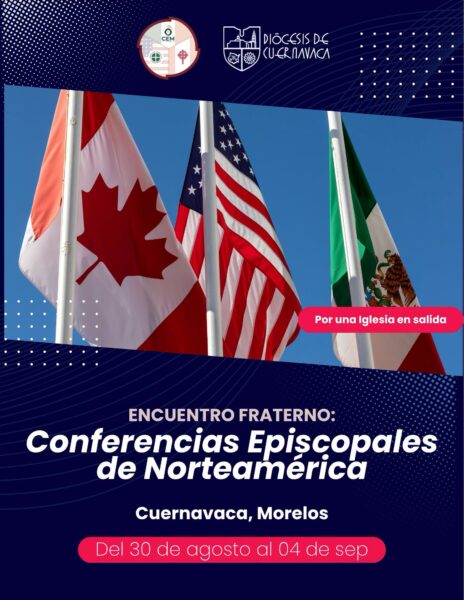
Starting August 30, the Diocese of Cuernavaca becomes the venue for a gathering that, due to its composition and the moment in which it occurs, has few parallels in the recent history of the Church in Mexico. The presidents of the three episcopal conferences of North America, Ramón Castro Castro, Bishop of Cuernavaca and president of the Mexican Episcopal Conference (CEM); Archbishop Paul Stagg Coakley, of Oklahoma City, president of the United States Conference of Catholic Bishops (USCCB) and Pierre Goudreault, Bishop of Sainte-Anne-de-la-Pocatière and president of the Canadian Conference of Catholic Bishops (CCCB), meet in the capital of Morelos for a pastoral dialogue of continental scope.
Castro has presided over the CEM since November 2024 and will be the host in the diocese that welcomes what can be called a “summit” and considered a “fraternal meeting” of episcopal presidencies in a territory marked by violence and disappearances, contrasting with a long tradition of peace walks that the bishop himself has led year after year.
The temporal framework reinforces the symbolism of 2026, the centenary year of the Mexican martyrs of religious persecution and the first of a pontificate of the first pope born in the United States, as well as various meetings of bishops from the continent. In February, the executive committees of the USCCB, the CCCB and the Latin American and Caribbean Episcopal Council (CELAM) held the biennial meeting of the Americas in Tampa, Florida, eleven bishops, including Coakley and Goudreault, together with Cardinal Jaime Spengler, president of CELAM.
In April, the Archdiocese of Montreal hosted another forum, of a different nature, a meeting on pastoral care for human mobility with bishops from Canada, the United States and Mexico, among them the Bishop of Matamoros-Reynosa, Eugenio Lira Rugarcía, with the Observatory of Human Mobility of Central America, Mexico and the Caribbean (OSMECA), as well as Cardinal Fabio Baggio of the Dicastery for the Service of Integral Human Development. Cuernavaca fits into this intensification of continental dialogue, but with a more reduced and specifically North American format.
None of the three conferences has published, at the close of this edition, an exhaustive agenda for the “summit” in Cuernavaca. Even so, the map of priorities that each episcopate has maintained in recent months allows us to anticipate, with reasonable certainty, the axes that will run through the table.
The first is migration. For the three Churches, the migrant is a neighbor and a sign of political contradiction. Mexico is a country of origin, transit and, increasingly, of return and refuge. The United States debates, under the second presidency of Donald Trump, the tightening of migration policy, raids and a rhetoric that U.S. bishops have denounced as “vilification of immigrants.” Canada receives temporary agricultural workers, asylum seekers and a growing flow of those who find no outlet at the southern border. In June, more than a hundred bishops, religious sisters, priests and laypeople crossed the border in Nogales in a procession that united both sides of the wall.
The second axis is violence and the drug phenomenon. In Mexico, the episcopate has made peace a persistent pastoral priority. On May 16, thousands of Catholics from Cuernavaca walked for the twelfth consecutive year led by Castro, who spoke of more than 133,000 disappeared persons, of the “protection money” that merchants pay in Morelos, one of the states with the highest perception of insecurity. “We do not resign ourselves,” he said. “We walk because peace cannot be built on empty speeches or on doctored statistics.” On the other side, the growing drug phenomenon has left thousands of victims, but the collateral effects are devastating for addicts and shattered societies, particularly in the United States and Canada.
The third axis is poverty, understood as a pastoral condition. In Mexico, the Church accompanies indigenous communities, day laborers and dioceses in the south where violence intertwines with institutional abandonment. In the United States it sustains a vast network of charities, clinics and schools, while facing the precariousness of Hispanic families and the housing crisis. In Canada, poverty intersects with the indigenous question, the loneliness of the elderly and the condition of temporary agricultural workers. The three episcopates share the grammar of social doctrine—dignity of the person, universal destination of goods, option for the poor—but each translates it into a distinct pastoral language.
A chapter intrudes that barely a decade ago would have sounded like science fiction in a meeting of bishops: artificial intelligence and, more broadly, digital culture. In September 2025, upon leaving the presidency of the CCCB, William McGrattan enumerated before his peers “the new social challenges” of the Canadian Church, “an accelerated growth of digital media, biological engineering and artificial intelligence, each of which threatens to compromise the dignity of the human person.”
AI does not interest the bishops as a consumer novelty. It interests them because it reconfigures work, education, information, intimacy and, more delicately, pastoral mediation itself and the dignity of the person. What happens to spiritual accompaniment when an algorithm offers instant consolation? How is the moral conscience of adolescents formed who inhabit platforms designed to capture their attention? What ethical criteria should guide the use of automated systems in Catholic schools, in confessional hospitals, in diocesan management itself? Recent magisterium has insisted that no technical innovation falls outside the judgment on human dignity.
To that chapter are added properly ecclesial challenges. In the three countries there is a decline in vocations, aging of the clergy and the need for a catechesis that is not reduced to a sacramental procedure. Mexico retains a Catholic cultural majority, but coexists with a “tremendous spiritual hunger,” as Castro has said, and with an indifference that is not residual. The United States is, in absolute numbers, one of the largest Churches in the world and, at the same time, a polarized Church, marked by the wound of abuse, by the debate on life and religious freedom and by the weight of Hispanic Catholicism—three out of ten parishes already offer Sunday Mass in Spanish. Canada, especially in Quebec, embodies the most advanced secularization of the subcontinent, the debate on euthanasia and the task of reconciliation with Indigenous peoples opened by Francis’s visit in 2022.
The three episcopates have followed, at different paces, the synodal process promoted by Francis and inherited by Leo XIV. Castro has defined the vision of the Church in Mexico for 2026 as that of “walking together as a Church more united, more synodal, closer to the people.” Coakley, at the biennial meeting in Tampa, described that encounter of the Americas as “a beautiful experience of fraternity, of collegiality and also a new experience of synodality.”
Although the table is common, each president arrives with his own dossier. Mexico’s is marked by peace, the centenary of the martyrs of religious persecution and the preparation of the Guadalupan Jubilee of 2031. Castro has promoted the Intercontinental Novena toward 2031 and the bishops of Mexico maintain tasks of synodality in local Churches, accompaniment of forced displacement and commitments on family and peace. On the horizon also appears the renewal of the episcopate; more than a third of Mexican bishops are of canonical retirement age or about to reach it, and Leo XIV will have to appoint some twenty new pastors between 2026 and 2027.
The U.S. dossier combines the defense of life, religious freedom, the protection of minors with annual audits covering nearly all dioceses and eparchies, Hispanic pastoral care and an increasingly explicit position on migration. Coakley assumes the presidency of the USCCB at a moment of strong tension between Washington’s official discourse and the Church’s social doctrine. The episcopate is not a monolithic bloc—it never has been—but it has coincided in rejecting the reduction of the immigrant to a police category. At the same time, the Church in the United States debates how to evangelize in a fragmented society, how to sustain its schools—nearly 5,800—and how to form laity in an environment saturated with polarization.
The Canadian dossier is crossed by reconciliation with Indigenous peoples, safeguarding, the ethics of life in the face of the expansion of euthanasia, the coexistence of Anglophone and Francophone communities—the CCCB habitually alternates the presidency between both sectors—and the question of the public place of a Church that no longer occupies the center. Goudreault, Francophone, successor to an Anglophone president, embodies that tradition of balance. He arrives in Cuernavaca with the experience of April in Montreal, where, as president of the CCCB, he hosted not the three presidencies but those responsible for migrant pastoral care from Canada, the United States, Mexico and Central America, and thought about mobility from where migrants live, the Le Pont shelter and the network of agricultural workers.
Who are the protagonists of this singular meeting? Paul Stagg Coakley, president of the USCCB, was born on June 3, 1955, in Norfolk, Virginia. The family, of Irish and French roots, first moved to Metairie, Louisiana, and in 1965 to Overland Park, Kansas. After studying English and classical antiquities at the University of Kansas, where he was a student in the Integrated Humanities Program of John Senior, Dennis Quinn and Frank Nelick, he traveled through Europe and considered a vocation to monastic life at the Benedictine Abbey of Notre-Dame de Fontgombault in France.
He returned to enter the seminary of the Diocese of Wichita in 1978. He was formed at Saint Pius X Seminary in Erlanger, Kentucky, and at Mount Saint Mary’s in Emmitsburg, Maryland. He was ordained a priest on May 21, 1983, at the Cathedral of the Immaculate Conception in Wichita. For 21 years he served as hospital and university chaplain, pastor, director of the Spiritual Life Center and vice-chancellor. He completed a licentiate in theology at the Pontifical Gregorian University in Rome and was director of spiritual formation at Mount Saint Mary’s.
John Paul II appointed him Bishop of Salina, a diocese in northern Kansas, on October 21, 2004, and he was ordained on December 28 of that year. Benedict XVI promoted him on December 16, 2010, to Archbishop of Oklahoma City, a see he has governed ever since through three pontificates. At the USCCB he was secretary of the conference, elected in 2022 and reelected afterward, chair of the Committee on Priorities and Plans, and has presided over Catholic Relief Services.
On November 11, 2025, at the fall assembly in Baltimore, he was elected president of the USCCB in the third round by 128 votes against 109 for Daniel E. Flores, Bishop of Brownsville, who was elected vice-president. His episcopal motto, Duc in altum, “Put out into the deep,” summarizes a style that combines doctrinal firmness, attention to social doctrine and a demeanor that U.S. observers describe as moderate in form and clear in convictions, especially in the defense of life.
Pierre Goudreault, president of the Canadian Conference of Catholic Bishops, was born on May 27, 1963, in Rouyn-Noranda, Quebec, in the mining border of Abitibi-Témiscamingue. In 1984 he obtained a certificate in administration at the Université du Québec in Abitibi-Témiscamingue and that same year entered Saint Paul University Seminary in Ottawa. He was ordained a priest for the Diocese of Rouyn-Noranda on May 18, 1991. In 1998 he earned a doctorate in theology at Saint Paul University, one of the reference ecclesiastical faculties in Francophone Canada.
His priestly ministry developed almost entirely in northwestern Quebec: vicar at Saint-Martin-de-Tours in Malartic; member of the formation team at the Ottawa seminary; pastor of the four parishes of the Notre-Dame-de-l’Entente pastoral unit; moderating priest of Sainte-Trinité in downtown Rouyn-Noranda for fifteen years; and also pastor of Sainte-Famille in Arntfield and of Blessed Sacrament. He taught practical theology at Saint Paul University.
Francis appointed him sixth Bishop of Sainte-Anne-de-la-Pocatière on December 8, 2017. He received episcopal ordination on March 10, 2018, at the Cathedral of La Pocatière, from the hands of Cardinal Gérald Cyprien Lacroix, Archbishop of Quebec and Primate of Canada. In 2023 he was elected vice-president of the CCCB. On September 26, 2025, at the end of the plenary assembly in Montreal, his peers elected him the 41st president of the conference for the 2025-2027 biennium, in the traditional alternation between Francophone and Anglophone sectors. He is accompanied as vice-president by Archbishop Donald Bolen of Regina, known for his ecumenical work and for reconciliation with Indigenous peoples. Goudreault arrives in Cuernavaca as the voice of a Church that has had to learn to speak from the margins of a secular society and, at the same time, as the pastor of a small diocese, which relates him, in scale, to his Mexican host.
Ramón Castro Castro, president of the Mexican Episcopal Conference, was born on January 27, 1956, in Teocuitatlán de Corona, Jalisco. He studied philosophy and theology at the Tijuana Seminary between 1973 and 1981. He was ordained a priest on May 13, 1982, in Tijuana, by Juan Jesús Posadas Ocampo, and began his ministry at the parish of San José Obrero in Ensenada. In 1985 he entered the Pontifical Ecclesiastical Academy, where he was formed for the diplomatic service of the Holy See.
He served in the nunciatures of Zambia and Malawi (1989-1992), Angola (1992-1994), Ukraine (1994-1996), Venezuela (1996-1999) and Paraguay (1999-2001). In 2001 he was appointed director of the Oblation of Saint Peter in the Secretariat of State, the body that administers alms destined for the pope. That African, European and Latin American decade gave him a mental map that few Mexican diocesan bishops possess—that of a Church thought of in terms of nunciature, borders and relations with States.
John Paul II appointed him titular Bishop of Suelli and auxiliary of Yucatán on April 2, 2004; he received episcopal ordination on June 3. Benedict XVI transferred him to Campeche on April 8, 2006. Francis sent him to Cuernavaca on May 15, 2013, as the XII Bishop of the diocese; he took possession on July 10. At the CEM he was responsible for the Dimension of Justice, Peace and Reconciliation of the Episcopal Commission for Social Pastoral Care and, from November 9, 2021, secretary general. On November 12, 2024, at the 117th Plenary Assembly, he was elected president for the 2024-2027 triennium. He is accompanied as vice-president by Jaime Calderón Calderón, Archbishop of León; as secretary general, Héctor Mario Pérez Villarreal, auxiliary Bishop of Mexico; and as treasurer, Jorge Alberto Cavazos Arizpe, Archbishop of San Luis Potosí.
The passage from diplomacy to the diocese did not extinguish in Castro the habit of public speech. He has been one of the most constant voices of the Mexican episcopate against violence, corruption and indifference toward victims. He has also aroused controversy: in 2020, a homily in which he interpreted the pandemic as “a cry from God to humanity” in the face of various moral disorders provoked rejection from collectives and wide media echo. In 2026 he has insisted that Leo XIV “wants to come to Mexico” and has maintained, at the close of the Jubilee, that the Church “will never lose hope” of a year of greater peace. Receiving Coakley and Goudreault in his own diocese closes, in some way, the arc of a vocation that began in the nunciatures and ends in episcopal hospitality.
The summit does not bring together three symbolic federations. It brings together the presidents of three ecclesial bodies of enormous institutional density, distinct in size, demographic weight and relationship with civil society. The figures that follow come, fundamentally, from the compilations of GCatholic and the Pontifical Yearbook referring to the close of 2023, cross-referenced with the current directories of the USCCB, the CCCB and the CEM, and with the state of the College of Cardinals in mid-2026.
The Church in Mexico is articulated, according to the CEM’s own count, in 19 archdioceses, 73 dioceses and 4 territorial prelatures—that is, 96 Latin-rite circumscriptions in the national territory—to which are added the military ordinariate and jurisdictions of Eastern Catholic Churches present in the country. GCatholic registers 99 jurisdictions if the apostolic exarchate and other figures are included. The episcopate in active governance—residential archbishops, diocesan bishops, prelates and auxiliaries—numbers around 110 to 115 prelates; the total number of bishops, including titular and emeriti, exceeds 170. In January 2026, an internal count of the episcopal map estimated 18 archbishops in see, 68 diocesan bishops, three prelates and 23 auxiliaries.
Mexico has six living cardinals. Two of them are electors: the Primate Archbishop of Mexico and Cardinal José Francisco Robles Ortega, Archbishop of Guadalajara; the other four, by reason of age, no longer enter a conclave. In terms of baptized persons, pontifical statistics place Mexican Catholics at around 120 million, nearly 91 percent of a population of some 131 million. That proportion, the highest of the three countries, coexists with uneven practice, with the advance of other confessions and with an urban secularization that is no longer an elite phenomenon.
The USCCB groups, according to its current directory, 144 Latin dioceses, 33 Latin archdioceses, 16 Eastern eparchies, 2 Eastern archeparchies, the Archdiocese for the Military Services and the Personal Ordinariate of the Chair of Saint Peter, 197 circumscriptions in total. It is one of the most complex Catholic geographies in the world, not only because of the number, but because of the full coexistence of the Latin rite with ten Eastern sui iuris Churches. The conference directory counts 440 archbishops and bishops, active and emeriti. Among the active ones it lists 3 cardinal archbishops, 31 archbishops, 159 diocesan bishops and 75 auxiliary bishops.
The College of Cardinals counts, in the summer of 2026, 16 U.S. cardinals, of whom nine retain the right to vote in a conclave. Pontifical statistics estimate some 75.5 million baptized Catholics, equivalent to 22.5 percent of a population of nearly 335 million. In absolute numbers, the United States is the third or fourth Church in the world; in proportion, it is an influential minority, institutionally dense, with more than 16,000 parishes, nearly 5,800 schools, a first-rate hospital network and culturally contested.
The CCCB in Canada has 59 dioceses of the Latin Church, 12 eparchies and 2 exarchates of Eastern Churches, as well as 2 ordinariates. GCatholic counts 74 jurisdictions that include 18 metropolitan sees, the non-metropolitan Archdiocese of Winnipeg, the military ordinariate and the personal ordinariate. The number of bishops, between residential, auxiliary, titular and emeriti, stands at around 135. Canada has five living cardinals and three electors, among them Cardinal Gérald Cyprien Lacroix, Archbishop of Quebec and Primate, and Cardinal Francis (Frank) Leo, Archbishop of Toronto, created cardinal in December 2024.
Baptized Catholics are estimated between 17 and 18 million, nearly 44 percent of a population of some 40 million. That figure, still high compared with much of Europe, conceals the pronounced drop in practice, especially in Quebec, and the specific weight of immigrant communities that today sustain many urban parishes. Canada is, of the three, the country where the Church has had to learn most rapidly to be a creative minority in a public square no longer reserved for it.
No reasonable person anticipates that a treaty or agreement will emerge from this summit. Episcopal conferences do not negotiate like States nor legislate like a council. What can be expected, and what would turn the meeting into something more than a protocol photograph, is a convergence of diagnoses and a common evangelical grammar for the coming years with absolute transparency. A shared word on the dignity of the migrant, spoken at the same time in Spanish, English and French, carries a different weight than three parallel communiqués. A common criterion on pastoral care against addictions and the criminal recruitment of young people. A joint reflection on artificial intelligence would prevent each Church from improvising, belatedly, an ethics of technology.
Also to be expected is something more discreet and, perhaps, more lasting: a custom. Since 1959 there has existed a tradition of episcopal dialogue in the Americas. What has changed is the intensity and specialization. Tampa, in February, was the biennial meeting of the Americas (USCCB, CCCB and CELAM). Montreal, in April, was a forum of specialists in human mobility, with the Vatican and OSMECA. Cuernavaca, at the end of August, brings together the three North American presidencies.
For Mexico, the fact of being host is not minor. For decades, the ecclesial relationship with the United States was read above all from migration and from the border dioceses; the relationship with Canada, from a respectful and uncommon distance. Seating in Cuernavaca the presidents of the three conferences, under the presidency of a Mexican bishop formed in Vatican diplomacy and tempered in a diocese wounded by violence, is a milestone in the country’s ecclesial history—not because Mexico “finally arrives” at an unusual table, but because it installs itself here, in a Church that contributes to the whole what the other two cannot contribute to the same degree: the memory of a baptismal majority, the raw experience of violence and the living word that from Tepeyac speaks to the entire American continent.