


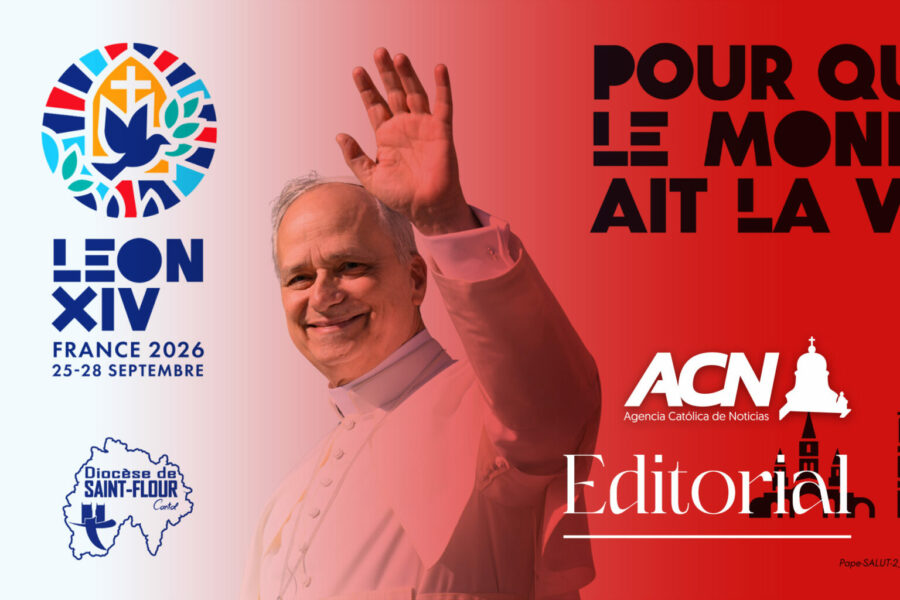
In five days, Leo XIV will land in Orly. It will not be a courtesy visit. It will be the first apostolic journey of this magnitude to France, from September 25 to 28, since Benedict XVI in 2008, four days between Paris, Saint-Denis, Lourdes and Metz and the UNESCO headquarters, under the motto “So that the world may have life”. Francis visited Strasbourg, Marseille and Ajaccio, but never undertook a comparable national visit. The successor now arrives in a country that is, at the same time, a laboratory of laïcité and the stage of a phenomenon that has puzzled sociologists, bishops and agnostics.
The underlying figures remain harsh. Regular Sunday Mass hovers around 5 percent; active diocesan priests are a fraction of what they were half a century ago; parishes have been merged; infant baptisms have plummeted. Christian Europe has largely become a continent of cultural memory and residual practice. France is no exception, it is the most eloquent case because there the separation between faith and the public sphere is not an accident, but a republican dogma.
Paradoxically, however, at Easter 2026 more than 21,000 adults and adolescents received baptism, some 13,200 adults, 28 percent more than the previous year and more than 8,000 adolescents. In a decade, adult baptisms have tripled. The profile is not that of a Church aging in silence; a very visible portion of these catechumens is between 18 and 25 years old. It is not, as is sometimes simplistically portrayed, a miracle of social media. What repeatedly emerges in the testimonies is something older and denser: the reading of the Bible, the search for an identity that does not dissolve, the encounter with other believers and the making of Christian identity in a country that is becoming Islamized.
That is the ground on which Leo XIV will speak. The itinerary says it more clearly than any communiqué. At the Élysée he will measure himself against the secular State and also against international organizations. At Notre-Dame, rebuilt, he will pray Vespers with the clergy of a country that no longer produces priests at the pace of its churches. At the Stade de France, 80,000 young people await him. Some 600,000 people have registered for the Mass in the Place de la Concorde. In Lourdes he will be with the sick, contemplative religious and, privately, with victims of abuse. In Metz, land of Robert Schuman and wounded borders, he will speak of Europe, peace and unity, and will sign an interreligious appeal. The geography of the journey is a map of wounds and spiritual reserves.
The migration issue runs through that map. On Saturday the 26th the Pope will visit Maison Bakhita, the diocesan house welcoming exiled people. It is not a minor pastoral detail. France is facing an electoral year in which immigration is once again a central issue and Europe still lacks a common policy that does not oscillate between impotence and harshness.
Leo XIV already called in Spain and the Canary Islands for a coordinated, solidarity-based and effective response and will recall an uncomfortable doctrine: the right not to have to flee, the duty to help those who are shipwrecked and the requirement to integrate those who arrive. Those words will have political consequences precisely because they are not partisan.
The outlook for the visit should not be confused with a forecast of re-Christianization. A full stadium does not rebuild a broken family transmission. Twenty-one thousand baptisms do not compensate for hundreds of thousands of children who no longer receive the sacrament. What can happen, and that is enough for the trip to matter, is that the Pope confirms in the faith those who have ceased to feel part of Christian France, that he compels the French Church to take its catechumens seriously and that he reminds a secular Republic that public faith is not an automatic threat to the civil pact. If he succeeds, France will cease to be merely the emblem of European emptying and will become the laboratory of a more difficult question: how to inhabit a secular society without renouncing the naming of God?
The French journey is the catapult for the leap Leo XIV will take in November to South America. From the 6th to the 17th he will visit Uruguay, Argentina and Peru, the first American tour of his pontificate. He will go to the land where he exercised a long ministry, Chiclayo, Lima, Cusco, Pucallpa and to the homeland of his predecessor, Francis, who never returned to Argentina while occupying the See of Peter. What is at stake in Paris and Lourdes—dignity of the migrant, credibility of a wounded Church, possibility of a young faith in an old continent—will not remain in Europe. It will cross the Atlantic with him.