


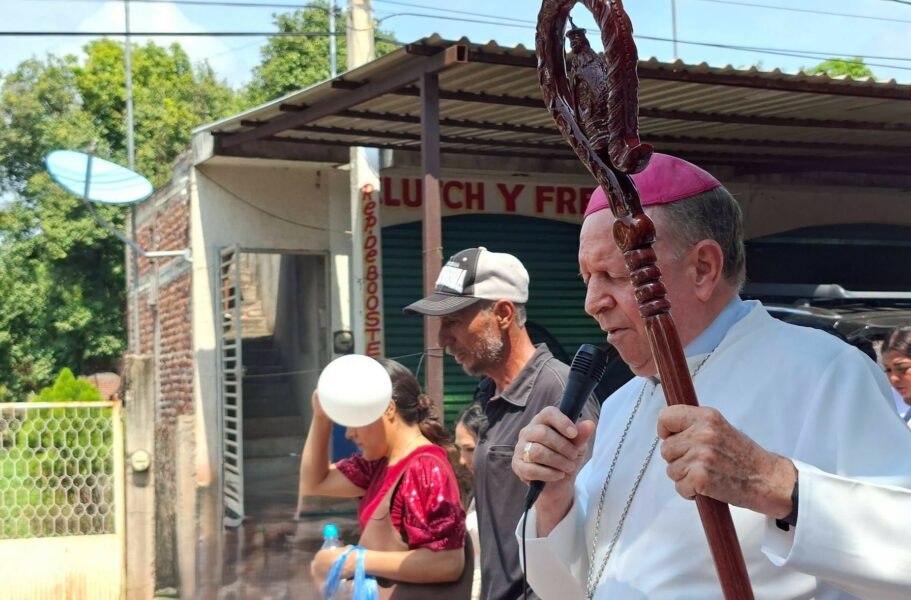
On October 18, 2026, in the cathedral of Apatzingán, Bishop Cristóbal Ascencio García celebrated the Mass of the XXIX Sunday in Ordinary Time with a precise and painful intention: the eternal rest of Bernardo Bravo Manríquez, leader of the citrus growers of the Apatzingán Valley, murdered on October 19, 2025. Exactly one year after the crime, the widow Amelí Navarro Lepe was present in the church. The celebration coincided with World Mission Sunday and with the Gospel of Matthew 22:15-21, the trap set by the Pharisees and Herodians regarding the tribute to Caesar and Jesus’ response: “Give to Caesar what is Caesar’s and to God what is God’s”.
Ascencio García did not limit himself to liturgical exegesis. In his reflection, read and preached from the ambo, he applied the text to the immediate reality of his diocese. He described the circumstantial alliance of Pharisees and Herodians to destroy Jesus and contrasted it with the contemporary reality of those who, from legalism or political power, keep their hearts far from God and from the people. The coin of tribute bears the emperor’s image; the human being, according to Genesis, bears the image of God. Therefore, he affirmed, no Caesar can claim absolute right over life, freedom, or conscience.
The prelate was explicit about the double burden that suffocates the region. “We pay taxes whether we like it or not,” he recalled, but immediately asked whether we give to God what belongs to Him. In the written homily it reads that “our peoples live under the siege of tax collectors, on one hand, the taxes established by the government, always rising and which we cannot stop paying, on the other, what is called ‘floor collection,’ the famous quotas, which must also be paid if one wants to continue working or not risk one’s life.” Whoever cannot pay, he added, must leave the region. In his diocese he has seen “so many families emigrate in search of a better life; seeking that peace to continue working, battered by injustices and feeling the impotence of being unable to do anything.” This denunciation also coincides with the current discussions in the Federal Legislative Branch on the economic package, the increase in established taxes, and, in the coming days, the approval of the budget for fiscal year 2027.
The bishop pointed out that these “taxes outside the law” or “covered by the law,” “in complicity with the law,” lacerate the people while “those who promised to protect it remain deaf and with narratives that everything is fine”. Paying taxes has become, he said, actions that “have bled us little by little” and lead to despair. In response to the phrase “Give to Caesar what is Caesar’s,” he asked radically: “What belongs to Caesar? Nothing, not even the taxes, because they are not for Caesar, but so that the Caesar of the moment may ensure that the people who elected him have a better life.” And he added another uncomfortable question: will not the Caesar be the one who must restore to the voiceless, to the excluded, to those displaced by violence, to the victims of slow justice? He cited the legal principle that “justice delayed is justice denied.”
In the framework of that critique, the prelate questioned the destination and visibility of public resources. If taxes such as property tax, acquisition tax, various fees, and federal and state contributions are collected, “where are they noticeable?” The militarized presence of security (Army, National Guard, Civil Guard) is constant in the Tierra Caliente region, with inter-institutional operations bases and patrols. However, Apatzingán lives in continuous violence that does not stop. The Human Security Observatory of the Apatzingán Region (OSHRA) documented nine homicides and three attempted homicides between October 12 and 18, 2026, precisely the week before and the very day of the homily, raising the year’s total to 144 violent deaths in the municipality.
The events of that week accentuate the gap between the security discourse and reality. On October 12, a young man known as “El Macaco” died in a hospital, attacked the previous day in the 18 de Marzo neighborhood. On the 13th, armed men burst into a home in El Guayabo and murdered Jorge Luis N.; his daughter Alexa, eight years old, was wounded in the abdomen and died in the early hours of the 14th at the Children’s Hospital in Morelia, despite the fact that an Inter-Institutional Operations Base operates nearby. The same day, two bodies were found in Exhacienda La Huerta, related to clashes between groups. The 16th was the bloodiest day, three men murdered with signs of torture (one in Cagüingas, two in El Varillero), a hamburger vendor wounded in Los Limones, and at night Verónica G., 35 years old, executed by gunfire in her home in the Generalísimo Morelos subdivision, in front of her minor children. Valeria G.R. and Miguel Irán M.H., both 25 years old, were also injured in the Buenos Aires neighborhood. The OSHRA warned of the risk of mass displacement in Guanajuatillo and documented the forced displacement of at least four families from Exhacienda La Huerta. A municipal councilor and a local deputy requested the intervention of the three levels of government.
The murder of Alexa and her father occurred a short distance from institutional presence. The execution of a woman in front of her children took place in an urban area. The discovery of bodies wrapped in blankets or with signs of torture is repeated. The lemon, the economic engine of the region, which generates hundreds of millions of dollars annually, is quoted between 5.50 and 6 pesos per kilo, below the estimated production cost of 10 pesos, while floor collection and quotas continue to operate.
The intention of the Mass for Bernardo Bravo also reflected the closeness of the pastor. Bravo, president of the Association of Citrus Growers of the Apatzingán Valley, had publicly denounced the extortions by organized crime against lemon producers. In February 2025 he reported threats that forced the closure of the lemon market offices. In September he described a security crisis intensified in Apatzingán and Buenavista due to clashes between groups since 2023, despite meetings with security cabinets. He demanded strategies to end the extortion of lemon and called for mobilizations for fair prices and protection. On October 19-20, 2025, his body was found in his vehicle, with signs of violence, in the Los Tepetates area. Investigations initially pointed to Rigoberto López Mendoza (“El Pantano” or “El Plátano”), linked to extortion cells (Los Blancos de Troya, related to Los Viagras and the CJNG). Later reports from El País pointed to César Sepúlveda, alias “Bótox,” as a central figure in a network that charged two or three pesos per kilo from packers in more than 100,000 hectares. The Apatzingán Valley is described as an “entangled ecosystem” where the boundaries between businessmen, politicians, police, and criminals are diffuse.
A year later, the widow Amelí Navarro Lepe, who has demanded “integral justice” and has pointed out that no resolution will repair the absence of her husband, was in the cathedral. Hours after the Mass, a mural was blessed at the lemon market. The motto of the commemorations was “For a free life and lasting peace.” The homily of Ascencio García, by remembering Bravo and denouncing the double tribute, connected the memory of the victim with the current situation: the same mechanisms of illegal collection that Bravo denounced continue to operate, families continue to emigrate or be displaced, and homicide numbers do not decrease despite militarization.
The prelate warned against the most twisted interpretation of Jesus’ phrase, abandoning the field of the world and society to governments and locking God in the sacristy. When the Church opposes laws on abortion, flawed education, or euthanasia, it is accused of meddling where it is not called. Exactly, he said, one must collaborate with Caesar in the creation of a better and more equal society, complying with just laws and paying taxes for the services received, but no Caesar, no matter how absolute a majority he has, can dispose of life, freedom, or conscience. The more power the State has, the greater the temptation to believe itself an absolute power; individual conscience is manipulated through the media and man becomes a voting machine. Every government is called to serve man, to seek his good, and to create the environment for him to be happy, without forgetting the transcendental element within him.
Saint Augustine, cited at the close of the homily, summarizes the demand: “Caesar seeks his image, give it to him; God seeks His, give it back to Him. Do not let Caesar lose his coin because of you; do not let God lose His in you”. “What Caesars today occupy a place that belongs only to God? Are we truly giving to God what belongs to Him?”
The excerpt of the homily can be seen here: