


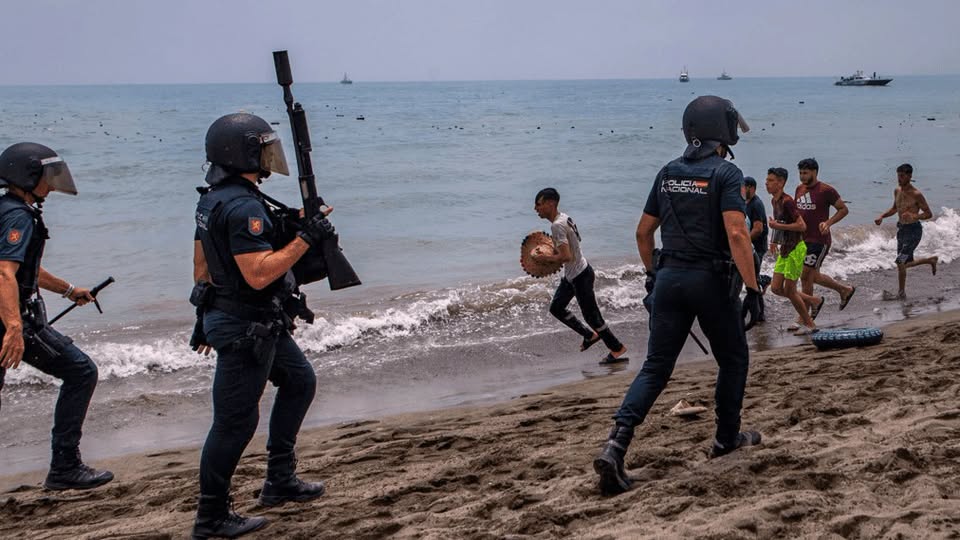
Pedro Mejías / acTÚa Familia.- In a single day, nearly 30,000 people crossed into Ceuta, a city of 80,000 inhabitants. It was not a spontaneous migratory flow. It was a calculated pressure operation that Morocco exerts on a territory it still considers its own. It is the contemporary version of the Green March: a hybrid offensive that combines demographics, borders, and destabilization.
Spanish intelligence services claim that, unlike in 2021, Rabat did not push the movement this time. It is hard to believe when the gendarmes watched without intervening, remained inactive, or even facilitated the passage of groups of minors. And it is even harder to believe when the avalanche coincided exactly with the anniversary of Mohamed VI’s accession to the throne.
Morocco spoke of cooperation and sent a single water-cannon truck. Meanwhile, irregular entries continued uninterrupted, repeating the same pattern as the previous crisis.
The timing was no coincidence either. Just days earlier, the Prime Minister had visited Algeria, reactivated the gas pipeline, and lavished praise on the Algerian regime. Morocco, Algeria’s historic rival, interpreted the gesture as an affront.
This is compounded by the Gibraltar precedent: the removal of the fence and the co-sovereignty rhetoric. In Moroccan circles, applying the same scheme to Ceuta and Melilla is openly advocated: Spain bears the costs and Morocco gains de facto control. Every sign of weakness is seen as an invitation to press harder.
Additional favorable factors converged: good weather, the president’s absence on vacation, and a judicial interpretation that prevents immediate returns when entry occurs by swimming, as no containment elements were breached. The technical response is predictable: install buoys and nets that meet the legal definition of an obstacle.
The Government has used that Supreme Court decision to deflect responsibility. However, the judicial error does not explain the passivity—or the complicity— of the Moroccan authorities, which is the true origin of the problem. Meanwhile, the Executive continues to praise Rabat’s “cooperation.” The inevitable question is what kind of dependence the president maintains with the Moroccan monarch and what sensitive information could justify this attitude.
When Italy warned of the possibility of closing its borders due to the risk of the crisis spreading, Minister Albares summoned the Italian ambassador for consultations, not Morocco’s. Only when the pressure became unsustainable was the army deployed and the Melilla border closed amid signs of a similar avalanche. Why were these measures not adopted from the outset? Why were there only 42 riot police in Ceuta and 55 agents at the border when the risk was already known? Incompetence or deliberate decision?
In 2023 the risk of migratory invasion was removed from the National Security report. Why was an evident danger withdrawn? Out of idealism or for another reason?
But the problem goes beyond the border and geopolitics. Each wave of this kind accelerates a process of demographic and cultural transformation already underway in Europe. It is not only about irregular entry figures: it is about the progressive Islamization of neighborhoods, cities, and, in the medium term, society itself. acTÚa FAMILIA has long warned of this reality. Its slogan clearly summarizes what is at stake: Recovering Our Civilization. Because without a firm response at the borders and without an active defense of the values that have sustained the West, what is lost is not only territorial control, but the very character of the society that inhabits it.