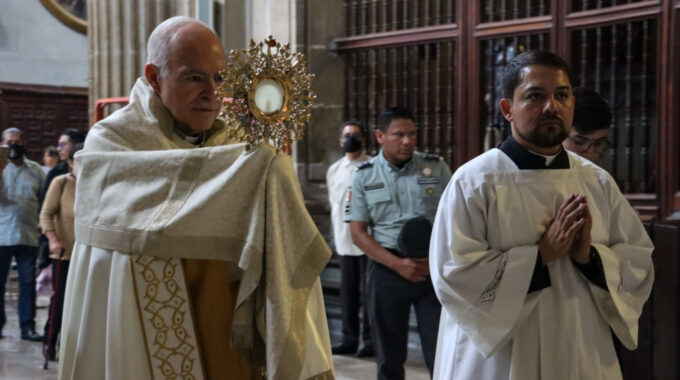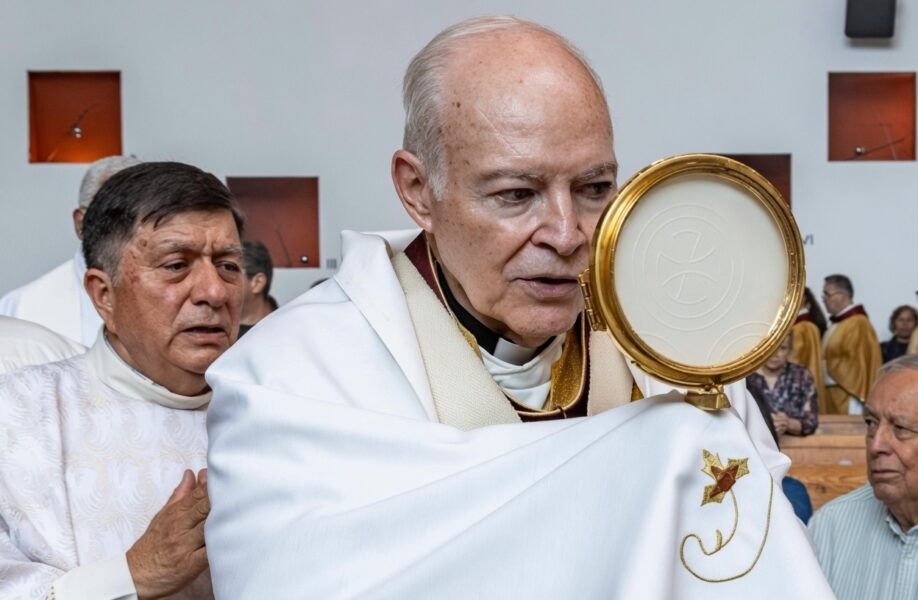
While the Catholic world celebrated Corpus Christi with magnificence and splendor, so that Our Lord might conquer all public spaces, in the capital of Mexico the feast ended on a sad note that came from the very primate archbishop himself, Carlos Aguiar.
2026 holds special meaning for Mexico City. It marks exactly five hundred years since the first Corpus Christi procession celebrated in New Spain, in 1526, just five years after the fall of Mexico-Tenochtitlan.
The first procession took place while the capital of the Viceroyalty was still being built upon the ruins of Tenochtitlan. Most striking is that the Diocese of Mexico did not yet exist, nor had fray Juan de Zumárraga arrived, who would not be named the first bishop until 1528.
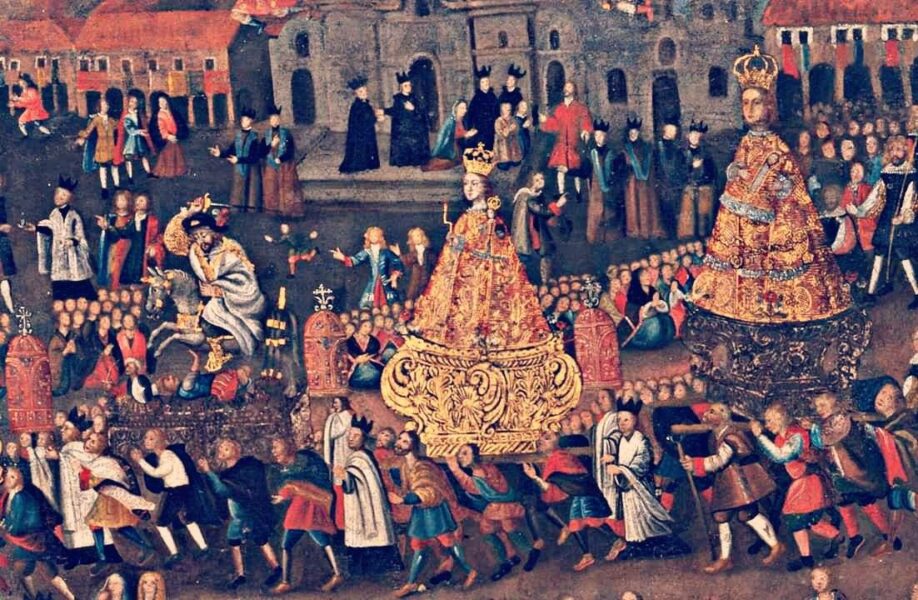
The conquerors wished to reproduce one of the most solemn feasts of Europe and the Spanish Empire: the public procession of the Blessed Sacrament through the city streets. From then on, Corpus Christi became the most important religious celebration of the year in the viceregal capital.
During the sixteenth century, Corpus Christi became far more than a liturgical observance. Civil authorities, religious orders, trade guilds, the military, confraternities, and indigenous communities all took part, adorning the streets with flowers, branches, and leafy arches while presenting dances. The feast served to manifest publicly the faith in the Eucharist and to display the unity of the new social order of New Spain.
Chronicles record that Corpus Christi was the most important public feast in Mexico City for much of the Viceroyalty. Even the city’s organization, guilds, and corporations were reflected in the order of the procession. It was a visible sign that Christ in the Eucharist was acknowledged as Lord.
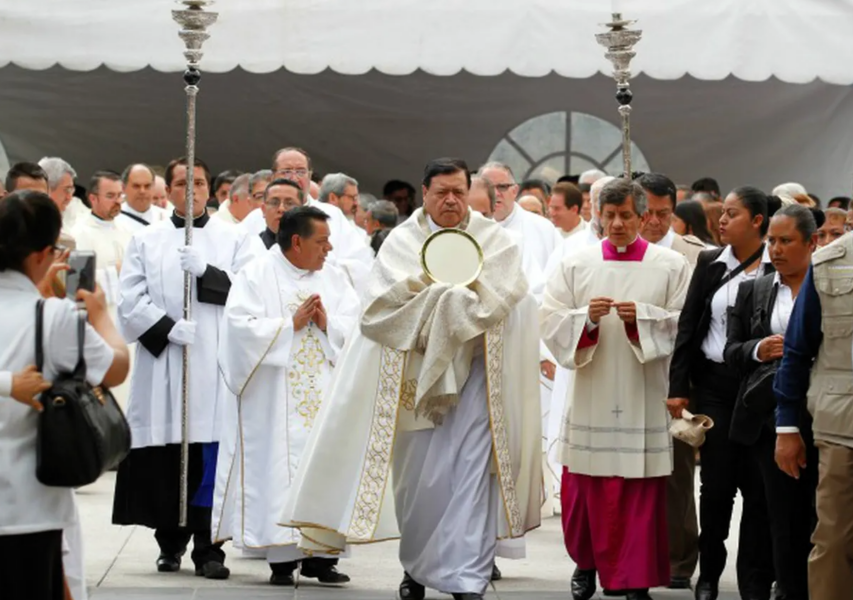
Because of the Reform Laws and the intense anticlerical sentiment that spread for decades, the Corpus Christi procession was suspended for many years. It was Cardinal Norberto Rivera Carrera who, despite the scandal and opposition of the Freemasons, once again brought the Corpus Christi procession to the Zócalo and the streets of the Historic Center on Thursday, June 6, 1996, after one hundred thirty years of being celebrated almost entirely behind closed doors.
For this reason, many priests of the Archdiocese of Mexico still remember that Corpus of 1996 as a historic event. It was not merely another procession, but the visible recovery of a eucharistic tradition that had disappeared from the public space of the Historic Center for more than a century.
Another interesting fact: years later, when the Zócalo was occupied by civic events, the procession would depart from Tlaxcoaque and proceed along Avenida 20 de Noviembre to the Metropolitan Cathedral, preserving the public character of faith that Norberto Rivera had promoted.
Upon the arrival of Archbishop Carlos Aguiar Retes in 2018, during his first meeting with the Metropolitan Chapter and without consulting or listening to the canons, he canceled the public Corpus Christi procession. He claimed to have received reports that, in previous processions, the Blessed Sacrament had been subjected to offenses by protesters stationed in the Zócalo.
The surprise among the canons was great. Three of them replied that such a thing had never occurred. They even pointed out that, on some occasions, the protesters gathered in the square—curiously the same groups that today take part in the CNTE demonstrations—had joined the procession, uncovered their heads, and many knelt as the Blessed Sacrament passed by.
The canons firmly confronted Archbishop Aguiar, but he refused to listen. For many of them, this was the first sign of his aversion to participating in public acts of popular religiosity. The same has happened with the annual pilgrimage of the Archdiocese of Mexico to the Basilica of Guadalupe, in which all his predecessors walked with the faithful from the Peralvillo roundabout to the Marian shrine. Archbishop Aguiar, by contrast, has limited himself to receiving the pilgrimage, once massive and now reduced to a much smaller attendance.
The great opportunity to celebrate the five hundred years of the first Corpus Christi procession was canceled by the cowardice and false priorities of Archbishop Aguiar, who falsely claimed he sought to protect the faithful when, in reality, no such danger existed. He even canceled the Eucharistic celebration planned at the historic Church of San Fernando, where there was no risk at all, and in a most shameful manner chose to take refuge in the comfortable and peaceful parish of La Esperanza de María, in the southern part of the city near his private residence, depriving the faithful of participating in a celebration that could never be repeated on the five-hundredth anniversary of Corpus Christi in Mexico.
He did not even dare to preside over the celebration at the Basilica of Guadalupe, aware that his presence is unwelcome and undesirable to the Chapter because of the reinstatement of rector Efraín Hernández, who faces serious accusations.
The Archdiocese of Mexico has been graced with great and holy archbishops. The weariness is now unsustainable. It does not deserve a shepherd like the present one, who flees from danger, abandons his sheep, and displays a lack of faith that scandalizes the faithful and deprives them of one of the greatest loves of the Mexican Catholic people—their love for the Eucharist.
The underlying issue is not merely the suspension of a procession. It is the vision of the Church behind these decisions. Because a Church that ceases to go out into the streets ends up closing in on itself. A Church that renounces public expressions of faith weakens its evangelizing presence. A Church that retreats before cultural challenges risks becoming accustomed to invisibility.
The Mexican Catholic tradition was never a hidden tradition. It was a faith lived publicly, proclaimed in the plazas, celebrated in pilgrimages, and manifested with pride by a people who never considered loving Christ something to be concealed.
Therefore, it is deeply troubling that the commemoration of the five hundred years of Corpus Christi has passed practically unnoticed, invisible and canceled in the very particular Church where that history began.
The Eucharist is not simply one more devotion. It is the center of the Church’s life. It is the greatest treasure the Christian people possess. And when a unique opportunity to exalt that mystery publicly is lost, the wound is not only historical but also spiritual. The great shepherds of history were not those who prudently managed risks. They were those who knew how to lead the people of God in their midst.
Many of the faithful today feel sadness, bewilderment, and disillusionment—not because an event was suspended, but because they perceive that a providential opportunity to proclaim to the city that Christ continues to walk with his people has been squandered.
The five hundred years of Corpus Christi deserved a memorable celebration. They deserved streets filled with the faithful. They deserved public adoration. They deserved a Church that is visible, courageous, and fully convinced of what it believes. Especially because of two coincidences that align with this half-millennium: the centenary of the beginning of the Cristero War, which, far from discouraging the faithful by the closing of churches, spurred them even more to live the faith in clandestinity, knowing it was necessary to proclaim the greatness and kingship of Christ amid persecution, regardless of the cost—even life through martyrdom—and, on the other hand, the first National Eucharistic Congress of 1924, held before the suspension of public worship and amid the political and religious turmoil that shook the country.
For that event, a precious silver monstrance was crafted—rectangular in shape, inlaid with stone, weighing 380 kilos and standing more than two meters high—made possible by the generous collection of the faithful themselves. This monumental monstrance is one of the Cathedral’s principal treasures, and according to records, a saying of the great peacemaking archbishop, the Servant of God Luis María Martínez, summed up in a few words what it contained: adoration of Christ in that monstrance is like “the spiritual heart of our homeland.”
All of this was vilified by a cowering archbishop who preferred to shut himself away in comfort rather than celebrate an occasion of such magnitude that would have impacted younger generations and a society whose faith in Mexico City grows ever more complex.
When the memory of a people is forgotten, when their deepest traditions are set aside, and when faith ceases to occupy the public spaces that legitimately belong to it, something essential begins to be lost. And when that happens, not only is a tradition impoverished: the soul of a people is also weakened.