


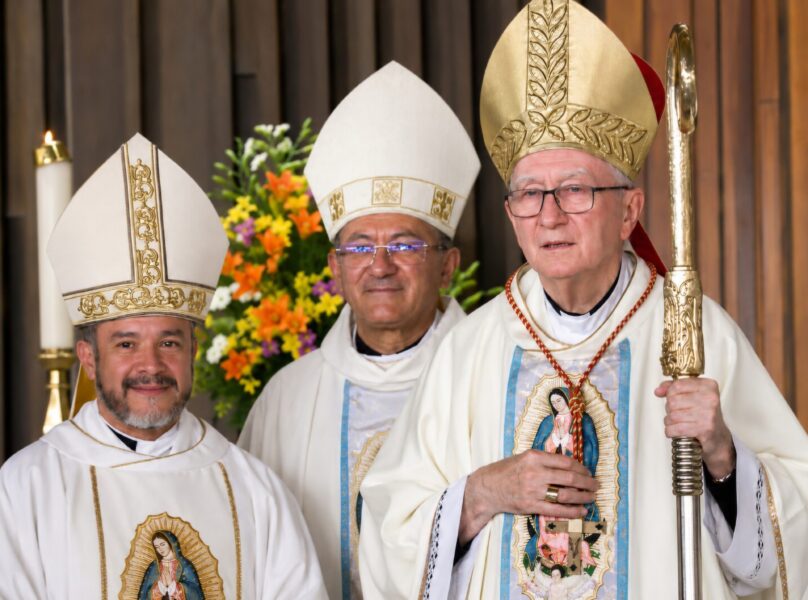
The first day of Cardinal Pietro Parolin’s visit, Secretary of State of the Holy See, to the Mexican capital deliberately combined pontifical diplomacy with the most intimate pastoral dimension of Mexican Catholicism. In the morning he held a meeting with the President of Mexico focused on artificial intelligence and the recent encyclical of Pope Leo XIV. At midday he presided over the solemn Mass at the Basilica of Guadalupe, coinciding with the annual pilgrimage of the Diocese of Torreón. The contrast between the dialogue table at the National Palace and the atrium of Tepeyac offered, in a single day, two distinct languages of the same Church: one that speaks with temporal power about the technological challenges of the 21st century, and another that, from the spiritual heart of the continent, reminds the faithful of the enduring lessons of the Virgin, Saint Mary of Guadalupe.
The morning meeting with the head of the federal Executive revolved around two axes that the Vatican considers priorities, the ethical development of artificial intelligence and the guidelines of the encyclical that Pope Leo XIV has dedicated to the relationship between the human person, technology, and the common good. Sources close to the meeting agreed that Parolin stressed the need for algorithms not to become new idols or instruments of exclusion, and that any scientific advance must remain subordinate to the dignity of the person. The conversation, it was reported, took place in a tone of institutional respect and a search for points of convergence between the Church’s social doctrine and public policies on digital matters. No detailed joint communiqué was issued, but the mere presence of the Holy See’s number two at the seat of Mexican civil power sent a clear message: the Church does not withdraw from the debates currently at the center of political discussion.
Hours later, the cardinal moved to the Basilica of Guadalupe. At twelve noon he presided over the Eucharist within the liturgical commemoration of the dedication of the Basilica of Saint Mary Major in Rome. The coincidence of both dates was not accidental. Parolin made it explicit from the beginning of his homily. The Diocese of Torreón, led by Bishop Luis Martín Barraza, had arrived on pilgrimage. With him were present the Bishop of Matamoros-Reynosa, Eugenio Lira Rugarcía; the Secretary General of the Mexican Episcopal Conference, Héctor Mario Pérez Villarreal; the Archbishop of Tlalnepantla and administrator of the Diocese of Azcapotzalco, Antonio Fernández Hurtado; and the Apostolic Nuncio to Mexico, Joseph Spiteri. The presence of these prelates created a scene of episcopal normality; however, the absences drew attention.
Carlos Aguiar Retes, Primate Archbishop of Mexico, was not present. After the financial scandals involving rector Efraín Hernández that shook the administration of the Marian shrine, Aguiar had announced a “pastoral and administrative” reform of the sanctuary “in the manner of the Roman basilicas.” The announcement, made in previous months, sought to project an image of transparency and alignment with the governance models of the great temples of the Eternal City. That the Holy See’s own Secretary of State celebrated at Tepeyac without the presence of Archbishop Aguiar inevitably led observers and the faithful to conclude that the institutional reform has not yet dispelled the shadows cast over the sanctuary’s administration. Cardinal Parolin’s homily, focused precisely on the meaning of the Basilica of Guadalupe, thus acquired particular resonance amid those unresolved financial scandals.
The cardinal began by thanking the Bishop of Torreón for yielding the presidency of the celebration. “It was his turn, but knowing that I am only passing through… I yield the place,” he said with the diplomatic courtesy that characterizes him. He then conveyed the special blessing of Pope Leo XIV and his closeness to the entire Mexican people. He then built the historical and theological bridge between Rome and Tepeyac. He recalled the tradition of the miracle of the snow on August 5, 352, when the Virgin indicated to a Roman nobleman and Pope Liberius the exact place where Saint Mary Major was to be built. Each year, in that basilica, a rain of white rose petals evokes the miraculous snow. Parolin highlighted the affinity with the miracle of the roses on Juan Diego’s tilma: “The true unity between both stories does not lie in the flowers, but in the presence of the Virgin, who never ceases to show her closeness and concern for her children”.
From there he structured his reflection around three fundamental meanings that, in his view, the Tepeyac shrine holds and that the Mexican Church urgently needs to recover.
The first is presence. “Am I not here, who am your Mother?” Parolin repeated the words the Virgin addressed to Juan Diego, which have resonated through the centuries. That presence, he explained, brought comfort to a society undergoing rapid and unexpected changes and showed a way to reconcile cultures and peoples in a truly universal faith. The contemporary lesson is clear: the Church is called to be present also for the needy, the marginalized, migrants, and foreigners. In a country marked by forced displacements and the precariousness of so many families, the cardinal turned the Guadalupana promise into an immediate pastoral mandate.
The second meaning is the witness of the little ones. The Virgin did not appear to the powerful or the influential, but to a simple man. “Though we are small and weak, by the grace of God we can work wonders.” A faithful witness to the truth of the Gospel can transform hearts and, therefore, transform the world. Parolin confessed to feeling “constantly moved” by the witness of believers who follow Christ in refugee camps, field hospitals, war zones, or areas ravaged by disease. He added that every Christian is called to give that same witness in their homes, workplaces, and “in the public and civic sphere.” The whole of society needs the message of the Gospel, and we are all, like Saint Juan Diego, bearers of a message we are called to share.
The third meaning is prayer. “How can we look upon this image and not feel moved to pray?” he asked. Dedicating time to meditating on the Word, to adoration, and to deepening the interior life are not optional extras, but the essence of the relationship with God. Nothing can replace that personal relationship. Only in prayer is found the peace the world cannot give, that inner peace which is the fruit of the Holy Spirit. From Tepeyac, Mary of Guadalupe invites us to a “school of prayer” whose central lesson is the pacification of peoples and reconciliation among brothers and sisters. Too many communities are marked by violence, and too many families have known the pain of loss. The Basilica, the cardinal said, is the privileged place to pray first for the peace of one’s own heart and then for the peace of society.
Before concluding, Parolin turned his gaze to the Gospel of the day, that of the Canaanite woman who insists before Jesus for her sick daughter, and connected it directly to the Mexican reality. “Her example resonates with special force here in Mexico, where so many mothers continue to search with firmness and faith for their missing children. Nothing can prevent them from doing everything possible to help their children, and we can all help them with our prayer”. In a country that continues to count thousands of missing persons, the Vatican Secretary of State placed the searching mothers at the center of the celebration.
The homily concluded with the simple plea: “Our Lady of Guadalupe intercedes for us. Saint Juan Diego prays for us, and so be it”.
Cardinal Parolin’s day in Mexico City was thus marked by two complementary scenes. In the first, he dialogued with civil power about artificial intelligence and Pope Leo XIV’s ethical proposal. In the second, from Tepeyac, he reminded the Mexican Church that its strength does not lie in administrative structures, however necessary reforms may be, but in Mary’s maternal presence, in the witness of the little ones, and in the prayer that brings peace. That this reflection was offered precisely at a moment when the administration of the Basilica faces economic questions and an announced “Roman-style” reform did not go unnoticed. The Vatican’s number two did not mention the scandals. He did not need to. By speaking of presence, witness, and prayer, he offered—perhaps unintentionally—the criterion by which the Mexican Church must judge any future reform of the most beloved sanctuary on the American continent.