


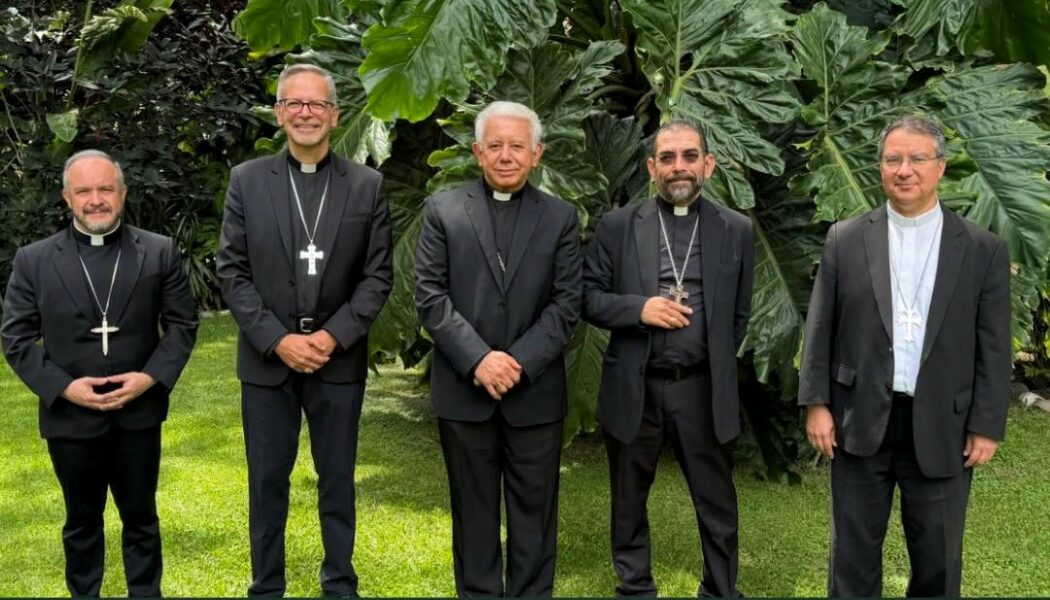
Cuernavaca did not celebrate on Sunday, August 30, 2026, just another ordinary-time Eucharist. In the diocesan cathedral, Bishop Ramón Castro Castro, president of the Mexican Episcopal Conference, inaugurated the first meeting of the Catholic Churches of Mexico, the United States, and Canada gathered around their episcopal conferences. The host himself stated it without ambiguity: it is the first gathering of this kind in our history, an unprecedented event.
The presbyterate brought together pastors from three countries. Castro Castro presided over the celebration and greeted his brothers from the Canadian and United States conferences, among them Archbishop Paul Stagg Coakley and Bishop Pierre Goudreault, along with other monsignors and priests who work in those structures; the vice-president of the USCCB, Daniel Flores, Bishop of Brownsville, Texas; Óscar Cantú, Bishop of San José and president of the subcommittee on Hispanic-Latino affairs of the U.S. conference, also concelebrated.
The day’s Gospel provided the framework. Castro, in his homily, began with a simple and demanding question: there is a phrase that can in some way sum up the whole Christian life. That phrase is: “If any want to become my followers, let them deny themselves and take up their cross and follow me.” The previous week, Peter had recognized Jesus as the Messiah and had received the primacy. This Sunday another Peter appeared: the one who resists when the Lord speaks of Jerusalem, of suffering, of the cross, and of self-giving. He loves Christ, he loves him, but he would prefer a Christ without the cross.
That resistance, the bishop said, is not merely an episode in Peter’s life. It is the permanent temptation of those who follow Jesus by choosing only the comfortable part of the Gospel. One cannot follow him on the easy side. Therefore the Word of this Sunday forces us to become aware of what we are as disciples. Jesus does not ask Peter to show him the way. He asks him to get behind: be a disciple, follow me, walk behind me.
Castro applied that correction to those who hold episcopal responsibilities. Before being leaders, we are disciples. Before having responsibilities, we are men called by the Lord. Before our structures, programs, and projects, stands Jesus Christ. Perhaps that is the deep spirit of the North American Church meeting: to place ourselves once again behind Jesus. Communion, he insisted, does not begin with shared agendas. It begins when pastors place themselves behind Christ.
The historical novelty did not erase the differences. We are three distinct countries. We are three Churches with different histories and realities, yet one same faith, one same baptism, one same Eucharist and mission. Mexico, the United States, and Canada do not come to the table with the same landscape. They come with one single faith and with wounds that already intersect.
The Bishop of Cuernavaca listed the challenges that weigh, in a particular way, on Mexico violence, demagoguery, corruption, loneliness, secularization, individualism, materialism, polarization, wounded families, and young people seeking reasons to hope. The United States and Canada, he added, also face transformations that affect the life of their peoples and the mission of their Churches. We come to meet one another from different realities. Mexico is living complex moments socially, politically, economically, and culturally. The other two nations are not outside that change.
Among so many issues, one emerges as the most common to the three conferences: migration. That is why the meeting included the voice of a specialist from the Mexican Episcopal Conference on the migratory reality that originates in Mexico and affects the United States and Canada. Castro anticipated the criterion that should guide that conversation. Analyses and strategies can be prepared, but the first mission remains the same as Jeremiah’s: to carry within the fire of God.
Human mobility, he said, must not be reduced to statistics, public policies, or economic duties. Behind every migrant there is a face, a story, a family, a hope, and, many times, many wounds. The Church must look at these persons as brothers and sisters whose dignity must be recognized and protected. The Christian tradition recalls that in the poor, in migrants, and in those living in situations of vulnerability, the face of Christ is served in a particular way.
That emphasis took on extra gravity on that date. August 30 is also a day of remembrance for the victims of disappearance. In Mexico that wound remains open, with tens of thousands of families searching. The homily did not turn the Eucharist into a numerical tally, but it did deny that persons in transit or in vulnerability can be treated as a file. Understanding better what peoples are living through is not an intellectual exercise. It is the condition for serving them better.
During the days of work, the pastors would share their perspectives not from judgment or confrontation, but from pastoral responsibility. In that horizon, reflection on human mobility and migratory management among the three countries acquires particular relevance. It will also be significant to read those realities in the light of Magnifica Humanitas, the recent encyclical of Pope Leo XIV on the safeguarding of the human person in the age of artificial intelligence. Dignity, in that key, does not depend on utility, passport, or productivity.
The second movement of the homily descended from the agenda to the inner fire. Jeremiah does not merely encourage better organization of the Church. He encourages a pastoral work born of passion. We do not need only a well-organized Church; we need a Church in love with Christ. The word of the Gospel is needed, but also witness. Pastors concerned with preserving themselves are not needed, but pastors willing, as Jesus says, to lose their life in order to find it. Saint Paul formulates it with another clarity: do not be conformed to this world, but be transformed by the renewal of your mind.
There appears a concrete task for the Churches of the three countries: not to let ourselves be separated by borders when the Gospel calls us to recognize one another as brothers and sisters. There are political borders that are necessary. Castro did not deny them. He added, however, the corrective that gives meaning to the entire summit: Christian charity has no foreigners. The immigrant, the poor, the indigenous, the young, wounded families, victims of violence, and all those who have lost hope or faith are our brothers and sisters and belong to the heart of the Church.
The bishop asked that the meeting not remain an exchange of ideas. He wanted a meeting of brothers and pastors: to listen to one another, to learn from one another, to pray together, and to formulate with simplicity a single question: “Lord, what do you want from our Churches at this historic moment?” And he asked for the courage to listen to the answer, even if that answer implies the cross, renunciation, pain.
From Cuernavaca, he said, a simple yet strong sign can be sent to the Churches pilgrim in Canada, the United States, and Mexico. If we can walk together, if it is possible, it is because we have first decided to walk behind Christ. That phrase sums up the deep purpose of the meeting. The novelty does not consist only in seating three episcopal conferences at the same table. It consists in inverting the usual order of ecclesial power: first the following, then the leadership; first discipleship, then statements.
The conclusion of the homily returned the summit to the terrain of ordinary life. We are invited to a more authentic life. We must ask God not for a life without crosses, but for a heart large enough to love when the cross arrives. Approaching the Eucharist, one receives the Body of Christ in order to learn to turn one’s own existence into a gift. The Our Father, “Thy will be done,” is then understood as a path toward a freedom without material or emotional slaveries.
What remains open is not whether the three Churches have common issues. They do, and the most visible is that of those who cross borders carrying hope and wound in their bodies. What remains open is whether this first meeting will be merely a historic gesture or the beginning of a custom: to speak before crisis erupts, to look at the face before the statistic, and not to separate what the Gospel has united. Cuernavaca offered the criterion of verification in a single line. Structures, programs, and projects will come later. First one must place oneself behind Jesus.