


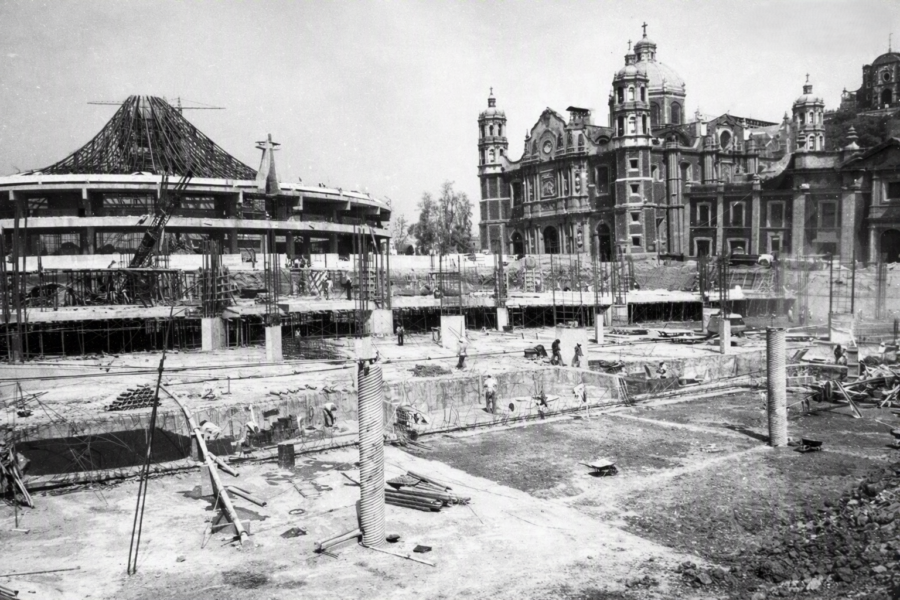
Those who live in or visit the northern part of Mexico City recognize the unmistakable building that dominates the urban landscape, the Basilica of Guadalupe, as new as it is already five decades old, half a century, whose peculiar form holds a profound meaning.
Its construction was marked by vertiginous and critical times, those of authoritarian political hegemony and social movements. The 1970s, on the other hand, were the era of the pax ecclesiae. The pacification, carried out by Archbishop Luis María Martínez and President Lázaro Cárdenas, would lead to the modus vivendi in Church-State relations. In other words, the Law on public worship was in force, but it could be filed away in the archives of history, and for good reason: no one wanted another episode of bloodshed.
Perhaps the most exemplary phenomenon of that modus vivendi was the construction of the Basilica of Guadalupe. There, relationships of power and frank détente were woven, in which the Church lived gratefully in that pax with the presidentialist regime of the time, although, since the six-year term of the first civilian president, Miguel Alemán, that of the so-called “Mexican miracle,” the grounds of the Basilica would see their extension with the creation of Plaza de Las Américas, thanks also to the relations of Archbishop Luis María; however, politicians could be secularists or rabidly anticlerical, but always Guadalupans, and, in addition, the activity of a “political clergy” in the sense of closeness to the relations of power.
One of those clerics was Guillermo Schulenburg, the last secular mitred abbot of the Collegiate Church of Guadalupe, whose later confrontation with the Archbishop of Mexico over the apparitions cost him dearly. However, his role is not minor. On October 12, 1976, under the decisive drive of the abbot, the image of the Virgin of Guadalupe was solemnly transferred from the old baroque collegiate church to the new sanctuary we know today as the Insigne and National Basilica of Our Lady of Guadalupe.
But reaching that point would cost disagreements and peculiar rapprochements. In the end, it was the Guadalupano miracle alone that could raise a new Basilica and gather the millions of pesos, no small matter in that time of economic crises.
Guillermo Schulenburg had been ordained in October 1940. His appointment as abbot was thanks to the distinction of Pope John XXIII in 1963. His Memoirs are a fundamental piece for understanding that prelate who, today, from a distance, is judged in a very simplistic way. His relations with power opened doors like few others. Cardinal Miguel Darío Miranda also saw in Schulenburg the man who would carry out a purpose: Before the end of the decade, and with the implementation of Paul VI’s norms on the resignation of bishops at age 75 looming, the legacy of the third Mexican cardinal should be a new complex worthy of being called the “Sacred Little House of Tepeyac,” but another factor was also at play: the presidential succession of 1976. Luis Echeverría, who had become the first president to set foot on Vatican soil, was not only engaged in frenetic international activity; in Mexico he also undertook the task of maintaining as an ally a sector of the Mexican Episcopate.
October 12, 1976 marked the end of a process of more than a decade of structural alerts, architectural debates, and liturgical decisions that transformed the Tepeyac complex. Fifty years later, the building remains the epicenter of the largest Marian pilgrimage in the world, capable of housing 10,000 people inside and up to 50,000 when the open chapel toward the atrium is opened.
The reasons that drove its construction were urgent and cumulative. Since the 1960s, engineer Manuel González Flores, inventor of the control piles, had warned of the danger of collapse of the old 1709 basilica. The lacustrine soil of the Valley of Mexico, combined with the drop in groundwater levels and the weight of the colonial structures, caused differential settlements: the southern half of the temple settled on mud while the northern half rested on the solid layers of Tepeyac Hill. Added to this was the country’s demographic growth and the explosive increase in pilgrims, especially around December 12. The old basilica, with capacity for barely 2,000 to 3,000 people packed in, proved insufficient and risky.
Guillermo Schulenburg assumed pastoral and administrative leadership of the project. In his Memoirs he recounts how he formed commissions and sought solutions that would preserve worship while resolving the emergency. A provisional measure was the “ephemeral basilica”: a large pink tent of 5,000 square meters that covered the plaza and allowed celebrations for about 8,000 faithful. This temporary solution, driven with the collaboration of Friar Gabriel Chávez de la Mora, served as a bridge while the definitive projects matured.
Before arriving at the current form, significant proposals were discarded. José Luis Benlliure Galán, a prestigious architect and author of the Minor Seminary of Tlalpan commissioned by Schulenburg himself, prepared several preliminary projects that located the new basilica at the summit of Tepeyac Hill. The idea took advantage of the solidity of the rocky subsoil and evoked the tradition of elevated sanctuaries. A commission under Schulenburg’s direction included Gabriel García Lascuráin as coordinator, Benlliure as architectural director, and González Flores for soil calculations. However, the project involved sensitive demolitions: intervening in the cemetery, the Cerrito chapel, and demolishing part of the Capuchin convent, in addition to accessibility problems for large pilgrimages. When Pedro Ramírez Vázquez intervened, he pointed out the inconvenience of building at the top and proposed a radical structural solution that allowed construction in the plaza without demolishing the existing heritage. Schulenburg leaned toward this alternative: “Let’s do it, but you will have to give up the idea of tearing down the old basilica, and I will give up my idea of building a new one on the cemetery grounds.” Thus the collegiate church (the Eucharistic Temple of Christ the King) was saved, and the new temple was located in Plaza de las Américas.
The definitive team brought together Pedro Ramírez Vázquez as director with the collaboration of José Luis Benlliure, Alejandro Schoenhofer (construction supervision), Javier García Lascuráin, and Friar Gabriel Chávez de la Mora (liturgical aspects). Final structural calculations were handled by the firm Colinas y de Buen; acoustics by Eduardo Saad. The contractor was Ingenieros Civiles Asociados (ICA) under the direction of Bernardo Quintana. The cornerstone was laid on December 12, 1974, blessed by Cardinal Miguel Darío Miranda. Construction, which effectively began in early 1975, was accelerated by the political and ecclesiastical reasons already explained.
The technical challenges were formidable. The building, with a circular floor plan of approximately 100–103 meters in diameter, rests on 344 control piles reaching the resistant layers at about 32–40 meters deep. Nearly 50,000 tons of earth were removed to compensate for the estimated 100,000-ton weight of the structure. The most innovative structural solution was the hanging roof supported by a central concrete mast about 42 meters high, from which catenaries extend to the perimeter ring. This “tent” of concrete and oxidized copper sheets minimizes the piloted area and resolves subsidence. Inside, the absence of columns allows total visibility toward the altar and the image. The roof, formed by triangular segments, favors acoustics and ventilation through the upper lantern. Beneath the altar, a conveyor belt allows the continuous flow of pilgrims who contemplate the tilma up close without interrupting the liturgies.
From a theological and symbolic point of view, the tent form was not a modernist whim. In response to criticisms that “it doesn’t look like a church, but a tent or stadium,” Pedro Ramírez Vázquez replied: “What was the first religious space? In what did Moses peregrinate with the Tablets of the Law from one place to another? In a tent.” If religious traditions are considered, the tent has deeper roots than the vault. As Martha Fernández analyzes in her study “The Image of the Cosmic Tent in the Sanctuaries of Tepeyac” (Interpretatio, 2016–2017), the roof refers to the Tabernacle that Yahweh commanded Moses to raise in the desert (Exodus 25–26), a demountable tent symbolizing God’s presence in transit. It also evokes the biblical image of the sky as a tent: “He stretches out the heavens like a canopy and spreads them out like a tent to dwell in” (Isaiah 40:22). In the Judeo-Christian tradition, the temple is a microcosm: the Holy of Holies represents heaven, the tabernacle the earth, and the atrium the sea. Both the old basilica (conceived as a second Temple of Solomon) and the new one converge in this image of the cosmic tent.
The circular floor plan responds to the demands of the Second Vatican Council: the gathered Christian assembly, the celebrant facing forward, and the active participation of the faithful. Ramírez Vázquez explained that it was adopted “to favor integration between the celebrant, the believers, and the unity of the assembly.” The seven radial chapel-boxes allow simultaneous Masses with a view of the image. The central one is divided: one interior and another open toward the atrium, evoking the open chapels of the 16th-century New Spanish period. A great cross crowns the mast and marks the main altar. Gold and liturgical elements maintain links with the Solomonic tradition and the heavenly Jerusalem. In the atrium, posa chapels were incorporated, and the ensemble visually respects the collegiate church and the Capuchin convent, avoiding overshadowing the historical heritage.
The cost of the work was around 150–200 million pesos of the time, financed largely by donations and the unpaid labor of thousands of bricklayers. Initially there was rejection from the faithful accustomed to the overloaded baroque and traditional crowding. Over time, functionality, comfort, and visibility of the image generated acceptance. Today the building is recognized as one of the fundamental works of 20th-century Mexican architecture, although its importance has been underestimated in some academic circles.
The new Basilica not only resolved a structural and pastoral emergency. It materialized, in contemporary language, a millennial symbolic continuity: the tent that covers the people on pilgrimage, the sky unfolded as a protective mantle, and the place where, according to tradition, the Virgin of Guadalupe appeared to gather a mestizo people. As Schulenburg recounts in his Memoirs, the inauguration of the great Basilica, the cosmic tent, should have counted on the presence of Paul VI. And that invitation was made in September 1976. A commission of the Mexican episcopate composed of Cardinal José Salazar, Archbishop of Guadalajara and president of the Mexican Episcopal Conference; Adolfo Suárez Rivera, Bishop of Tepic and vice-president of the bishops of Mexico; Genaro Alamilla, Bishop of Papantla and secretary general of the organization; Cardinal Miguel Darío Miranda; and the Abbot of Guadalupe, Guillermo Schulenburg, conveyed the greeting of the Catholic people of Mexico to Paul VI, who, for health reasons, did not personally attend the country.
The opening of the new Basilica occurred in two moments: on October 11 with the dedication and consecration of the temple, and on the 12th, the solemn transfer of the image of the Virgin of Guadalupe to the sanctuary, which the abbot defined as a “feat of descent, transfer, and ascent of the sacred icon” entrusted to architect Jorge Campuzano Fernández.
The memory of that celebration and transfer was the culmination of Miguel Darío Miranda’s pontificate as Archbishop of Mexico. He had the personal commission of Paul VI to be papal legate in that Guadalupano apotheosis, and the grand celebration was not entrusted to occasional or improvised masters of ceremonies; the protonotary Orazio Cocchetti himself (1945–2006) was sent by the Pope as apostolic master of ceremonies for Cardinal Miranda and had a direct line to the secretary of the Congregation for Divine Worship and the Discipline of the Sacraments, Antonio Innocenti, who approved ad experimentum the Guadalupano ritual in accordance with the Ordo Dedicationis Ecclesiae of the 1973 Roman Pontifical, adapted by Friar Gabriel Chávez de la Mora and Father Alfredo Ramírez Jasso of the Liturgical Commission of the Archdiocese of Mexico.
After half a century, the commemoration of those events justly recognizes the efforts of the protagonists of that moment. Cardinal Miguel Darío Miranda, in the biography written by the auxiliary bishop of Mexico, Francisco María Aguilera, describes what it meant for the archbishop. Darío Miranda narrates: “In the hours of that afternoon, already at home, I remained as if in ecstasy, giving thanks to the Lord Jesus Christ and His Most Holy Mother, for the ceremony of that day represented for me the culmination of my years as Archbishop of Mexico, custodian, as successor of Friar Juan de Zumárraga, of the most precious pledge that God’s love has granted to the people of Mexico. Before sleeping that night, I took on my lips the canticle of the aged Simeon: Nunc dimittis servum tuum in pace…”
Fifty years later, the ingenious mast continues to hold that cosmic tent over Tepeyac, while millions of pilgrims pass beneath it each year. October 12, 2026 opens a jubilee year that has been read and decreed until 2027 for indulgences and the forgiveness of sins; however, referring us to those years leads to a recognition of those giants who dared to dream and challenge on a grand scale… And to lament for the dwarfs who today want to stand on their shoulders, those who are now the “successors” who, they say, shepherd us.