


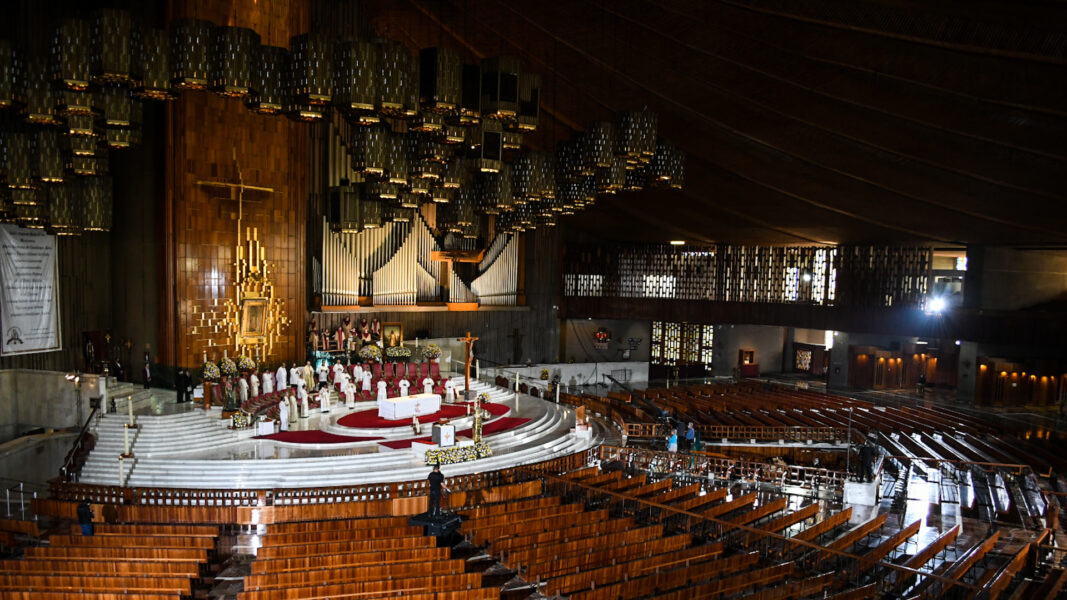
It is impossible to continue claiming, in the face of persistent and accumulating doubts, that the eventual appointment of the next rector at the Basilica of Guadalupe, successor to Canon Efraín Hernández, can be treated as just another routine ecclesiastical matter. Whoever it may be, it constitutes an unavoidable reason to carry out a thorough analysis of the situation facing Mexico’s and America’s principal Marian shrine. The circumstances surrounding the site demand looking beyond names and examining the structures, responsibilities, and pending accounts that have eroded its credibility before the faithful and public opinion.
Unlike what might have occurred with a unilateral appointment by the Archbishop of Mexico, the process appears to be moving toward the proposal of a canon from the Guadalupe chapter itself. This circumstance carries specific weight: the collegiate body would be imposing its own criteria over possible external decisions, thereby reaffirming its role in the sanctuary. This is no minor detail at a time when trust in ecclesial institutions is going through delicate moments.
The Guadalupe chapter, a collegiate body composed of thirteen priests, holds the primary responsibility, in accordance with the apostolic brief Praestatem Pietatem of Saint John Paul II, for maintaining the sanctuary’s cultic, liturgical, and sacramental ministry. In addition, under the coordination of a rector, the canons collegially exercise priestly ministry.
Its organizational lines place it directly under the tutelage of the Archbishop of Mexico. Of the fourteen full members, seven have been appointed by the current archbishop and, according to his provisions, will remain in office for a set period, usually six years. The others were named by the previous archbishop and retain their positions until the retirement age established by canon law or a few years beyond. This composition creates a scenario in which continuity and renewal coexist, but it can also generate tensions that the new rector will have to manage.
The profile required for the position goes beyond administrative management skills. It is important to note that no one oversees the rector, except his immediate superior. The new rector needs a personality capable of uniting the efforts of all the Basilica’s collaborators, from the canons to the lay staff and service groups. At the same time, he must confront without evasion the crisis already in the public eye.
His appointment does not represent a clean slate. Nor can it serve as a smokescreen to claim that everything is fine, that all has been repaired, and that there are no outstanding debts or unanswered questions. The reality is more complex and requires acknowledging that structural problems persist that cannot be resolved with a simple change of name on the organizational chart.
What will be essential is to verify whether the appointee demonstrates real self-sufficiency—that is, that he is not willing to take refuge in “gatopardismo”, changing the forms while preserving the substance to please the Archbishop of Mexico and personally benefit from the open coffers. His leadership must not be aimed at leading vendettas or reprisals that would further divide an already fractured internal environment. On the contrary, always acting in a spirit of authentic collegiality, the new rector has the opportunity—and the obligation— to promote a profound reform of the sanctuary, similar in depth to the one that took place when the era of the mitred abbots ended. That historic reform showed that it is possible to transform entrenched structures when there is clarity of vision and determination.
However, beyond good aspirations and sincere hopes that this appointment marks a turning point, it is necessary to state with rigor that much remains to be answered. No, the crisis is not resolved. One cannot look only at the puppet without directing one’s gaze upward, toward whoever or whoever moves the strings. Those actors still have much to say and to clarify. Because the problem is not limited to an isolated appointment. It concerns the progressive corrosion that has shaped an institutional structure from which a few have benefited—not in the spiritual realm or in generous service to pilgrims, but in the things of this world. As long as that dimension is not addressed with transparency and accountability, any change in the rectorship will remain insufficient to recover the trust that the Church in Mexico expects and deserves in the “Little House” of Our Lady of Guadalupe.