


We begin another day; today we have the funeral of Cardinal Camillo Ruini in St. Peter’s Basilica, presided over by Pope Leo XIV. Afterwards, the coffin will be transferred to the cardinal’s home diocese for a second Mass, presided over by Archbishop Giacomo Morandi in Reggio Emilia Cathedral on Friday. Yesterday’s audience focused on the trip to Spain, which has undoubtedly impressed Leo XIV and also needs to be digested in Rome.
Audience on Wednesday about the trip to Spain.
Heat, intense heat in Rome, yet we continue to see very acceptable attendance figures at the general audience. The children, as usual, were the main protagonists of Leo XIV’s walk through the various sectors. A little girl dressed as an angel, all in white, wings included, made an appeal: “Will you give me a hug?”
Leo XIV interrupted his cycle of catechesis on the Second Vatican Council and focused his attention on his experiences in Spain over the past few days. Last night, when journalists outside Castel Gandolfo asked him about the trip—since he had been unable to do so in the usual return press conference—he wanted to recount this apostolic journey to the faithful gathered there, a journey that was a success and left a deep impression on the Pope. After “the long journey to four African countries,” this time he found himself immersed in a European nation “with an ancient and very rich Catholic tradition.” It is precisely on the relationship between that tradition and a Spain profoundly transformed socially and culturally that the Pope built his entire catechesis. Leo XIV stressed something that, as Bishop of Rome, he said he had not taken for granted: the expectation and warmth with which he was received “by people of all ages and conditions,” both in cathedrals and in stadiums. “This fact was not something to be taken for granted and deserves reflection.” Participation expresses the faith of the Spanish people, but also manifests “the widespread need to find ourselves united on a true and deep foundation, not ideological or biased.” A foundation that only Christ can guarantee and that the Gospel transmits through the necessary “inculturations,” thus responding to two questions that he kept united throughout his address: the search for truth and the thirst for justice. In this context, he placed the proper service of the Successor of Peter: to strengthen the faithful and encourage them to overcome “every form of division and opposition” by cultivating communion, dialogue and “unity in diversity.”
Recalling the settings—the great cathedrals and ultra-modern stadiums, the Rosary at Montserrat Abbey, the celebration at the Sagrada Família, described as a symphony of stone and light—he interpreted that encounter between the ancient and the modern as Europe’s own character: a richness that must not be considered obsolete, but carefully preserved so that it can be invested in the present global context.
He listed the faces he encountered. He acknowledged the need for the “Gospel of hope,” especially “in the faces of the little ones and the poor”: the child who read him a letter in the parish, “some victims of abuse asking to be heard,” the prisoners who awaited him in prison, the young people “full of anxiety and plans,” and the migrants in the first reception centers in the Canary Islands. The archipelago itself, the final stop on the itinerary, offered him, he said, “an integral interpretation”: because of its geographical position and a local Church that welcomes a large number of forced migrants, especially from Africa. He acknowledged that the phenomenon “requires organic and concerted action plans”; the Pope outlined a broader perspective, that of the exchange of gifts between cultures and dialogue “in a spirit of fraternity” as the path toward “the civilization of love.”
At the end of the audience, the Pope welcomed the agreement reached between the Islamic Republic of Iran and the United States of America, which, he announced, will be signed on Friday, the fruit of patient dialogue and negotiation. He expressed gratitude to the mediating countries and voiced hope that the agreement would strengthen mutual trust, security and stability in the Middle East. His second appeal, dedicated to Ukraine, had a different tone, as he received painful news about the escalation of the conflict: innocent victims, rescuers killed, churches and cultural heritage sites devastated by flames. Hence the invitation to pray for an end to the war and for the opening of paths of dialogue toward a just and lasting peace.
Ruini is very much Ruini.
He reaffirmed the duty of Catholics, in their full autonomy, to follow the Church’s teaching in ethical and social decisions. He always tried to make politicians listen and pay attention to the issues important to the Church and to John Paul II in particular, and he did so with great diplomacy, engaging in constructive and open dialogue with Berlusconi and with D’Alema, while openly confronting Romano Prodi, a disciple of the Dossetti school, who never forgave Ruini for having favored the dissolution of Italian political Catholicism by declaring that the experience of the single Catholic party had come to an end.
After his death, the CEI completely lost the prominence that “Don Camillo” had assured it, because those who succeeded him lacked both the charisma and the capacity to lead the Italian bishops and, above all, to influence Italian politics concretely. A single speech by Ruini was enough to tip the balance of the Catholic vote and determine the outcome of elections. For this reason he was “hated” by the secularist and anti-clerical world, by the Repubblica club, but also by left-wing Catholics such as Famiglia Cristiana and Jesus, who often took positions openly contrary to the CEI’s orientation, with the blessing of cardinals and bishops such as Martini, Silvestrini and Bettazzi, openly hostile to him.
A man of unwavering faith to the end, who remained firm and raised his voice against a pope like Bergoglio, whom he considered distant from the doctrinal and pastoral clarity of Wojtyła, ambiguous in his statements and, above all, excessively conditioned by the applause and consensus of the world, beginning with those same radical and secularist circles that had been his bitterest enemies. He suffered, like many Catholics, to see a pope, the successor of Peter, consider other voices more worthy of being heard and receiving more attention than a cardinal like himself, who had given so much to the Church and to whom the Church owed so much.
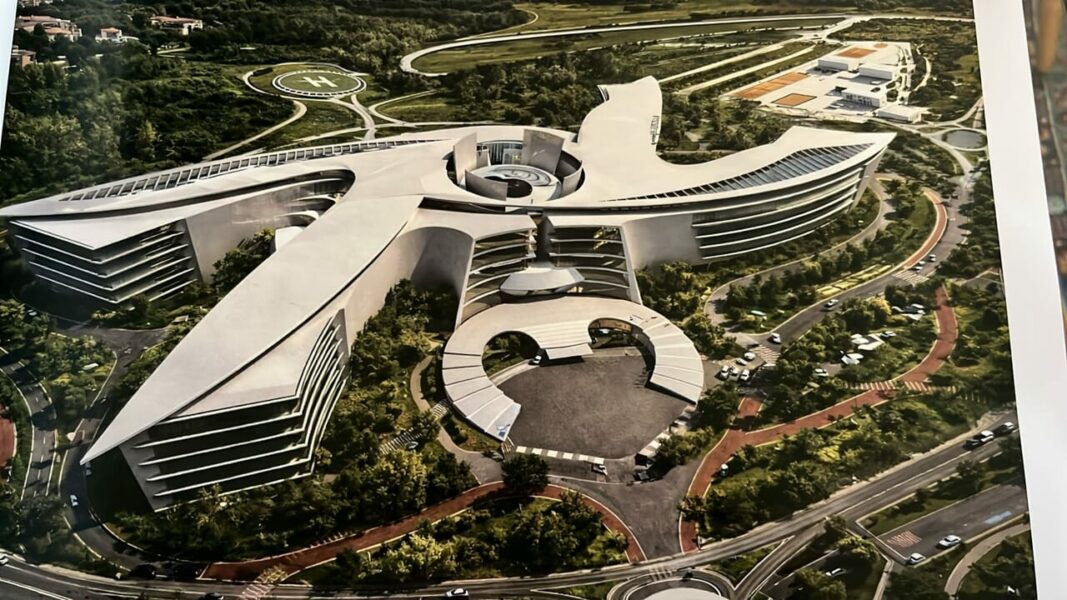
The new Bambino Gesù.
The future of the Bambino Gesù hospital, owned by the Holy See and located in extraterritorial territory, has not yet been finalized. It was taken for granted that everything was already prepared for the purchase of the former Forliani hospital. Today we know that there appears to have been a change of plans and the Holy See is considering building a health center from scratch on its own land inside a park in the capital, instead of buying the former Forlanini hospital. Our image today is the leaked project of the new hospital, which seems to be very advanced and undoubtedly impressive. The Holy See has chosen to take up the idea put forward in the curia reform studies of a new construction with ample spaces seeking a more contemporary image. The large abandoned pavilions of Monteverde are left aside in the vast complex, closed since 2015.
The schismatic ordinations.
Pope Leo XIV addressed the upcoming ordination of bishops by the Society of St. Pius X, saying on Tuesday in Castel Gandolfo that the Vatican might make a final request to the SSPX to reconsider its episcopal consecrations. The ordinations are scheduled for July 1 at its seminary in Écône, Switzerland, where four priests of the society will be consecrated bishops. “We have invited them, and I am still considering making another appeal, to say to them: ‘Do not do this. Let us try to live in communion in the Church.’ But it is their decision. They must understand what this means for them and for the Church.” The Pope alluded to some reforms and teachings of the Second Vatican Council: “Certainly, division among Christians is always painful. But they refuse to accept certain fundamental elements of the Church, beginning with several points of the Second Vatican Council. And if they make those decisions, I regret it. But we must move forward.”
Communion: Finding My Way Back to Faith.
The first texts of the newly published memoirs Communion: Finding My Way Back to Faith, in which Vance details a tense encounter with the Vatican Secretary of State, Cardinal Pietro Parolin, are causing a stir. The confrontation, which took place in April 2025, revolved around the Trump administration’s hard-line immigration policies. Vance, a convert to Catholicism, writes that he was troubled by the Church’s refusal to endorse a nation’s right to secure its borders, and describes the experience as a turning point in his relationship with the institutional Church. The dispute highlights a deep ideological gap between the current U.S. administration and the Holy See under the pontificate of Pope Francis. The Vatican has consistently defended the rights of immigrants and the moral obligation of wealthy nations to provide them refuge. Vance argues that this stance ignores the practical implications of national security and the rule of law. Vance considered Cardinal Parolin’s emphasis on the “humane treatment” of migrants to be a veiled criticism of the administration’s deportation strategies.
In his memoirs, Vance presents himself as a defender of “authentic” Catholicism, which should prioritize the stability of Christian communities within sovereign borders over globalism. He expresses his frustration that the Church, an institution with “moral authority and a global perspective,” chose diplomacy instead of directly addressing the complexities of the migration crisis. This public airing of internal grievances is highly unusual for a sitting vice president and evidences a growing division within the American Catholic community.
The Catholic Church in the United States is currently one of the most politically polarized institutions in the country. Vance’s comments serve to encourage conservative Catholics who believe the current trajectory of the Vatican is too aligned with progressive internationalism. The implications of this tension extend beyond U.S. borders. The public nature of Vance’s criticisms could complicate future cooperation between the United States and the Vatican on issues such as climate change and poverty. Vance is clearly seeking to appeal to a specific segment of the electorate: religious conservative voters who see the “border crisis” as a moral imperative. The criticisms increase pressure on U.S. bishops, who must find a balance between loyalty to the Pope and the political realities of their faithful.
For Catholics in Africa and other parts of the world, the public dispute between the U.S. vice president and the Vatican generates a mixture of concern and curiosity. In Kenya, where the Catholic Church plays a fundamental role in education, health care and political mediation, the idea of a high-ranking government official publicly rebuking the Vatican is almost unthinkable. Issues of migration and national sovereignty are equally relevant in East Africa. Vance’s memoirs are more than a personal story of faith; they are a manifesto for a new type of religious identity in the United States and are presented as a response to the supposed “weakness” of the Vatican. Vance attempts to redefine what it means to be Catholic in the current political sphere. The book reaches bookstores and the Vatican has not yet issued an official response, maintaining its usual diplomatic silence, which Vance himself has criticized.
“…for your Father knows what you need before you ask him.”
Happy reading.