


Es Tuesday, Pope Leo is in Castel Gandolfo, as is customary, and everything points to him resuming the use of the Apostolic Palace this summer, which was turned into a museum by Pope Francis. It is a good instrument in which all popes, except Francis, have spent long seasons and which is prepared so that normal government activities can be carried out. It is not only a space for rest, but a space that allows the Pope to work in another way. We have seen the Archbishop of Vienna, Josef Grünwidl, strolling through the Sacred Palaces, very well accompanied by a ‘deaconess’ in mourning. We start another impossible day.
The Pope’s rest.
Tuesday has traditionally been a special day in the Pope’s week, dedicated to silence, prayer, and rest, away from the usual activities of Vatican . As is customary, the Pope moves to Castel Gandolfo on Monday night, where he spends the entire Tuesday in a more intimate setting, away from his official duties. His return to the Vatican usually takes place the night of the following day. On this day, official decisions are not usually made nor important appointments published, such as bishop appointments, except in cases of urgency or extraordinary needs. In Rome, there has also long existed the tradition of a day off for priests, although in practice it is not always possible due to pastoral commitments. Rest, in fact, helps us to rethink our thoughts and decisions, fostering greater inner clarity and better choice. A Pontiff is important not only for what he says or does, but also for his ability to stop, pray, and listen. Tuesday in Castel Gandolfo thus becomes a symbol of balance between action and contemplation, between government and silence.
Pope Leo XIV with Specola.
We are not talking about ourselves, for now, everything will come. They tell us that Pope Leo is a man very attentive to what circulates on the networks and that, let’s say, he browses us, frequently. It won’t hurt him and something can help. Today we talk about another Specola, the Vatican one. In the Apostolic Palace audience with the members of the Council of the Vatican Observatory Foundation, the foundation that for decades has supported the work of the Vatican Observatory. He thanked them for their «faithful and generous support» to what he called a «dear institution of the State of the Vatican City at the service of the Holy See and the universal Church.»
He recalled that one hundred thirty-five years ago, his predecessor Leo XIII refounded the Vatican Observatory with a specific objective: to show the world that «the Church and its pastors do not oppose true and solid science, whether human or divine, but welcome it, encourage it, and promote it with the greatest possible dedication». This quote was taken from the document Ut Mysticam of March 14, 1891, which the Pontiff contextualized by explaining how, at that time, science was increasingly presented as a truth rivaling religion, which forced the Church to counter the widespread perception of enmity between faith and reason.
Leo XIV explained that today, both science and religion face a threat «different and perhaps more insidious» than in the past: that of those who deny the very existence of objective truth . The Pope directly linked this cultural drift to the concrete consequences for the protection of creation, denouncing the «irresponsible exploitation of both people and the natural world» and recalling the solemn responsibility toward the planet and its most vulnerable inhabitants. Precisely for this reason, he emphasized, the Church’s adherence to a «rigorous and honest» science remains not only valuable, but essential.
Contemplating the sun, moon, and stars with wonder is a gift offered to every human being without distinction, capable of rekindling both wonder and «a healthy sense of proportion». Contemplating the heavens, he added, invites us to see our own fears and limitations in the light of God’s immensity. The night sky has been described as «a treasure of beauty open to all—rich and poor alike—» and, in a world painfully divided, one of the last sources of truly universal joy. He quotes Benedict XVI: we have filled our skies with artificial light that blinds us to the lights God has placed there, an image—Benedict suggested in his homily of April 7, 2012—particularly appropriate for sin itself.
A son of St. Augustine.
« I am a son of St. Augustine ». Thus Pope Leo XIV presented himself upon being elected from the central Loggia of St. Peter’s Basilica. At the same time, he explained to the cardinals that he chose to call himself Leo « mainly because Pope Leo XIII [1878-1903] , with the historic encyclical Rerum novarum , addressed the social question in the context of the first great industrial revolution; and today the Church offers everyone its heritage of social doctrine to respond to another industrial revolution and advances in artificial intelligence, which pose new challenges for the defense of human dignity, justice, and work » ( Address to the College of Cardinals , 10-5-2025).
The Pope is aware that « there is a growing demand for the Church’s Social Doctrine to which we must respond » ( Address to the members of the Centesimus Annus Pro Pontifice Foundation , 17-6-2025) and for this reason his choice explicitly expresses the desire to relaunch and «update» the corpus of social moral doctrine that has accompanied Catholics throughout the centuries. History, therefore, is not a collection of uncoordinated or randomly juxtaposed events, but has a meaning and a purpose.
The origin of De civitate Dei is apologetic. In the year 410, Rome—the ancient center of the political and administrative power of the empire—was sacked by Alaric’s barbarians (d. 410). While it is true that the Roman Empire had long been in its death throes, the sack of the Eternal City shocked its contemporaries, and pagan circles accused Christians and the spread of the new faith of having weakened the empire and, therefore, of being responsible for what happened. Augustine decided to respond to the accusation, publishing twenty-two books between 412 and 426. In the first ten, he directly demonstrates how the causes of the empire’s decline lay in moral corruption and pagan idolatry: the pursuit of mere earthly glory does not produce a just society. In the remaining twelve, he develops a hermeneutic of history through the juxtaposition of two cities. Shaping the city of men according to the principles of the city of God is the task that Catholics must undertake. Working to build a society on a human scale and according to God’s plan clearly implies allowing the glory of God to prevail over that of man, even in the social sphere.
Vatican II: An event of the past? A moment to forget? Or a compass to guide you?
At the beginning of this year, Pope Leo XIV began to dedicate his Wednesday audiences to the Second Vatican Ecumenical Council. Concluded more than sixty years ago, in 1965, Vatican II is being ignored in two senses: by those who consider it an obsolete assembly, of little relevance in a changing world and Church, and by those who view it negatively as an unpleasant interlude that must be forgotten quickly. It is not difficult to identify among the former the so-called progressives and among the latter the so-called traditionalists.
The Pope is rereading the Council of the documents, not the Council of arbitrary interpretations, which have persisted for decades and have generated division and uncertainty among the faithful. Leo XIV starts over: « not by «rumors» nor by the interpretations that have been given of them, but by rereading their Documents and reflecting on their content ».
To begin to understand it, one must first read the opening speech of St. John XXIII, of October 11, 1962 : «in our times, on the other hand, all Christian teaching must be subjected to a new examination by everyone, with a calm and peaceful spirit, without taking anything away from it, in that careful way of thinking and formulating words that stands out above all in the acts of the Councils of Trent and Vatican I; it is necessary that this same doctrine be examined more broadly and deeply and that minds be more fully imbued and informed by it, as all sincere supporters of Christian, Catholic, and apostolic truth ardently desire; this certain and immutable doctrine, to which faithful assent must be given, must be deepened and exposed according to the demands of our times. Because the deposit of faith, that is, the truths contained in our venerable doctrine, One thing is the proclamation; another, the way in which it is proclaimed, but always in the same sense and with the same meaning. Great importance must be given to this method and, if necessary, applied with patience; that is, the form of exposition must be adopted that best corresponds to the magisterium, whose nature is predominantly pastoral «.
Courage International defends itself.
Courage International defends itself from the allusions in the Synod report published last Tuesday by calling it «calumny and defamation» against this Catholic apostolate and its members. One of the testimonies collected described their negative experience in a Courage group. “I vainly tried to go out with a Catholic woman, but our relationship failed when my family faced a crisis. It was time to be honest with myself, with God, and with others.” Based on these testimonies, the Synod’s working group condemned “the devastating effects of reparative therapies aimed at recovering heterosexuality” as well as the “contradictory” indications of those who advise marriage “with a woman to ‘find peace’.”
“Courage considers this report a calumny and a defamation against the organization and its members. A calumny, because the report misrepresents Courage’s work, which does not participate nor has ever participated in ‘reparative therapy’.” “The working group could have clarified this point simply by contacting Courage’s management. However, instead of doing so, the report presents the experience and opinion of a single person as part of an official document.” Courage recalls that “it has suffered calumnies and defamations before, but generally from secular media. It is a great sadness and a wound for our members that this false and unjust description appears in a Vatican document.”
Courage is a Catholic apostolate that provides support to people with same-sex attraction who seek to live in chastity according to the doctrine of the Catholic Church, and they were received by Pope Leo XIV in the Vatican on February 6, 2026. Courage was founded in the United States by Fr. John F. Harvey, OSFS, at the request of Cardinal Terence Cooke, who was Archbishop of New York for 15 years. The first meeting of a Courage group was held in New York in 1980, and it was this initial group that developed the organization’s five goals: chastity, prayer and dedication, fraternity, support, and good example. Currently, Courage has more than 160 delegations in 15 countries.
Good results from the Vatican Bank?
It’s in the media today, it’s a self-confession without any possibility of minimally hiring the data. They tell us that net profit increased 55% compared to 2024, the first dividend for Pope Leo was 24.3 million euros, and they boast by telling us that the balance sheet was certified after years of turbidity and corruption. It is clear how the outgoing president pretends to tell us how well he has done it and how well he leaves things: «We can continue to improve. But we have come a long way.» After 12 years, he handed over the presidency to his successor, François Pauly, Rothschild Bank brand. He tells us that net profits rose to 51 million euros in 2025, and the dividend—the first that the Commission of Cardinals assigned to Pope Leo XIV for works of religion and charity—amounts to 24.3 million euros (a 75 percent increase compared to the previous year), with the rest allocated to finance the Institute’s capital needs.
When Frassu assumed the direction of the IOR, profits were higher (over 80 million euros), but they came from management within the gray area of international finance, «or rather, close to the black line,» a fact for which the Vatican was considered a tax haven, as he himself declared to the French Catholic weekly Le Pelerin.
Between 2004 and 2014, the IOR was presumably «looted» of nearly 150 million euros between dishonesty or incompetence on the part of those responsible at the time. Frassu tells it: «I would say both. The former bank president (Angelo Caloia) was found guilty of embezzlement to the detriment of the IOR in a real estate transaction. The former general director and his deputy (Paolo Cipriani and Massimo Tulli) were also convicted.» «In light of the financial abuses» suffered before 2013, the Institute has recovered «significant sums from third parties» and «continues to undertake related actions to obtain justice in other proceedings.» «One day, Pope Francis emphasized that there are two types of corruption: financial corruption, but also intellectual corruption, when crimes are committed not to obtain money, but power. Often it was power that attracted the convicted Vatican employees.»
Frassu stated that he never expected to find «such a lack of professionalism, such contempt for rules, and such thirst for power among so many people» in the Vatican when he assumed the presidency, but he never considered resigning. «Out of loyalty to Pope Francis, we were called to solve the problems.» «When I arrived in 2014, we decided to stop granting loans, as the IOR had extensively done to Catholic organizations that never repaid them. They considered them donations. In March 2019, the Secretariat of State asked us for a 150 million euro loan, without providing any details. We said: «You are the State, so we are willing to lend you this amount, as long as you are completely transparent.» For three months, we requested the documents, without success. We rejected the loan. Chaos ensued. I was summoned to the Secretariat of State. «On what basis do you reject it?», they asked. I replied: «Based on international financial standards.» We obtained the documents. We immediately realized that an illegal act had been committed. We notified the Pope. He reacted immediately. He took a firm stance.» Frassu speaks of Francis: «He was a great prophet. And he will be recognized as such, I am convinced of it from the bottom of my heart. I had some difficult moments with him… But many saints have been recognized as authentic troublemakers».
The corruption of minors.
We have always called it that and it is what it is. A case, among many, in Canada, it is very complicated to find these news about the explicit sexual content to which schoolchildren are habitually exposed as part of the school curriculum. A group of students from Campbell Collegiate in Saskatchewan recently saw a particularly offensive performance at the Globe Theatre in Regina. At one point, the play, titled «The Little Red Warrior and His Lawyer,» included a drag queen dancing on a pole. The show included, as it described the National Post , “a drag queen performing a swaying, provocative version of Queen Elizabeth II with a corset under the bust.” The show was so disgusting that the teachers decided, in a surprising display of discretion, to leave the May 6 performance with their students. Another fragment shows the drag queen doing a handstand supported on a pole and spreading her legs wide while shouting lustfully: «Oh, you make me want to split like Danielle Smith!». In that shot, the guests can be seen leaving the theater; in the video, they are described as ninth-grade students.
The Regina school sent a letter to parents to explain what happened. «Today’s play fit the curriculum, as it was a satirical farce with touches of romantic comedy.» «The material provided by the theater indicated that the play was rated for ages 14 and up due to its mature content. As the play progressed, the production reached levels that exceeded expectations, and we decided to withdraw early, based on our professional judgment.» What they did not explain is why they considered it important to take the students to a risqué courtroom romantic comedy with themes announced as «for adults,» although they did tell CTV that «we have contacted the Globe Theatre about this discrepancy in the rating and our concerns, and we hope to continue our positive working relationship.»
The Globe Theatre, for its part, told the press that the «subversive» play actually contained important messages about «landback politics» and condemned the «gross inaccuracies» about the show and the «hate and online rhetoric» directed against an artist (presumably the drag queen). The theater insists that criticizing the obscenity on stage has its roots in transphobia and homophobia, and that they have zero tolerance for it.
This is not the first time that Regina schools appear in the media for exposing students to sexually inappropriate material. Last year they received a visit from a supposedly pregnant man to give a talk. In 2023 Planned Parenthood was suspended from giving presentations in Saskatchewan schools after the content of the «ABC sex cards» they distributed to ninth-grade students was revealed. The cards incited the consumption of pornography, urinating and defecating on a partner, and a wide range of other perverse sexual practices.
About pissed-off priests.
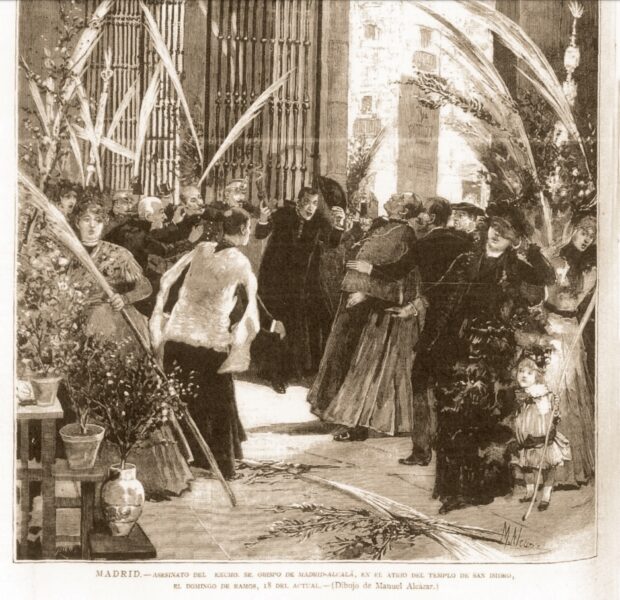
A diocesan priest was formally reprimanded after publicly urging Cardinal Grzegorz Ryś, the controversial Archbishop of Krakow, to resign due to the cardinal’s links to LGBT collective initiatives and his heterodox pastoral stances. Without reaching, for now, the famous Galeote crime that cost the life of Madrid’s first bishop, magnificently recounted by Benito Pérez Galdós, it seems that in Poland too there are hot-blooded clerics. On May 1, 2026, the Diocese of Drohiczyn issued a public statement stating that Father Beniamin Sęktas had violated local ecclesiastical norms on the media activity of the clergy and that he was prohibited from publishing similar material in the future. «In relation to the publications of Father Benjamin Sęktas and the inquiries about the reaction of the ecclesiastical authorities, the Drohiczyn Diocesan Curia declares that it is solely the private opinions of the author, which he was not authorized to express».
The controversy arises from Pope Leo XIV’s decision, on November 26, 2025 , to transfer Cardinal Ryś, then Archbishop of Łódź, to Krakow after accepting the resignation of Archbishop Marek Jędraszewski. The appointment drew attention in Poland because Krakow has long been associated with the legacy of Pope John Paul II and is considered one of the country’s most symbolically important dioceses. InFronda , Father Sęktas: «I appeal to Your Eminence to refrain from accepting this position hastily. There is still time until the scheduled date for taking possession. Therefore, I dare to make the following request with a sense of responsibility toward the Church of Christ, whose task is to discern the signs of the times and respond to them».
The Polish priest: «I recall the circumstance that preceded the bishop’s nomination as cardinal in 2023. It was the immoral Mass celebrated, presided over by the bishop during the Youth Arena event on September 13, 2021. It caused such a scandal that the cardinal was forced to publicly apologize to the faithful for the scandal caused during the Mass by performing the consecration without a prior act of penance or the liturgy of the word». «This liturgical abuse, which seems deliberate and planned, did not become a cause for repentance or review of his actions. With this act of contempt for divine worship in his conscience, the bishop assumed the dignity of cardinal».
Ryś participated in the Catholic Women and Men Congress Forum held in Łódź on November 22 and 23, 2025. He described the meeting as linked to organizations that support stances contrary to Catholic morality, including support for homosexual relationships and the ordination of women. The priest also objected to the presence of LGBT activists and an ecumenical prayer led by Tomasz Puchalski of the Reformed Catholic Church of Poland, a community that publicly supports same-sex relationships. «Being one of the highest positions in the Church in Poland, this cardinal continues to provoke scandals among many Catholics. He presents himself as an authority in the public debate, but I dare to say that it is a mask behind which the cynical face of an activist seeking applause from the elites that shape public opinion hides».
Cardinal Grzegorz Ryś , linked to the late Pope Francis, is widely recognized as one of the country’s most progressive bishops and is described as «the man of Pope Francis» in Poland. His elevation to the cardinalate was interpreted as an incentive for efforts to reform the traditionally conservative Polish Church toward a «more synodal» direction: «I don’t want another Church. I simply don’t want it. I can’t imagine another Church than the one Francis taught us».
Catholic? Benedictine schools and drags.
Two “Benedictine Catholic” schools in Minnesota organized the “Drag Show Olympics,” insisting that it did not violate campus policies. Campus Reform reports that the sister institutions Saint John’s University and College of Saint Benedict allowed the campus «Queer Proud Lavender Union of Students» (QPLUS) to hold the event on April 18, announced as a «celebration of pride, performance, and community» and featuring artists like «MOMO,» «Rat Lord,» and «HELLRAZOR.» Photos of the event show a mix of flashy and provocative attire, along with dances that have become a hallmark of drag.
In response, it is stated that they simply defend the «right of students to organize educational events on campus» and justified the «Drag Olympics,» assuring that «they do not violate any campus regulations» and that QPLUS «offers a safe and supportive space for LGBTQ+ students,» to «ensure a joyful, respectful, and educational event in line with our Benedictine values.»
The deterioration of priestly formation.
In a recent interview, the former priest Alberto Ravagnani, known for his social media activity, delved into the reasons that led him to abandon the priesthood after eight years of ministry. His choice is presented not as an abandonment of God, but as an attempt to remain «authentic» in the face of a public image that no longer coincided with his deepest feelings. He places the crisis of the faithful and the Church’s difficulty in responding to the demands of modernity—from gender equality to sexual morality—, emphasizing how religion is no longer «the air we all breathe,» but simply one of the many voices in a secularized society. Even celibacy is relegated to mere ecclesiastical law, an unbearable burden for emotional life.
The priestly question is posed exclusively in terms of «human sustainability» and «authentic choices.» From this perspective, Christian life ceases to be a supernatural experience and is reduced to an ethical-heroic effort, a kind of titanism of the will that inevitably fails when clashing with the modern project of psychological self-realization. The underlying problem does not lie in the priestly role itself, but in the pretense of performing it according to the mentality of the «good boy»: an attitude that narcissistically trusts in one’s own capacity for moral performance. It almost seems as if, during the years of formation, the fact that without the help of Grace, even the Gospel is destined to become an unbearable yoke was overlooked.
The «sustainability» of the priesthood and Christian life cannot depend on the emotional fluctuations of the moment or the psychological success of the individual, but arises solely from participation in divine life. This fracture between the psychological-existential dimension and the ontological-supernatural represents the true breaking point of many contemporary vocational crises. Are we still capable of believing that Grace can truly operate where nature fails?
The Church is analyzed exclusively from the perspective of sociology or anthropology, it ends up being reduced to a «organization of meaning» or an ethical agency, subject to the same dynamics as any other human institution. If the dimension of sacrifice and the gift of the Spirit disappear, what remains is a highly communicative «philosophy of life,» but lacking the regenerative power that only ontological union with the divine can guarantee.
These situations reveal the alarming theological fragility in which seminarians and priests find themselves today. It is a symptom of an educational desert, a direct consequence of episcopal leadership that in many dioceses seems to have lost its way. We are faced with pastors who seem to have abdicated the task of governing the Church according to the Logos , preferring to take refuge in a comfortable sociological horizon. Thus, we end up speaking the language of the world, forgetting theological categories, the only ones capable of showing the flock a true path of transfiguration.
There are too many bishops who now act as «liquidators» of the life of faith, more attentive to the applause of powerful figures and secular agendas incompatible with the Gospel. If selection criteria prioritize flexibility over political correctness or bureaucratic monotony at the expense of a solid theological foundation and a human balance tempered by prayer, we cannot be surprised by the results. We need men who know how to distinguish the voice of the Good Shepherd from the clamor of the century. These crises are those of a system of government that has stopped nourishing its members with the bread of Truth.
«…the prince of this world is already judged.»
Good reading.