


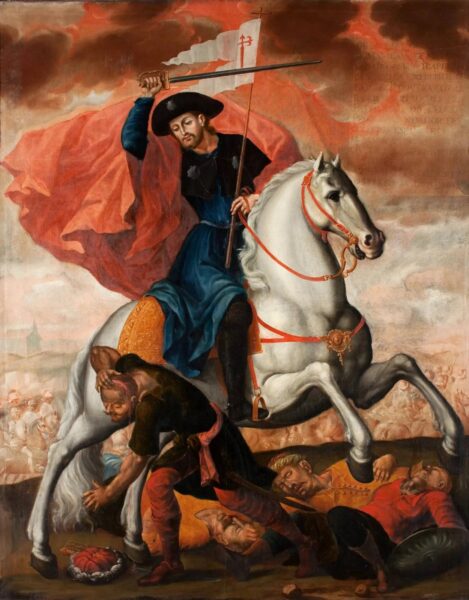
Saint Adalid, patron of the Spains,
friend of the Lord:
defend your beloved disciples,
protect your nation.
The victorious arms of the Christian
we come to temper
in the sacred and burning fire
of your devout altar.
Firm and secure like that column
which the Mother of Jesus entrusted to you;
the Holy Christian faith shall be in Spain,
a heavenly good that you bequeathed to us.
Glory to Saint James,
illustrious patron!
Grateful, your children
bless you today.
Prostrate at your feet, we offer you
the most heartfelt pledge of our love.
Defend your beloved disciples,
protect your nation.
It is the feast of the Apostle James, patron of the Spains and friend of the Lord. Widely celebrated throughout the world, and especially in Spain and the peoples evangelized by Spanish missionaries. We joyfully join all of them and those who continually walk as pilgrims to venerate his relics in the Field of Stars.
Another schism today.
After the schism of the Lefebvrians, who consecrated four bishops without Vatican approval, today it will be the Transalpine Redemptorists who disobey the Pope. Father Michael Mary will be consecrated bishop by Monsignor Pierre Roy on the Scottish island of Papa Stronsay. The co-consecrators will be Monsignor Rodrigo Ribeiro da Silva and Monsignor Fernando Altamira. The new bishop, Father Mary, aged 72, on the eve of his consecration, harshly criticizes the Second Vatican Council and emphasizes that “the central elements of our faith are the Latin Mass, the catechism, and the traditional life of the sacraments and devotions. Our true religion has remained unchanged in its principles from the time of Our Lord until the Second Vatican Council. But the new religion represents a drastic change and is hostile to the true religion.”
The synodal Pope Leo.
A new report published this week by National Catholic Reporter (NCR), which includes interviews with members of the Diocese of Chiclayo, Peru, sheds new light on how then-Bishop Robert Prevost, the future Pope Leo XIV, implemented synodality and encouraged women to assume leadership roles during his tenure as bishop. The July 21 report recounted that, upon arriving in Chiclayo in 2014, first as apostolic administrator of the diocese, seven years before Pope Francis’s Vatican inaugurated the Synod on Synodality, Prevost sought to heal a deeply divided diocese by creating a “diocesan pastoral animation team” that would later be known by its Spanish acronym, EDAP. This group, later described as a “synodal laboratory,” was composed of priests, religious, and laity who traveled throughout the diocese to listen to the needs of each parish, with special emphasis on the perspective of the laity.
“At that time, Monsignor Robert (Prevost) spoke of the ‘co-responsibility of the laity.’” Prevost used to say: “The priests are busy with their tasks; bring in more laity, because the laity are the ones who can best reach the laity.” Father Elmer Uchofen, a priest who helped lead the diocese’s synodal process, highlighted that Bishop Prevost often spoke and focused on “encounter” and “listening” to the faithful. “His way of being was of great help, because he was a bishop who knew how to listen and be patient. He sat with the groups and listened to the people, to everyone: priests, laity, those who had drifted away a bit or distanced themselves from the Church. In that sense, he was a true shepherd.”
On the eve of his seventieth birthday, Archbishop Georg Gänswein recalls the years he shared with Joseph Ratzinger, his service in the Pontifical Household, and his current diplomatic mission in the Baltic countries. He recounts his personal relationship with Benedict XVI, his encounters with Donald Trump and Vladimir Putin, the latent tensions on Europe’s northeastern border, and the expectations generated by the pontificate of Leo XIV. “If only for its duration, I would say the time I spent in Rome. I remained there for 28 years, beginning with my service in the Curia as personal secretary to Cardinal Prefect Ratzinger. Later, I continued as his personal secretary when he became Pope Benedict XVI and even after his resignation, as pope emeritus. In Rome, I also served as Prefect of the Pontifical Household. Those 28 years marked me, without a doubt. They were also the most intense and dynamic years of my life.”
He accompanied the Pope Emeritus until his death. What kind of relationship did they maintain? “It is a relationship that has developed over many years. Initially, it was purely professional, when I was secretary to the prefect. Then it became much closer when I became the Pope’s secretary. We not only worked together, but lived under the same roof and spent the entire day together, from morning to night. Each in his own way and with his own tasks, of course, but all of that leaves its mark. In the ten years since his resignation, our closeness and our relationship have grown even stronger. The personal dimension has become increasingly profound.”
“Before meeting him personally, I had practically studied everything the theologian Ratzinger had written. That was, so to speak, my first encounter with him, because I was familiar with his theological positions, his work, and his orientation. I knew his theological thought. The personal encounter enormously deepened and broadened this understanding. It was his person that left the deepest impression on me. But I also consciously chose to allow myself to be shaped by him.”
“As the Pope’s secretary, I had already attended a kind of preparatory school, so to speak. In that position, I had naturally already had indirect contact with those figures. However, as Prefect of the Pontifical Household, my task was to receive them officially on behalf of the Pope. At first, all of that intimidated me a little. Over time, I became more and more involved in the role and found a way to cope with it internally. I simply tried to be myself, naturally and normally. And, in retrospect, I think I can say that, over the years, it has worked out quite well for me.
“I think, for example, of Trump during his first term, or even of Putin. Putin came twice. The first time he met with Pope Benedict XVI, and I was there as his personal secretary. The second time, I was Prefect of the Pontifical Household. Trump and Putin are two personalities who left me very different impressions. Seeing a person on screen is one thing. Having them face to face, looking them in the eyes and speaking with them is completely different. At that moment, one wonders: does this correspond to the image I had in mind? In Trump’s case, my image was not confirmed. On that occasion, he seemed to me a very courteous person with a great sense of humor. With Putin, on the other hand, I felt as if I were looking into the eyes of a refrigerator. A cold gaze that made a strong impression on me and frightened me. These were the experiences that marked me most during my service as prefect.”
“The Holy See has maintained diplomatic relations with the three Baltic states for more than a hundred years. And although these countries are small, the presence of the Catholic Church plays an important role. Also because they are on the northeastern flank of Europe, at the heart of this conflict, or at least on its border. It is a reality that I witness daily. It shapes the mentality of the people and subjects them to intense pressure. In Lithuania, the Catholic population represents approximately 80 percent. Latvia, with its three million inhabitants, has more than two million Catholics. Estonia has a million inhabitants and only between eight and nine thousand Catholics. However, the presence of the Church is felt beyond religious borders. The Holy See is the symbol of a universal Church. This is its great advantage, its great strength. Moreover, the Holy See and the Pope provide a great impetus. Even through diplomacy, much more is achieved, away from the media spotlight, than could be done publicly. Now I can confirm this personally, as I am one of the collaborators involved in this field.”
Diplomatic activity with the new Pontiff. “The Pope does not determine diplomacy by himself. The new Pontiff arrives in a context in which diplomatic relations already existed—with the Baltic countries. However, I perceive that the personality of Leo XIII has brought a new sense of relief and dynamism. It is not yet possible to predict to what extent this dynamic will translate into concrete initiatives and results. Peace is the key word. From his first speech, Pope Leo XIII placed the peace of the Risen Christ at the center. It is the magic word that has ignited the hearts of the Baltic peoples, regardless of their religious confession. And this magic word is associated with the face of Leo XIV. He has turned an adverse wind into a favorable one. It is impossible to predict whether the wind will change direction again.
The vocational crisis.
Two articles today are related to the growing crisis of vocations in religious and priestly life. The vocational crisis is leading many religious institutes to seek outside the strength they no longer find within themselves. Thus, alliances with the laity are growing, who become involved according to very diverse formulas, limitations, and degrees of belonging. Some experiences produce genuine results. Others end up creating an ambiguous zone, where the boundaries between consecrated life and lay life are weakened, often with painful consequences for both parties. The relationship between religious orders and the lay faithful has been part of the Church’s history for centuries. Tertiaries, secular oblates, and confraternities have allowed men and women living in the world to be nourished by the spirituality of a religious family. Today, however, this bond has changed sign and is something much more forced by the extinction of many orders and congregations that lead to desperate formulas to save what can be saved.
The reduced seminaries have become strange places and attract individuals who are, at best, incompetent. Can your superior tell you with whom you should associate? Can he decide with whom you can make friends and from whom you should keep your distance? This question often circulates in a low voice through the corridors of seminaries, the halls of monasteries, and during recreation in religious houses. Those who ask it already fear the answer, because they know that certain relationships are frowned upon, commented on, and censored. Therefore, it is necessary to turn to Dom Dysmas de Lassus, prior of the Grande Chartreuse and minister general of the Carthusian Order, one of the most authoritative and lucid observers of the internal dynamics of monastic life. In his book “Crushing the Soul: Risks and Derailment of Religious Life,” de Lassus rigorously reconstructs the mechanisms by which religious authority can be distorted to the point of dominating, controlling, and subjugating consciences. With de Lassus, all ambiguity disappears: the superior has no right to dictate the friendships of those under his care. When he attempts to choose, limit, or break those relationships, he incurs an abuse that the prior of the Grande Chartreuse attributes without hesitation to the dynamics of sectarian tendencies.
Weekly chronicle of abuse cases.
These are days of great expectation in the Vatican for the trial of the artist and former Jesuit Marko Rupnik, who awaits trial for abuse before an ecclesiastical criminal tribunal established by the Dicastery for the Doctrine of the Faith. Some rumors claim that sexual assault has been ruled out, but a communiqué from the Holy See categorically denies this. The French newspaper La Croix suggests that the trial is nearing its conclusion and that the verdict is imminent, undoubtedly before the end of summer and especially before Pope Leo XIV’s apostolic visit to Lourdes, scheduled for September 27. In Lourdes, it should be recalled, Bishop Jean-Marc Micas ordered that some of Rupnik’s mosaics decorating the portal of the Basilica be partially covered.
Hamish Tait was arrested a year ago by Sydney police for child sexual abuse. His identity was made public in recent days to encourage the families of his victims to file more complaints. Over 16 years, Tait worked in several daycare centers and sexually abused at least 136 children; he is accused of at least 329 sexual offenses. The police have reported that they have contacted 121 affected families, while another 22 are being identified.
A 28-year-old scout leader has been charged by the Besançon prosecutor’s office, France, with sexually abusing three girls under the age of 14 during a summer scout camp in Doubs. The judges ordered that the young man, who confessed to the crime, be placed under judicial supervision and prohibited from having contact with minors. It was one of the girls, aged 11, who revealed to her parents the abuses she had suffered.
A priest from the Swiss canton of Vaud will be tried on charges of child abuse. The abuses occurred in two parishes in the canton. The priest was reported two years ago by the father of a fourteen-year-old girl, who suffered at least seven abuses between 2023 and 2024. The priest had already been the subject of complaints and controversies in Switzerland and France, including a complaint filed with the police by the dioceses of Lausanne, Geneva, and Fribourg in 2019. The criminal proceedings were archived in 2020.
The Archdiocese of Mexico City announced that one of its priests has been arrested on charges of sexual abuse of a minor. “To date, the archdiocese has not been notified by the competent authority; however, it expresses its full willingness to cooperate, as requested, to contribute to the clarification of the facts and the administration of justice.
Ricardo Yesquén Paiva, a 59-year-old Peruvian priest, died in Ferreñafe. In 2020, a victim reported to Prevost, then bishop of Chiclayo, having been abused by the diocesan priest; two years later, two other people, both minors at the time, approached Prevost for the same reason. This complex matter generated controversy during the conclave that ended with Prevost’s election as pope.
Revolt of Munich priests: Marx backs down.
Twenty-six priests of the German Archdiocese of Munich and Freising have written to Cardinal Reinhard Marx, telling him that his request that they follow the national guidelines on blessings has created a conflict of loyalty for them, because the Vatican has criticized those guidelines. The newspaper Die Tagespostreported on July 23 a May letter in which the priests requested a dialogue with the cardinal on whether they owed obedience to him as their archbishop or to “the general doctrine and moral teaching of the universal Church” regarding the blessing of couples in irregular situations, including same-sex couples.
Marx responded to the letter by proposing that the national guidelines be implemented in the Archdiocese of Munich and Freising during a one-year pilot period. The cardinal emphasized that the guidelines should not be understood as a canonically binding order and added that he would invite the priests to discuss the matter once the trial period had elapsed. The national guide of the German Church has been surrounded by controversy since it was first made public on April 23, 2025, two days after the death of Pope Francis. The document’s supporters dismissed accusations that its publication coincided with the papal interregnum, noting that it was approved on April 4, 2025.
The document was presented in an official press release as a recommendation of the Joint Conference “for diocesan bishops to proceed according to the guidelines,” rather than as a binding text. These guidelines were published in response to a resolution adopted in 2023 by participants in the Synodal Way, a multi-year initiative bringing together selected bishops and laity to discuss far-reaching changes in Church doctrine and structures. The 2023 resolution, on “blessing ceremonies for couples who love each other,” called for the official introduction of blessing ceremonies in all German parishes.
The national guidelines of the Joint Conference have received a mixed reception among German dioceses. The dioceses of Limburg, Osnabrück, and Aachen published the guidelines in their official bulletins, a step that publicly committed the dioceses to implementing the provisions of the document. But the dioceses of Cologne, Augsburg, Eichstätt, Passau, and Regensburg rejected the document, arguing that it went beyond the provisions of Fiducia supplicans, the Vatican instruction of 2023 on blessings approved by Pope Francis. In September 2025, then-president of the episcopal conference, Bishop Georg Bätzing, insisted that the guidelines were drawn up “transparently with the Dicastery for the Doctrine of the Faith,” but Fernández said in October 2025 that his dicastery had not endorsed the document. The Pope said: “The Holy See has made it clear that we do not agree with the formalized blessing of couples, in this case, homosexual couples, as you asked, or couples in irregular situations, beyond what Pope Francis specifically allowed, so to speak, when he said that all people receive blessings.” “When a priest gives a blessing at the end of Mass, when the Pope gives a blessing at the end of a great celebration like the one we had today, they are blessings for all people. The well-known expression of Francis, ‘Tutti, tutti, tutti,’ is an expression of the Church’s belief that everyone is welcome; everyone is invited; everyone is invited to follow Jesus, and everyone is invited to seek conversion in their lives.” “To go further today, I think this issue can cause more disunity than unity, and that we should seek ways to build our unity on the basis of Jesus Christ and his teachings.”
The German episcopal conference and Marx declined to comment on the pope’s statements. The Vatican published a letter criticizing a draft of the national guide that the dicastery sent to the German bishops in November 2024.
We already know that this type of rebellion provokes reprisals; priests depend entirely on their bishops, and the latter do not like to be put on the spot. It is an act of courage that of the 26 priests who sent their May 12 letter to Marx, only two are retired; the rest were still in active service. In 2023, the Archdiocese of Munich had more than 900 priests. The priests stated in the letter that Marx was asking them to implement a synodal resolution that lacked binding legal force. They further argued that the national guide contradicted the doctrine of Fiducia supplicans, since the Vatican document only allowed spontaneous blessings of a few seconds’ duration, rather than blessings with detailed liturgical considerations, as described in the German guide. “How do you explain this evident contradiction?” “Why are we being asked to act against the wishes repeatedly expressed by the Holy Father?” They added that their concern was that “among us priests, and consequently inevitably among the faithful, significant misunderstandings will arise that will lead to division.” “For the love of the Church, we cannot reconcile this with our conscience. We thank you for your clarifications, assure you of our prayers, and send you our cordial greetings.” If the priests were not satisfied with Marx’s response, they would consider the possibility of submitting a request for clarification to Rome.
From Masonic temple to Catholic shrine.
A true example of what must be done, of what the path is and not the opposite. The College of St. Joseph the Worker in Steubenville, Ohio, announced that it will purchase the city’s historic Masonic temple and transform it into a Catholic shrine and public space. According to a statement from the college, at the end of this year, in November, “the Masons of Steubenville will celebrate their last event in the temple they have occupied for nearly a century and then move out. When they do, the College of St. Joseph the Worker will purchase the building, exorcise it, and return it to the city ‘as a shrine, table, and athenaeum.’ A shrine that will house first-class relics and a replica of the Shroud of Turin, and the Café Pope Clement will become the first upscale restaurant in downtown Steubenville. Rector Jacob Imam: “Our students will restore this building with their own hands… This is not a fundraising strategy; it is part of the curriculum.”
The College of St. Joseph the Worker opened its doors to its first students in the fall of 2024 in downtown Steubenville, welcoming a first class of 31 students from 21 states. The following year, it already had a total of 63 students enrolled, as it continued to grow. Founded by Imam, the institution was created to address what its leaders consider a separation between intellectual formation and practical work. “We are trying to unmask the supposed separation between mind and hands. We have told people that manual trades are no longer worthy… forgetting that Christ himself—God himself!—spent most of his life in a workshop.”
Born into a Muslim family, Imam embarked on a path of conversion, first to Protestant Christianity and later entered into full communion with the Catholic Church under the guidance of his godfather, Walter Hooper, who happened to be C.S. Lewis’s personal secretary. The students pursue a Bachelor of Catholic Studies while training in one of four specialized trades: carpentry, HVAC, plumbing, or electrical. The curriculum integrates a foundation of Church history and Sacred Scripture with practical workshop courses, lectio courses (close reading) and disputatio courses (seminar discussion) inspired by the methods of the medieval universities of Christendom. The goal is to form graduates capable of sanctifying family life, the workplace, and the temporal order in general, and to graduate without overwhelming debt.
The college’s website also features testimonials from personalities such as Cardinal Raymond Burke, Dr. Scott Hahn, and Matt Fradd. Hahn, a professor at the nearby Franciscan University, writes that “the university’s intention to form people who integrate mind, heart, and hands—following the example of Christ’s incarnation—fills me with hope for the future of the Church.” The purchase, exorcism, and transformation of the Masonic Temple “is too exciting an opportunity to keep to ourselves, and too great an effort to undertake alone,” said Imam in an explanatory video. “That is why we ask you to collaborate with us. Let us transform the Temple of the Freemasons into a shrine in honor of Our Risen Lord.”