


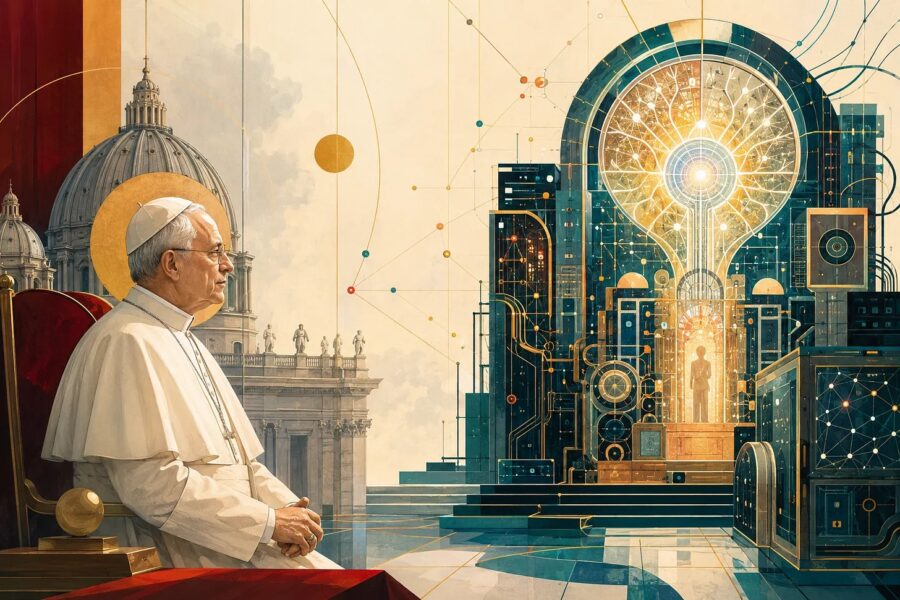
Today is a very special day centered on the first encyclical of Pope Leo XIV: Magnifica Humanitas. Almost all the news focuses on certain aspects of the document with analyses that are necessarily premature. The first impression is that it is almost eternal and difficult to read; some media colleagues commented yesterday that reading it is a true penance. The impact in the media is very limited, with references to its release and some comments on rather secondary aspects of its content. On the central theme—artificial intelligence—there is rather little or almost nothing; we will try to highlight some aspects that we find interesting about the encyclical, while the rest of the information is very repetitive.
The digital revolution is interpreted within the Christian philosophy of history: history is the place of coexistence and conflict between two ways of life, which build two opposing cultures (the Augustinian duae civitas), and every man and every society is called to choose which side to be on. Will it be pastorally useful or too difficult? But above all, a “vision” is expected in the first encyclical: what vision does this Pope have for the Church? What is his program? It should be remembered that the first encyclical of a pontiff is not always the programmatic one: Lumen Fidei by Francis was written by Benedict XVI, but the real program was Evangelii Gaudium . Dilexi te (October 2025) was also a text by Francis completed by Leo XIII. Magnifica Humanitas is, on the other hand, in terms of date and architecture, a program.
The spectacle of the presentation.
The Vatican wanted Pope Leo XIV’s first encyclical to be a media «event.» On the long table hung a screen showing videos of popes who defended the Church’s social doctrine, beginning with Leo XIII, and images of extreme scenes of war and poverty. On his table, the Pope could see himself on a small screen giving speeches or embracing the faithful during his recent trip to Africa. An unprecedented spectacle for the publication of a papal document : halfway between a conference and the launch of a new invention.
Magnifica Humanitas and Rerum Novarum.
The day the document was signed, May 15, recalls the date of the encyclical Rerum Novarum promulgated by Leo XIII in 1891, a foundational document of the Church’s Social Doctrine. The message is clear: just as in Rerum Novarum Leo XIII addressed the social question at the end of the 19th century, in the context of the first great industrial revolution, today Leo XIV feels the urgency to address the social question once again because another revolution is underway, that of artificial intelligence. Since May 2025, Leo XIV has spoken about AI on numerous occasions, and already in his first address to the College of Cardinals he had linked the choice of his name to this theme. The novelty of the encyclical lies in the fact that it organically connects the question of AI with the Church’s Social Doctrine. AI and its applications constitute the res novae that must be read in the light of the history of Social Doctrine (ch. 1) and its principles (ch. 2), but they are also what puts Social Doctrine itself to the test. Paragraph 17 states that artificial intelligence «must be understood not as a thematic appendix, nor as an emergency to be managed, but as a transformation that questions the categories of social doctrine from within and demands its further development.»
The human and the inhuman.
In reality, therefore, it is incorrect to call it an encyclical on AI . The subtitle clarifies the theme: «The safeguarding of humanity in the context of AI». Magnifica Humanitas seeks to establish the framework for Catholic discourse on AI. In a way, the approach is the same that Pope Francis used with the ecological question: the ecological crisis is not only a problem of pollution or a problem in itself, but one of the serious manifestations of a general crisis of humanity, which presents itself in different forms and requires an integral ecology. Even the debate on AI goes back to the crisis of humanity and is seen as a factor that accelerates both good and evil. If in the abstract technology is neutral, in practice «it is not neutral, because it takes on the face of those who conceive, finance, regulate, and use it» (MH 9).
AI must be «disarmed» (now a key term of the pontificate), preventing it from dominating humans: «This means removing it from monopolies, making it debatable, disputable, and therefore habitable, reintegrating it into the plurality of cultures and human ways of life» (MH 110). The guiding image of the document is that of construction, that is, a fully human activity that has a plan and employs many people: «Let us not be afraid to get our hands dirty in the work of our time» (MH 16); «I encourage everyone, especially the lay faithful, not to be afraid to let themselves be challenged by reality, to listen to one another, and to firmly assume their own responsibility in building a more human and fraternal society» (MH 91).
Between the Bible and Saint Augustine.
Both drawn from the Old Testament: the Tower of Babel (Gen 11:1-9) and the rebuilding of the walls of Jerusalem under Nehemiah (Neh 2:6). The first is a project of imperialist, uniformizing, and dehumanizing domination. The second is a work of craftsmanship and shared responsibility: Jerusalem lies in ruins and the people who returned from exile set to work to rebuild its walls, under the guidance of Governor Nehemiah, who assigned each family a section of the wall.
There are not many citations of Augustine in the encyclical. In the introduction (MH 11) on the restless heart, at the end of the third chapter, that is, roughly in the middle of the text (MH 130), in the fifth chapter on peace (MH 215) and in the conclusion, on the Eucharist (MH 234). The most important citation is the central one, quoting a famous phrase from Book XIV of De civitate Dei : «Two loves made two cities: the earthly city, from love of self even to contempt for God; the heavenly city, from love of God even to contempt for self.»
A Church under construction by Leo XIV.
What vision of the Church does Leo XIV propose? The first impression is that it is a Church «a work in construction of humanity.» Pope Francis saw the Church as a «field hospital,» a Church «on the move,» committed to proclaiming the Gospel; Leo sees and desires a Church present and active in the work of building the world: Christians who work together with all those who build a human world and who fight against dehumanization. Citing Paul VI, Leo invokes the project of a “civilization of love”: «The work seems already underway, especially thanks to many living stones firmly united to Christ, the cornerstone (cf. 1 Pet 2:4-6).
The reformulation of the classical principles of Social Doctrine in the second chapter—the common good, the universal destination of goods, subsidiarity, solidarity, social justice (although human dignity is not listed among the principles, it is the foundation of all)—serves as a compass for evaluating and governing technological developments and their applications, which are transforming the world in which we live. At the end of the chapter (MH 86-89), the encyclical turns to subsidiarity as a «criterion of governance and pastoral life,» the participation of the baptized «through real, not nominal, bodies of participation,» transparency, accountability, «regular forms of evaluation of the exercise of ministerial responsibilities,» listening to victims of «spiritual, economic, institutional, sexual, abuse of power, and abuse of conscience.» Leo XIV clearly rejects any interpretation of his pontificate as a departure from synodality: paragraph 89 is closely linked to the synodal path.
Who is Nehemiah for Leo XIV?
He is someone who «does not impose solutions from above. He calls the families together, entrusts each with a section of the wall to rebuild, listens to their fears, coordinates efforts, and faces opposition» (MH 8). He is a leader in the sense of someone who knows how to empower the entire people. He is not a nationalist, but the protector of a weak and defenseless people. “In him I see a luminous parable of our vocation to be, in the era of digital transformation, not resigned spectators of social and cultural fractures, not mere commentators on the ruins, but women and men who enter into the works of history—research laboratories, technology companies, schools, media, institutions, local communities—to raise what has collapsed and protect what is exposed” (MH 241). Pope Leo repeated this reading of Nehemiah in his speech during the presentation, almost as if to reiterate his desire to recover a biblical figure and protect it from inappropriate interpretations.
Leo XIV and Anthropic.
Why did Leo XIV want the co-founder of Anthropic, one of the companies that contributed to the risks exposed by Magnifica Humanitas, at the Vatican? Why give prominence to one of the main players in the sector, specifically the company Anthropic, which produces Claude? Is inviting someone who is developing artificial intelligence while presenting the most important programmatic document of a pontificate that warns about the risks of technological transformation not the same as giving the floor to an oil magnate to speak about the environment, or to a drone manufacturer to speak about peace? Regardless of any theological or doctrinal analysis, the presence of Olah alongside the Pope has set off alarm bells.
The presence, at the table of the official presentation at the Vatican, of Christopher Olah, co-founder of Anthropic and also mentioned by the Pope in his speech, centers some reports. Olah is responsible for research on interpretability, the discipline that investigates what happens inside an AI system when it is in operation.
The Pope acknowledges that: «In the past, it was mainly States that guided and directed innovation. Today, however, the main drivers of development are private actors, often transnational, endowed with resources and intervention capacity superior to that of many governments. Technological power thus acquires a new facet, predominantly “private,” and therefore becomes even more difficult to discern, govern, and orient toward the common good» (MH 5). Anthropic presents itself with an ethical commitment and Olah himself has sought out various Christian interlocutors since January 2026.
The presentation table was very asymmetrical, balanced in the theological sphere (Czerny, Fernández, Lushombo, Rowlands), but with only one voice from the technological world, without independent critics or political leaders. For Anthropic it is a market positioning: it is the most open to dialogue because it needs legitimacy, and the risk, more than evident, for the Holy See is lending itself to a marketing strategy.
The pressures of the technology industry.
According to a report by Politico , which consulted various sources, the drafting of the document was subject to considerable pressure from the technology industry. The last documented incident dates from April 29, when a delegation with representatives from Meta, Google, and Amazon was briefly received in St. Peter’s Square and later moved to the French Embassy to the Holy See for several hours of talks with Paolo Ruffini, head of Vatican communications. The main topic was child protection in the age of AI. The real, far-reaching question lies in how one of the planet’s oldest moral authorities intends to judge the technology that Silicon Valley is rushing to develop.
The link between both worlds was Father Éric Salobir, a French Dominican with experience in investment banking, current president of the executive committee of the Human Technology Foundation, whose members include Google, Qualcomm, and Palantir. Between the external collaborators of the “constitution” published in January by Anthropic to define the values of its AI model are two advisors to the Holy See, Bishop Paul Tighe and Father Brendan McGuire, a priest from Silicon Valley and former software engineer. The encyclical was preceded by a long process of negotiation in which technology companies presented themselves as ethical partners, not as adversaries.
The parish priest of Silicon Valley.
«I was ordained a priest 26 years ago and I come from the sector, so, although I have participated in various activities, I have never really moved away from this field and have always kept in touch with everyone». «I held a managerial position in a company; my friends became CEOs and CFOs, and I have kept in touch with them over the last 25 years, but especially over the last ten. Many came to me and told me they were worried about what they saw coming from outside the valley. Some wanted to retire: «It’s too much for me.» Or they asked me: «What can we do?» So we started gathering groups and, with the help of Bishop Paul (Monsignor Paul Tighe of the Dicastery for Culture and Education ) , we organized dialogue sessions».
All this happened about eight or nine years ago, when it was decided to condense these contacts into a concrete initiative: an Institute of Technology, Ethics, and Culture at Santa Clara University, in collaboration with the Dicastery for Culture and Education. «We also published a book, a handbook titled Ethics in the Age of Disruptive Technologies . And so «we began to gain greater recognition.» Last fall he met Olah, which «led to a very close relationship, based on mutual listening,» followed by Tighe’s visits to California for the Minerva Talks with Silicon Valley executives and numerous other events in Rome. All this strengthened the dialogue with the Catholic Church and other religions in a «shared search for wisdom»: «They felt they had found in us a partner on this path. And that is what we did».
Magnifica Humanitas can therefore be considered the culmination of a long and complex path in which the Church seeks to look «in the light of the Gospel,» as the Pope emphasized in his speech today, at the challenges and transformations of our time. And also, as mentioned during the presentation, to engage in dialogue with those who lead these transformations, so that their contribution may be more effective and immediate. «It would be a greater risk not to risk dialogue,» says McGuire, rejecting the accusations and criticisms that a company like Anthropic could use the Vatican for a «social image-washing» operation. «The greatest risk is to do absolutely nothing.»
Father Brendan: “As a Church, we certainly do not agree on everything, but it is crucial to truly embrace Pope Francis’s idea of synodality: to listen, to meet, and to work with people. And I think there has been a very fruitful dialogue so far”. How much dialogue with these giants is possible without conflict? “I think many people fear the impact that technology will have on them, on their children, and on the world of work. And this fear is well founded, to be honest. At the same time, technology has always brought change, a transition”. The next step «is to create what I call ‘circles of wisdom.’