


Pope Leo XIV’s trip to Spain is drawing to a close: Madrid, Barcelona, and the Canary Islands remain. We will surely hear thoughtful reflections on what has happened in these days, which is no minor matter. Pope Francis avoided the old Europe on his travels, and it has been many years—fifteen in the case of Spain—since Catholics have been able to pray in public with the Pope. It is clear that Catholics in the old Europe have not died; it is clear that there is an institutional Church that wants to lead them down very synodal but hardly Catholic paths. One Church is dying—rather, it is already dead—and presents itself with worldly makeup that seeks to conceal its decomposition. Another Church is being born, proud to be Catholic and increasingly visible, full of future and without any need for worldly makeup it does not require.
Pope Leo in Barcelona.
During his day in Barcelona, the second stop of his trip to Spain: «Let us renounce insults, hasty judgments, slander, and gossip.» «Let us cast off the armor that has gradually hardened our hearts,» Jesus «wears no armor» and invites us «to return to the path of mercy, reconciliation, and truth.» Jesus «unmasks the violence that may be hidden in our words and attitudes: the criticism that humiliates, the condemnation that destroys, and the aggression that divides,» recalling how this «hidden violence» can often be disguised behind apparent defenses that ultimately harden human relationships.
In the afternoon, at a meeting with the most marginalized sectors of the population in the Raval neighborhood, the Pope stated that «the dignity of man does not depend on the wealth he accumulates.» In response to questions from a six-year-old boy, Renzo, he also confessed that he «never thought of becoming Pope,» and took the opportunity to refer to the upcoming World Cup: «Football reminds us of something we must never forget: life is not a competition to show off alone, but a path we learn to walk together. Whoever does not know how to pass the ball, even if talented, has not yet understood the game. And whoever does not know how to live with others and for others has not yet understood life.»
Amid the applause and moments of strong popular participation, protests were also present. Miguel Hurtado, a victim of abuse at the Abbey of Montserrat and founder of the movement «Reparación Integral Ya,» denounced not having been received by the Pope: «León XIV did not meet with us, citing scheduling problems, but then even received Bad Bunny in a private audience: so I do not understand what this pontiff’s system of priorities is.»
An atheist government attends Pope Leo’s Mass.
Pope at Montserrat.
The Benedictine abbey is an important center of piety. He prayed the rosary and, in his subsequent address, the Pope said he entrusted his ministry as Pope and the mission of the Church in a world crying out for justice and peace to the Black Virgin, venerated under the name of «Moreneta.» The Virgin Mary invites the faithful to recognize one another «as brothers and sisters, where no one is excluded and where communion is stronger than any division.» «Let us ask Mary, the Queen of Peace, to teach us to refrain from hurtful words, hasty judgments, slander, and defamation. And let us learn to preserve and cultivate love in the family, among friends, at work, on social media, in political debates and in Christian communities, so that hatred may give way to hope and peace.»
The monastery of Montserrat was a victim of left-wing violence during the Spanish Civil War; 23 monks were murdered. Abbot Aureli Maria Escarré (1908-1968) was forced to leave the country after publicly criticizing the repression of freedom under Franco’s dictatorship and died in exile in Italy. The Montserrat Boys’ Choir, considered the oldest church boys’ choir in the world, first sang the Marian hymn «Salve Regina» in Latin, followed by a traditional Catalan Marian hymn. During the final papal blessing from the abbey balcony, many Spanish flags were seen waving among the crowd.
The venerable Gaudí.
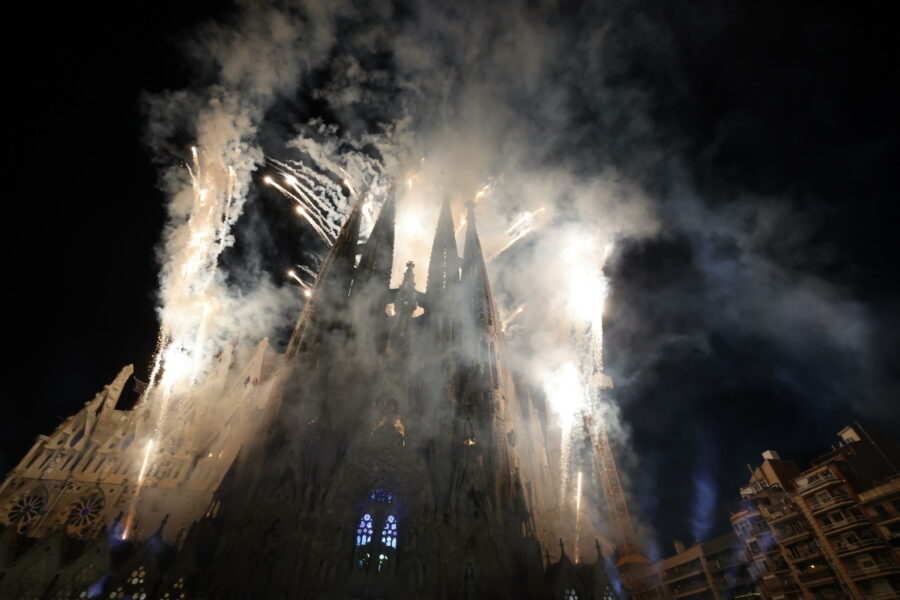
On April 14, 2025, Pope Francis named him Venerable. On June 10, 2026, Pope Leo XIV inaugurated the last tower of the Sagrada Familia, the crowning work of Antoni Gaudí, on the centenary of his death in 1926 at the age of 73. Gaudí was born in 1852 in a Spain undergoing profound transformation, a rapidly expanding city. Great symbolic construction projects emerged, such as the Almudena Cathedral in Madrid and the Sagrada Familia in Barcelona: works that evoke the Middle Ages but reinterpret it through the techniques and materials of industrial modernity, and whose construction would take decades, if not centuries, to complete. Antoni Gaudí remains the most celebrated Spanish architect and, paradoxically, the least imitated. The work of Gaudí lacks any real constructive continuity; Barcelona lives for Gaudí, but does not speak his language. Gaudí does not belong to any stable genealogy. He is too late to be a simple modernist, too mystical to be a rationalist, too radical to be eclectic, too experimental to be academic.
Gaudí remains an exception. His architecture has not generated a school, but an increasingly mythologized reception. The Sagrada Familia is today the most recognizable monument in Spain, but Gaudí appears more as a deviation than as the origin of Spanish modernity. A hundred years after his death, he remains an eccentric figure compared to the history that follows him: not a foundation, but a foreign body that continues to generate interpretations.
The Sagrada Familia is an expiatory temple and, as such, is built thanks to donations from everyone, so even today its construction continues to evolve according to available resources. In fact, its architect used to repeat: «My client is God, and God is in no hurry to finish His work.» Gaudí stated that his client was not in a hurry, even though the project developed during a period of great economic crisis. However, the expiatory economy does not fluctuate with the real economy, since it also depends on the generosity of a single donor, which can manifest itself at any moment. Even today, the Sagrada Familia lives on those who enter as tourists and leave as pilgrims.
Gaudí returns the religious sense of humanity to the center. Since the times of Stonehenge, light has always been the way God manifests Himself in the world. Moreover, a cathedral is a place of light, due to its orientation toward the east, where Christ was born, the «rising sun,» and its stained-glass windows that give color to every space. Therefore, what Gaudí does is exalt this religious sense and propose it anew to contemporary man, who had completely lost the capacity for wonder. He presents himself as a collaborator of the Creator: creation is a continuous process, and man collaborates as a creature working alongside God, creating a work that can enter the history of salvation and therefore is never finished, because finishing something always has a negative dimension. Cathedrals also exhibit this characteristic, requiring, in order to be built, the lives of numerous generations.
The Poles and synodality.
Polish Catholics, led by Dr. Artur Dąbrowski, president of Catholic Action of the Archdiocese of Częstochowa, have published a detailed open letter addressed to priests and synodal participants, condemning the Final Document of the Synod on Synodality as «deeply anti-Catholic» and a systematic attempt to replace the immutable Deposit of Faith with an ideology of inclusion and process. The letter, published in recent days, analyzes the report of Working Group 9 of the Synod and the Final Document issued on October 26, 2024, accusing it of imitating the heterodox German Synodal Way through decentralization and the relativization of doctrine. The Polish faithful describe the document as the construction of «a framework for the new identity of the Church» that subordinates the Deposit of Faith to a fluid «ideology of inclusion,» instead of guiding souls toward salvation.
Which side is the Vatican on?
That the Islamic Republic of Iran is an imperialist nation seeking regional domination, in opposition to Israel, is a fact. That, to achieve this, it intends to fight the Great Satan, that is, the United States, the homeland of depravity, and destroy the Little Satan, that is, Israel, by any means, including the use of nuclear weapons, is also a fact, since these objectives are rooted in the official doctrine of the Islamic Republic. Alongside these political objectives, there is another religious objective: Shiite hegemony over the Sunnis and, consequently, the conquest of the two holy places of Islam, Mecca and Medina. Faced with these plans, now known worldwide, the United States and Israel acted preventively. There is a at least cordial relationship between the Vatican and the Islamic Republic, beginning with their respective diplomatic corps. This privileged relationship with Islam in general has not always been so rich in dialogue. In past centuries, not to mention the Crusades, in 1885 Leo XIII recalled how Christian Europe had victoriously repelled Muslim invasions, while in 1944 Pius XII recalled the Crusades, which historically served to defend the faith and civilization of the Christian West against Islam.
With the Second Vatican Council, things changed and, in this sense, the first pioneering Pope wanting to understand and believe in the supposed message of peace coming from Islam was John Paul II, the first Pope to pray in a mosque (Damascus, 2001) and who in 1999 made a symbolic gesture of rupture by kissing the Quran. The case of Benedict XVI was different. He continued the dialogue, but considered Islam a religion totally distinct from Christianity and Western society; this did not facilitate coexistence, since he had understood in advance the ambiguity in which contemporary Islam operates and its difficulty in finding a place in modern society. The Pope Francis fully embraced the dialogue of fraternity with Muslims, to the point of signing the Document on Human Fraternity for World Peace and Living Together in Abu Dhabi on February 4, 2019, together with the Grand Imam of Al-Azhar, Ahmad Al-Tayyeb.
This is the path also followed by Leo XIV, apparently indifferent to the aggressiveness of the Iranian theocratic regime, to the Islamist intolerance that incites lone terrorists throughout the West, to the inability of so-called moderate Islam to condemn terrorism, and to the lack of women’s rights in many Islamic communities, starting precisely with Iran. The dialogue seems to be the Vatican’s policy and Shiite Islam enjoys great popularity among the Vatican hierarchy. Unlike Sunni Islam, where there is no common authority, Iranian Shiite Islam has a hierarchical structure, with a hierarchy of Islamic jurists headed by the Supreme Leader. Is the Pope really sure that in the Islamic world, Sunni or Shiite, there exists a great desire for coexistence with the Christian West?
Catholic universities?
The rector of Dartmouth College, Santiago Schnell, a recognized mathematical biologist, spoke at the United States Conference of Catholic Bishops in Orlando. He shared his reflections on the current state of Catholic higher education, 25 years after the conference implemented the apostolic constitution on education of Pope John Paul II, Ex Corde Ecclesiae. Last year, the University of Notre Dame appointed a declared abortion advocate to head one of its academic institutes, but days later announced that the professor would not assume the position of director after widespread condemnation of the appointment by students, university donors, and bishops.
Schnell stated that, while Catholics are present in current American public life—constituting, for example, more than a quarter of Congress and two-thirds of the Supreme Court—they lack sufficient presence in the so-called Catholic institutions that must shape ideas, language, and imagination. «The Catholic paradox is that we have a massive infrastructure of higher education, with mediocre results.»
Approximately one in five American adults is Catholic, and there are 230 Catholic universities and higher education centers in the country, with an enrollment of more than 600,000 students. But only 35% of the country’s Catholic adults have at least a bachelor’s degree, which coincides with the national average among all American adults. And among Hispanic Catholics, this figure is 20%. The 43% of American adults who were raised in the Catholic faith no longer identify as Catholic, and those who no longer practice the faith are more than twice as likely to change their beliefs, with scandals in the Church as the main reason.
According to Schnell, it is evident that there is a crisis in Catholic higher education and the root of the problem lies in the fact that Catholic institutions have largely imitated their secular counterparts. Students are trained primarily for employment rather than for the integral development of their person. Even the academic vocabulary adopted by Catholic universities focuses on topics such as «progress» and «success» rather than on the human person. The majority of Catholic universities have become essentially secular, imitating non-Catholic schools instead of embracing their distinctive religious identity. «If we compare the missions of secular institutions with those of Catholic universities, we see that they are not very different.» «We all want to be a force for good. We all want to help the poor. We all want to support democracy, but we do so in a way that is devoid of religion.»
Catholic universities must assume their own religious identity. They must ensure that academic freedom is oriented toward truth and make it clear that they are not an NGO or a political organization. The Catholic institutions should realize that they are forming the intellectual future of the Church and, hopefully, the next Doctors of the Church. He also invited the bishops to pay attention to the percentage of Catholics among faculty and students, noting that he had recently rejected the opportunity to serve as president of a Catholic university where the vast majority of students and professors were not Catholic. «We have changed the demographics and composition of faculty and students to the point that it has affected what [John Henry] Newman called the genius loci, the spirit of the place.»
Consecration of the United States to the Sacred Heart of Jesus.
Two hundred fifty years after the Declaration of Independence, the American bishops will consecrate the country to the Sacred Heart. A gesture that calls the entire nation to unity between faith and life, and to the recognition of Christ’s reign over all aspects of humanity, including politics. Today the American bishops will consecrate the nation to the Sacred Heart of Jesus during a Mass in Orlando, Florida. The date coincides with the 250th anniversary of the founding of the United States, which took place with the approval of the Declaration of Independence (1776). It is worth noting that the Mass will also include the relics of Saint Margaret Mary Alacoque, the nun of Paray-le-Monial, France, who had revelatory visions and initiated the devotion to the Sacred Heart. The American consecration seeks to connect with this entire tradition. The consecration will express, at least implicitly, the need to recognize the unique public role of the Catholic faith as the true religion .
«Go and preach.»
Happy reading.