


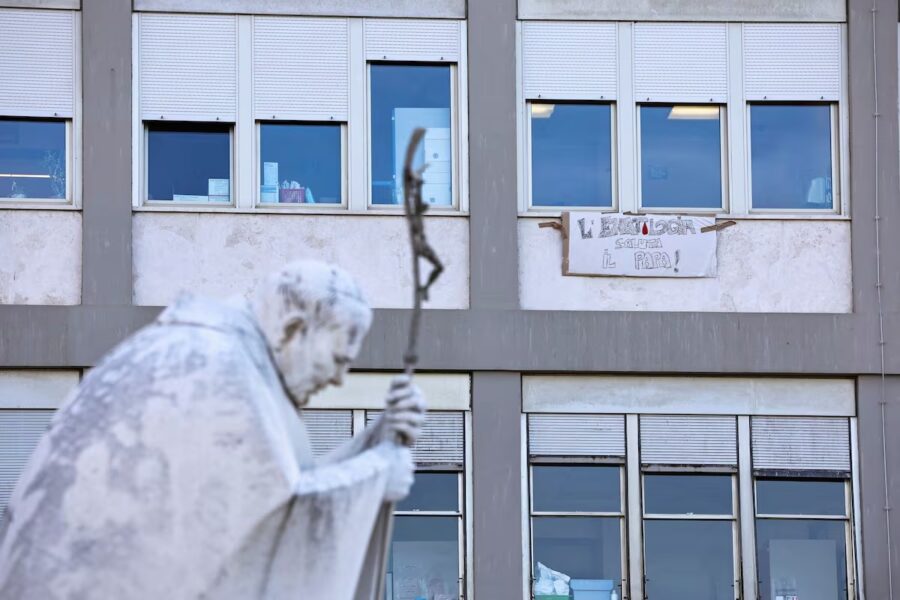
It must be acknowledged that these are not easy times for reporting. Whether they admit it or not, the new situation and its unpredictable consequences in the very short term have left everyone off balance. The facts are what they are, rumors are reported as rumors, and what is not in a document is not written as if it were. The third day of bulletins brings more questions than answers; it is only natural, and even the usually measured Parolin seems visibly unsettled. Today we have gone a little longer than planned; today we have seventy external links. We have the impression of facing an entire doctoral thesis every day, and we count on readers’ forbearance for the more than possible errors.
Yesterday the Pope got up, had breakfast, completed a full physiotherapy session and concelebrated Mass at midday on the tenth floor of the Gemelli. And because the question of the week has been who governs the Church while he is hospitalized, we went looking for the answer where it was: in the Regulations of the Curia he himself promulgated eleven months ago, in a Fundamental Law issued ten weeks ago, and in an article from twenty-six years ago.
Thursday’s bulletin
First, the form, which is already news for being repeated: the bulletin is not a Bollettino. It is issued through the channel of “Communications to journalists,” without number or time, again signed by Dr. Luigi Carbone and Professor Stefano Margaritora. It also has an official Spanish version, so we quote it verbatim:
“This morning the Holy Father underwent routine examinations, which returned normal results. The chest X-ray showed good recovery of the operated lung. He carried out his daily activities independently. The physiotherapy session included full motor activities. In general terms, the postoperative course is proceeding regularly.” Earlier, first thing in the morning, Telegram reported that the Pope “had spent the night well in hospital, had got up and had breakfast.” The phrase “had got up” is already accurate, by the way: the day before yesterday two outlets wrote it when the bulletin only said he had begun walking in the room.
Coverage was correct and brief: Adnkronos, RaiNews and Il Tempo reproduced the text. Il Tempo headlines the “good recovery of the lung,” attributing it to the doctors, and the attribution is exact: it is in the bulletin, word for word.
Midday Mass on the tenth floor
L’Osservatore Romano, the Holy See’s own newspaper, reports it, citing Bruni: the Pope had concelebrated on Wednesday afternoon in a room set up for the purpose on the tenth floor of the hospital, “and he did the same today at midday.” It does not say with whom. Nor does it mention that the floor’s chapel is under renovation; that has been known since the 13th, from the Gemelli’s own press chief, because the traditional papal apartment on that floor is being refurbished.
And the phrase of the day, also via Bruni and in a single line without further detail: “the Pope has resumed his working activity.” That is all. L’Osservatore does not specify what he has resumed: neither paperwork, nor audiences, nor documents, nor signatures. Coming from the Holy See’s newspaper, the silence is itself information. AgenSIR, for its part, writes that he has resumed it “gradually”; the adverb appears neither in the bulletin, nor in L’Osservatore, nor in Bruni’s quotation.
What the bulletin still does not say
Three days of bulletins and the public clinical file remains just as brief. There is no staging, neither pathological nor clinical. No mention of lymph-node involvement or whether lymphadenectomy was performed. No molecular profile. No definitive histology: the only one that exists is the intraoperative frozen section from the 13th, done on the operating table. There is not a word about chemotherapy, radiotherapy or targeted therapy. No prognosis, no discharge date, no mention of the trip. And no bulletin announces the next one.
That is why the questions raised by Silere non possum about the lymph nodes and staging are legitimate: we have checked them against the official texts of the 14th and 15th, and none of them mention them. The gap exists. What is not an open question, even if it comes in the form of one, is to insinuate a motive based on the health of the Pope’s relatives. And in that same piece there is a named accusation against Matteo Bruni—that he would arrange off-the-record meetings with journalists outside the Dicastery for Communication, using information obtained from gendarmes and collaborators—supported by nothing more than the author’s assertion.
The reproach collapses on its own, moreover, because of the calendar: on the day it is published, Bruni is speaking to journalists openly, and L’Osservatore Romano and Il Messaggero report it as such. Attacking the off the record on the day the information is on the record has its irony. The site’s second piece, by contrast, is usable reporting; it matches the official record and even anticipated Cardinal Comastri’s rosary.
Suspected and known are not the same
Giovanni Panettiere published in Quotidiano Nazionale a comparison between Francis and Leo XIV regarding medicine, and in passing took a step no one else had taken: that the Pope “already knew for several days that the lung lesion was tumoral, malignant,” and that the operation and biopsy “only confirmed the initial indications.” He bases it on anonymous “Vatican circles.”
The document says something else. The bulletin of the 13th speaks of an adenocarcinoma confirmed by the intraoperative biopsy “as suspected from the preoperative examinations,” and in the Angelus the Pope spoke of a nodule. Suspected is not known, and the difference is not a nuance: it changes the narrative of that Sunday. Even Silere non possum, which is not cautious, stayed with “suspected.”
Three attributions that do not hold up
They go together because they are from the same day and the same genre. Corriere Roma headlines “the Gemelli bulletin” and writes in the body “the daily bulletin from the Gemelli”: the bulletin is not from the hospital; it is signed by the Pope’s personal physician and the surgeon who operated on him, and it is distributed through a Press Office channel. Sky TG24 calls it a medical bulletin, which it is not, and adds figures for the itinerary—thirty-one thousand kilometers, fifteen stages—that appear in no published Vatican source.
And Editoriale Domani does something worse than getting the name wrong. It puts in quotation marks “if necessary the pontificate may be readjusted,” in the passive and without a subject, when Parolin’s phrase is active and has the Pope as subject; and it also quotes “if he is well he will do it from the Gemelli,” which no one else has. These are rewritings presented as citations. It also attributes to “the pontiff’s oncologist,” unnamed, that a week will be needed to decide on the trip: it is not in any official document and no other outlet reports it. The cleanest of the day, for contrast, is Adnkronos, which transcribes Parolin at length and in direct style and does not attribute to the bulletin anything that is not in it.
Parolin, with an open microphone
The Secretary of State spoke to journalists yesterday on the sidelines of an event of the Iraqi embassy to the Holy See and said three things. The first, personal: “I remain concerned because what has happened truly pains me enormously. But I trust the news we have been given in the bulletins.” The second, operational and in the conditional: “if by the weekend he is better, I believe he will deliver the Angelus from the Gemelli,” which is his own hypothesis, not an announcement.
And the third is the one that must be read twice, preceded by a caution of his own that some outlets have trimmed: “it has been barely two days since the Pope was admitted; no forecasts of any kind can be made,” and then, “later the Pope will also readjust his pontificate, if it is necessary to readjust it.” The verb he used is rimodulare, not rimodellare: to readjust, recalibrate, pace the rhythm and intensity. Not to redesign. Whoever translates it as “remodel”—and we almost did—is giving it a structural weight the Italian does not have. After saying that if he was better he believed he would do it from the Gemelli, Parolin added: “but these are all conjectures I am making, without having news.” AgenSIR and Adnkronos report it; ANSA presented the forecast as firm and left out the brake. The Secretary of State labeling his own words as conjecture is, moreover, a lesson in method that is not seen every day.
On the trip he said considerably more than has circulated: “it is a long and demanding journey; it will depend on the doctors”; that “the initial decision when the Pope was admitted was that the trip would be maintained in the planned form”; that “I imagine that if everything goes well the trip will take place, and if there are later developments that we cannot foresee”; and, in case there was any doubt, that “the Pope has not yet spoken on this matter.” To the Peruvian president, who was awaiting news, he replied with a phrase that sums up the whole week: “when there is news we will give it, but one must have the news to give it.”
Of the atmosphere in the sacred palaces, he said the announcement “has been a great surprise” but that “the climate is quite serene; there is confidence and the hope is that it can be resolved in a short time and definitively.” AgenSIR and Sky TG24 report it with the same quotation marks.
Who governs, and why one can sign from a hospital bed
The answer was in a document that Leo XIV himself promulgated on 23 November last year and that entered into force on 1 January: the General Regulations of the Roman Curia, approved ad experimentum for five years. Its article 31 §3 provides that the file “must be left to the Roman Pontiff, so that he may examine it personally and then communicate his decision in the manner he deems appropriate,” and article 33 §2 that decisions of greater importance must be submitted to him for approval.
In other words: the handling of business is designed to be documentary, not in-person. It does not require an audience or physical presence. That is why on 13 October, the day of the lobectomy, the bishop of Itabira-Fabriciano and coadjutor of Huehuetenango were appointed; on the 14th the resignation of Msgr. Bernard Bober from the pastoral government of Košice was accepted and two metropolitan archbishops, of Košice and of Cuiabá, were named; and on the 15th the bishop of Ponta de Pedras. There is no substitution because none is needed.
It is worth not inflating it, however. The business of the 15th consisted of a single new appointment: the episcopal ordination of the bishop of Haimen reported in yesterday’s Bollettino corresponds to an appointment of 24 August, and the union of the eparchy of Cluj-Gherla is signed by the major archbishop of the Romanians, not by the Pope. And the audience with the president of the Dominican Republic was not given by the Pope: it was given by Parolin and Gallagher at the Secretariat of State.
The only canonist with a name who has spoken all week put it in fewer words. Cardinal Gianfranco Ghirlanda, former rector of the Gregorian, told Quotidiano Nazionale: “the Pope does not lose his prerogatives even during hospitalization,” “during the time planned for anesthesia the ordinary government of the Roman Curia continues,” and “the vacant see occurs only in case of the Pontiff’s death or resignation.”
There is also a formal detail we had missed: in the Bollettini of the 13th, 14th and 15th there is not a single entry under “Le Udienze.” Since the admission, no papal audience has been published. And the one with the president of the Dominican Republic—Parolin and Gallagher at the Secretariat of State, to discuss bilateral relations and transnational organized crime—is the only diplomatic act the Secretariat has handled. There is not, therefore, a systematic substitution: there is a suspended agenda and one act redirected. The communiqué, incidentally, does not mention the Pope at any point, nor does it explain why he did not give the audience himself.
And the report everyone will cite, without a single source
La Sicilia published last night Le staffette dei gendarmi portano al Papa i documenti urgenti al Gemelli, under the label “il retroscena”: links of the Gendarmerie arriving at the polyclinic “to deliver to Pope Leo XIV the most urgent documents coming from the Vatican,” a service that allows him “to keep abreast of the governance issues of the Holy See and to affix his signature to the acts that require it.”
It fits so well with what precedes that it is tiresome to say what must be said: the piece has no source. None. It does not say “Vatican sources,” nor “it is known,” nor “according to what has been learned.” It carries no personal byline, no agency credit, and no one has replicated it: only that newspaper and its own English translation. The paragraphs attributed in the article are the usual ones—the bulletin, the resumption of work, the visit of the Substitute for General Affairs, Archbishop Paolo Rudelli—and precisely what the headline promises is what goes unattributed. We were on the verge of accepting it as good because it confirmed what we already thought. What is documented, published and signed by the Pope himself is the Regulations of the Curia, which state that the file is left to him so that he may examine it personally. What is not documented is how it is left to him. And the report that tells it—and that will circulate widely, because it is good and sounds true—rests on nothing. It may be rigorously true, but it is not substantiated.
And what no norm resolves
Having said the above, the gap remains, and this week it has become visible. Canon 335 provides that, when the Roman see becomes vacant or is completely impeded, nothing is to be innovated in the governance of the universal Church, and refers to “the special laws given for those cases.” For the vacant see those laws exist and are Universi Dominici Gregis. For the impeded see they do not exist. And the contrast is domestic: Canon 412 defines when an episcopal see is impeded, and 413, on the next page of the Code, says who then governs the diocese. For the Apostolic See there is no equivalent.
James H. Provost pointed it out in America on 30 September 2000, with a clarity no one has improved: “although John Paul II promulgated new norms for the vacant see in 1996, there still do not exist special laws regulating what to do if the Apostolic See becomes impeded. It is a rather serious gap in the constitutional law of the Church.” Twenty-six years later it remains a timely quotation. Canonist Geraldina Boni called in 2021 for canonical scholarship to draft a proposal of law precisely on this point.
And there is a new document that could have closed it and does not. The Fundamental Law of the Vatican City State, promulgated by Leo XIV on 31 July this year and entirely replacing that of 2023, states in article 1 that the Supreme Pontiff, Sovereign of the State, “has the fullness of governmental power,” and foresees only one case of interruption, the vacant see, in article 3. By contrast, it regulates in minute detail what happens “in case of absence or impediment” of the President of the Governatorate, the Secretary General and the Vice-Secretary General, with a named chain of substitution and with the express limit that the substitute may not issue provisions having the force of law.
A Fundamental Law ten weeks old that resolves what happens if the Secretary General is missing and says not a word about what happens if the Sovereign is missing. Of the Pope it only foresees that he dies or resigns. It is worth not exaggerating the hole: the State would continue to function, because legislative power is exercised by the Pontifical Commission, executive power by the President of the Governatorate, and judicial power by the courts in the name of the Pontiff. The gap is not in Vatican administration; it is in the supreme power of the universal Church.
The trip, with the numbers from the Bollettino
The trip is fixed by Bollettino of 5 August: Uruguay, Argentina and Peru from 6 to 17 November, with Montevideo, Paysandú and Florida; Buenos Aires, Córdoba and Luján; Lima, Chiclayo, Cusco and Pucallpa. And there exists a detailed program since 21 September, which adds Claypole, Pimentel, Santa Cruz de Succhabamba and Zaña: fourteen localities outside Rome.
Since figures from agencies have been circulating these days, we give them counted from the document. Air movements: fourteen, twelve by plane and two by helicopter. Planned papal interventions: thirty-five, of which sixteen speeches, thirteen homilies and six greetings. The figure of “more than forty speeches,” if acts rather than texts are counted, the program records forty-eight. The overall demand is: twelve days, fourteen flights and thirty-five interventions.
How a papal trip is postponed
If it must be postponed, the procedure is documented and leaves no room for surprise. It is announced by the director of the Press Office, in a statement with its own Bollettino number: neither the Pope, nor the Secretariat of State, nor a dicastery. And the formula always has the same three pieces: the decision attributed to the doctors, the Pope’s regret, and the fate of the commitment.
The two recent precedents show it. The trip to Congo and South Sudan, scheduled for 2–7 July 2022, was postponed by Bollettino of 10 June, twenty-two days earlier: “acceding to the request of the doctors, and so as not to jeopardize the results of the knee therapies still underway, the Holy Father finds himself obliged, with regret, to postpone the Apostolic Journey […] to a new date to be determined.” The COP28 in Dubai, by contrast, was canceled by Bollettino of 28 November 2023, three days before. Note the lexicon: in one case posticipare, in the other annullato. Rinviato is the word of the press, not of the communiqué. Two days later, in the Angelus of 12 June 2022, Francis said: “with great regret, because of the problems with my leg, I have had to postpone my visit to your countries […]. I ask your forgiveness.”
And there remains the precedent that is truly worth retaining, because it answers the question of what happens to what has already been committed. Seventeen days after the postponement, by Bollettino of 27 June, Francis sent Cardinal Parolin to Kinshasa and Juba “to show his closeness to the beloved Congolese and South Sudanese people,” from 1 to 8 July: the very dates the trip would have occupied. The trip took place seven months later. So if the American trip is postponed these days, what will have to be watched is not only the communiqué: it will be whether the Secretary of State appears in Montevideo and Lima in November.
Status of the trip, today
No organ of the Holy See has said anything about the trip since the diagnosis. The closest is Bruni’s reply, and it is worth giving in full because it is usually quoted trimmed: “we have heard the Pope’s words, his intention and his desire to go. Then we shall see.” From Peru, President Keiko Fujimori said recovery would take several weeks and that therefore the program could change. MilanoFinanza summarizes it precisely: the trip “remains confirmed, barring different indications,” and a lighter program “is a possibility, not yet an official decision.” No one, in any outlet, gives a deadline for the decision.
And Assisi, which is not a papal trip
It must be distinguished, because it is being mixed up. The event of 27 October in Assisi is not an apostolic journey convoked by the Pope: it is the annual international meeting of the Community of Sant’Egidio, “Pace disarmata e disarmante,” from the 25th to the 27th, with 384 representatives from 53 countries. Vatican News reported in advance that this year Leo XIV would close the meeting, praying with Christians in the Lower Basilica alongside Patriarch Bartholomew. It is forty years since the World Day of Prayer for Peace convoked there by John Paul II on 27 October 1986, but this one is convoked by Sant’Egidio. It has not been announced in the Bollettino as a papal visit. On whether he will go, Umbria24 reports a “vedremo” from an anonymous Vatican source to questions from Corriere della Sera. We do not confuse it with Bruni’s “then we shall see,” which was about America.
Seven hundred days without a new cardinal
While who governs is being discussed, there is a datum almost no one is talking about. Leo XIV has not created a single cardinal in his entire pontificate. It is not an impression: in the table of distribution of living cardinals by pontificate of creation published by the Press Office itself, only John Paul II, Benedict XVI and Francis appear. The last consistory of creation was 7 December 2024, Francis’s tenth, with twenty-one cardinals. It is six hundred seventy-seven days without a single incorporation.
The arithmetic, as of today: 240 cardinals, 116 electors and 124 non-electors. The Press Office statistics page gives 241 and 116, but it is updated to 24 July; the difference of one unit is the death of Cardinal Júlio Duarte Langa on 3 August. The electors have not moved since then for a verifiable reason: no living cardinal was born between 19 July and 15 October 1946. A warning for those arriving via search engine: the Press Office keeps a second set of statistics pages frozen in January 2014.
The drift over the next twelve months is seven fewer electors: Collins in January, Betori in February, Braz de Aviz in April, two Santos Marto in May, De Kesel in June, Ramazzini in July and Farrell—camerlengo and prefect of the Dicastery for the Laity, the Family and Life—on 2 September. From 116 to 109, and to 104 by the end of 2027. In 2026 seven have already left, among them Cardinal Omella, who turned eighty on 21 April. And 81.9 % of the current electors, 95 of 116, were created by Francis; 17 by Benedict XVI and 4 by John Paul II.
Two clarifications so as not to exaggerate, which are the ones missing from almost everything written about this. The cap of one hundred twenty electors exists—Universi Dominici Gregis, no. 33—but it is not a barrier: no. 36 establishes that a cardinal created and published in consistory thereby has the right to elect, and in fact the ten consistories of Francis left the College above one hundred twenty, the last at one hundred forty. The 2025 conclave was the first held with more than one hundred twenty electors, one hundred thirty-three. And the second: no norm obliges the Pope to convoke a consistory or to keep the College complete. Venice has gone fifteen years without a patriarchal red hat and Milan nine without a cardinal archbishop; no see has a right to a cardinal.
What does exist is a commitment of his. In January he said he wanted to maintain consistories on an annual basis, and at the close of the June one he added: “I wish to continue this annual appointment also from next year. I have not yet set the date: I hope to communicate it toward the end of this year.” Those consistories are extraordinary, consultative. The instrument that creates cardinals, the ordinary public consistory, he has never used.
An appointment read in code, and the source says something else
LifeSiteNews publishes an analysis with a blunt headline: that the Pope has named archbishop a bishop who backed same-sex blessings. It refers to Marek Forgáč, named metropolitan archbishop of Košice on 14 October, one of the appointments dispatched from the hospital. He had been auxiliary of the same see since 2016, and chairs the Slovak Episcopal Conference’s commissions for the Protection of Minors and for Catechesis.
We went to the primary source, which is an interview by Mária Kostyálová in the July 2024 issue of Nové Mesto, and it says to a large extent the opposite of what the headline suggests. On what is blessed: “it is not a blessing of their union, but a blessing of the house, or of the people who are there.” Asked whether Fiducia supplicans can be read in a permissive sense: “that is an incorrect interpretation.” And he backs the pastoral orientation of his episcopal conference, which is restrictive: the blessing must be very brief and simple, without an approved rite, neither within liturgical rites nor with liturgical vesture, and avoiding “even the slightest hint of giving the impression that it is an approval or legalization.”
What the interview does contain is harmony with Francis in pastoral register and two phrases that, taken in isolation, make a headline: that a person’s history “sometimes may not fit into a particular paragraph” and that “the synod is about the encounter with the person, not with the book.” And the “in Slovakia we are little prepared” that gives the original Slovak title does not refer to blessing same-sex couples, but to sustaining at once moral clarity and not wounding anyone.
James Martin, two headlines and a nine-year-old quotation
The same outlet reports that Fr. James Martin took part in the Napa Institute’s eucharistic procession through the streets of New York on Tuesday, the sixth edition, with a prior Mass in St. Patrick’s Cathedral presided over by Auxiliary Bishop Espaillat, and that he was invited to carry the monstrance for one stretch; he described it on social media as “deeply moving.” There has been no reaction from the Napa Institute or the archdiocese, and the chronicle in the National Catholic Register of that same procession does not mention him at all.
It also reports that Martin said homosexuals are “treated like dirt” by being asked not to receive Communion. The phrase comes from an episode of The Pillar podcast on the 12th, whose transcript has not been published, so we have not been able to verify it at source. What we have verified is that the formula is not new: America ran it in a headline in June 2017, in connection with the Pulse massacre. And that the headline welds two different stretches of the conversation: the “like dirt” is general, and the example of Communion goes another way. He continues to appear as a consultor of the Dicastery for Communication on the dicastery’s official structure page.
Cupich, and a warning about a web address
Cardinal Blase Cupich, Archbishop of Chicago, spoke about the Pope’s cancer in an interview with Elisabetta Piqué for La Nación: “it was a shock, it was shocking,” “people are very unsettled, even worried,” “the situation comes down to deciding whether he can fly or not” and “I have been told it is a very treatable condition.” In the English version, with Gerard O’Connell, he adds: “I applaud the Holy See and the Holy Father for the transparency they have shown at this time.”
And the warning, which is standard: the web address under which that interview circulates joins the cardinal’s name and the word cancer, and more than one misunderstanding has arisen from it. Cupich has not announced any illness. He is speaking about the Pope.
The people, and a headline without a body
The lines continue in the square, with rosaries in hand and people standing in silence before the façade. AgenSIR reports it with a single quotation, and anonymous: “we need his spiritual guidance, some pilgrims say.” The headline phrase, “we await him soon among us,” does not appear in the body of the article, so it cannot be attributed to anyone. With name and origin there are testimonies, collected the day before by Daniele Piccini for Vatican News: Fr. Roland Elsner, of Görlitz, for whom what was to be an audience with the Pope became a moment of prayer; Robin Weeks, of South Carolina; José Zozaya, Mexican, who hopes to see him again soon in the square; and Fr. Michael Antony, of India. Last night there was a rosary at eight in Sant’Anna in Vaticano, presided over by Cardinal Angelo Comastri, to Mary who unties knots. And we clarify a confusion we have seen these days: the torchlit rosaries in St. Peter’s Square are on the Saturdays of October at nine at night. The next one is tomorrow.
How three tests became official without anyone publishing them
This deserves to be followed step by step, because it is the cleanest case of the week. On the 14th, ANSA and Il Messaggero published that before the operation three tests had been performed—robotic bronchoscopy with biopsy, contrast-enhanced chest CT and PET—attributing it with a loose formula to what “has been learned from the doctors.” On the 15th, the same newspaper writes that “the Vatican press office has confirmed” those three tests. We have checked against the four official texts that exist—the communiqué of the 13th and the bulletins of the 13th, 14th and 15th—and in none of them does the word bronchoscopy, nor CT, nor PET appear. In forty-eight hours, and without a single document intervening, an attribution to unnamed doctors became an institutional attribution to the Press Office. The tests may have been performed exactly that way. What has not happened is that anyone has officially confirmed them.
And the chronology is going the same route. RaiNews, with a byline by Ignazio Ingrao for Tg1, headlines that the Pope “already in France had appeared fatigued” and that then came the tests and the CT. The trip to France exists and is on vatican.va—apostolic journey to France and to the seat of UNESCO, 25–28 September—but of the three links in that chain none carries a source: neither the fatigue, nor the tests, nor the CT. The only documentary anchor on the origin of the finding remains what the Pope said on the 11th: that the doctors found the nodule “recently, during some check-ups.” Without place and without date.
Phase is not stage
This is for the Spanish-speaking reader. The Pope said, in Italian, that the nodule had been detected “in una fase molto iniziale”: phase, a layperson’s word. The AFP dispatch published by El Mundo translates it as “en un estadio muy temprano,” which in medical Spanish is something else. And on that translation, in the same piece, oncologist David Carbone, of Ohio State University, piles on: “this leads me to think it was a tumor in a very early stage, with a rather favorable prognosis.” The chain ends up being read as if the Holy See had given a stage. It has never given one.
In the same piece, Juanita Mora, spokesperson for the American Lung Association, gives a five-year survival of between 80 and 98 % when detected at an early phase, and David Spigel, of the Sarah Cannon Research Institute, says the patient “can be cured.” The text does warn, however, that prognoses vary enormously according to subtype and stage, and immediately publishes the figures.
Let us do the count, which is what no one has done. Up to today, eight specialists have opined on the Pope’s case, by name and position: Francesco Facciolo, Edoardo Mercadante, Francesco Cognetti and Francesco Blasi in Italy; Juanita Mora, David Carbone and David Spigel via AFP; and Mauricio León Rivera, of the League against Cancer, in Peru, who attributes curability and a figure of up to 70 % “in certain cases.” None is recorded as having seen the patient, and all reason from the same one-hundred-fifty-word bulletin. The only two physicians who have actually seen him, Carbone and Margaritora, sign the bulletins and have given neither stage, nor nodes, nor prognosis, nor a single figure.
The extreme case is Mauro Evangelisti’s piece of the 15th, which constructs three treatment scenarios—one of them with four cycles of chemotherapy and immunotherapy afterward—and publishes the size of the tumor with this formula: “it has not been made official, but it emerges that the dimensions of the adenocarcinoma would not be large.” “It emerges” is not a source. And Facciolo infers that the mediastinal nodes were unaffected from a bulletin that does not mention the nodes. What is notable is that both specialists set the limit in so many words—Cognetti says “we are going too far; it is too soon to pose that scenario”—and it is the newsroom that jumps it.
Justice to whom it is due: Franca Giansoldati’s piece carries the most restrained headline we have seen in all the Italian press, “the doctors do not speak of chemo,” and the word chemotherapy appears in its interior only once and in the negative. That it is in the web address is a matter of search-engine positioning, not of the text. It has three other defects, however: it quotes as official a phrase that is not in the communiqué of the 13th or in the bulletin, it suppresses the adjective from “extemporaneous histological examination”—so that it reads as definitive—and it writes Carboni where the official text says Carbone.
The brother, and who actually spoke
It is circulating that Louis Prevost, the Pope’s older brother, has suffered a relapse. It is worth saying whose words those are: they are not his. The one who spoke, with CBS News on the 13th, was his wife, Deborah Prevost, and she said that he “came out of remission” three months ago. He is not quoted at any point. Multiple myeloma diagnosed in 2017, treatment in 2019 with stem cells and a clinical trial, kept at a very low level since then. And a phrase that matters: “we continue to pray, keeping our spirits up for both.”
She expressly refused to say what stage her husband’s disease is in, said she had heard nothing about radiotherapy or chemotherapy for the Pope and that she could not pronounce on his condition. RPP reports it, attributing it correctly in the body, with the chain visible, and compresses the remission into “relapse” in the headline; and adds on its own general statistics on myeloma. They are figures of the disease, not estimates about him, but they are attached to the name of a patient who has not spoken. We stay with what she said, to whom she said it and when.
They asked Parolin about the letter, and he answered
In Giansoldati’s piece there is a question someone had to ask and an answer worth fixing before the matter gets out of hand. Asked about the letter of preventive resignation that Francis said he had signed and delivered to his predecessor in office, Parolin replied: “that letter has never been shown to me and I have never seen it,” and about the current Pope, “if the Holy Father has signed something similar I do not know, but frankly I doubt it.” In the same piece, Fr. Roberto Regoli, professor at the Gregorian, resolves the question of anesthesia with a domestic comparison: “even under anesthesia the Pope remains the Pope. It is a bit like when he sleeps, so there is no impediment; everything falls within normality.” With Ghirlanda, that makes two canonists with names saying the same thing, and neither of them says it in the conditional.
And we close with the Gospel of the day, Friday of the XXVIII week. Forty-eight years have passed since the election of John Paul II. “Even the hairs of your head are all counted” (Lk 12, 7).
And the usual prayer:
“Oremus pro Pontifice nostro Leone. Dominus conservet eum, et vivificet eum, et beatum faciat eum in terra, et non tradat eum in animam inimicorum eius.”