


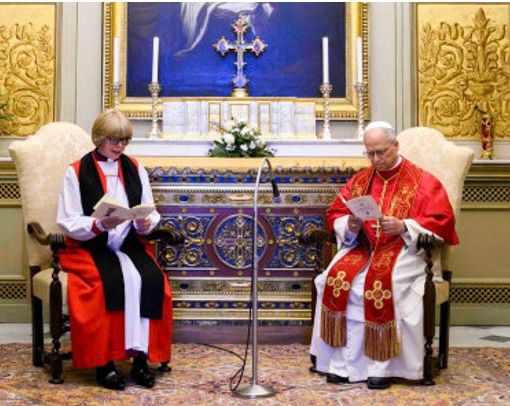
Today, the news undoubtedly focuses on the Mullally case, which stops being an unfortunate passage and becomes an image, far from positive, of an emerging pontificate.
A ‘great complex’ dedicated to Pope Francis.
Pope Leo XIV visits ‘the school’.
Yesterday, Pope Leo XIV crossed the threshold of the Pontifical Ecclesiastical Academy in Piazza della Minerva, on his first visit as Supreme Pontiff to the institution that has trained the Holy See’s diplomats for more than three centuries. The occasion is the jubilee of the 325th anniversary of the Academy’s foundation, established in 1701 by order of Clement XI. The Pope described the characteristics of what he called the «Pontifical Diplomatic Priest». The Pope acknowledged that the Institution, through the various reforms carried out over time—the last of which was commissioned by his predecessor Francis—has preserved its distinctive seal: an unbroken chain of priests from all over the world, united in building that communion in Christ that characterizes Vatican diplomacy.
The core of the speech was dedicated to outlining three traits of the diplomatic priest, each rooted in an evangelical reference. Messenger of Easter peace, witness to the Truth that is Christ, and he recalled that He is the promoter of justice and human dignity. The students and superiors demonstrated, once again, their enormous and flexible capacity for adaptation to the environment. It is enough to compare the images of Pope Francis’s visit, all in suits, with the current ones, all in cassocks, to realize it. Now it’s what’s appropriate, tomorrow we’ll see, the right convictions.
Courtesy or ideological pressure?
Progressive historicism seeks to present its rise as an inevitable destiny for the Catholic Church, a kind of «necessary anticipation» of modern times. However, this vision reveals a Gnostic origin that disdains the concreteness of the Incarnation: if the sacramental sign—the body, matter, the gender of the minister—becomes manipulable and fluid, faith dissolves into an intellectual abstraction. Elevating those who support abortion or same-sex marriage to the level of spiritual interlocutors means backing a diluted Christianity that has exchanged dogma for consensus.
The reservation of ordained ministry to men does not arise, as has often been explained, from a form of contempt toward women, but from the preservation of the mystery of nuptial love. The ministerial priesthood is not a reward for moral perfection, but a sacramental sign: the priest is called to make Christ visible as Spouse of the Church. Only a man can embody this sacramental sign of Him who, as Spouse, offered Himself on the Cross for His Spouse, the Church. Altering this sign obscures the entire symbolism of the union between God and humanity, reducing the sacrament to a mere bureaucratic or social function.
The Anglican Church presents itself to Rome not simply as a community of free believers, but also as a civil institution structurally subordinate to the Crown and, by extension, to the interests of financial dynasties and globalist circles that influence, or could influence, the British monarchy. The figure of Sarah Mullally could serve—albeit unintentionally—as a «Trojan horse» to export a model of a democratic and synodal Church, in which truth is no longer received from God, but voted by majority or decreed by governments. An ethically subordinate entity to globalization, eliminating all «scandal» of faith to make it compatible with the dominant cultural hegemony and the Masonic logic of universal unification without Truth.
Apostolic succession is not a delegation of civil power, but a transmission of grace that remains tied to Christ’s will, making any attempt to «feminize» or «democratize» ordained ministry ontologically impossible. Approximately one-third of Anglican priests, wounded and disoriented by Canterbury’s secularist trends, have chosen to return to communion with Rome thanks to Benedict XVI’s Apostolic Constitution Anglicanorum Coetibus (2009). This document, far from being a diplomatic concession, was the recognition that true Christian identity can only flourish within the framework of apostolic succession and Petrine magisterium.
The entire framework of contemporary ecumenism risks collapsing if we ignore the warning of Unitatis Redintegratio, which calls for an ecumenical action «fully and sincerely Catholic, that is, faithful to the truth we have received from the apostles and the Fathers». The Council clearly rejects that «false irenicism» that alters the purity of doctrine, reminding us that unity is not a human engineering project, but a mystery whose supreme model is the unity of the Trinity. Diplomatic welcome must not obscure the awareness that the purpose of reconciling all Christians «surpasses human strength and gifts».
Ecumenical encounter?
For the first time, the Pope received the Archbishop of Canterbury, Sarah Mullally, in the Vatican. Sarah Mullally undertook a four-day pilgrimage to commemorate, among other things, the ecumenical path begun by Paul VI together with the then Primate of the Church of England, Michael Ramsey, in 1966, in the Basilica of St. Paul Outside the Walls, and whose 60th anniversary we celebrate this year. It cannot be forgotten that the priestly ordinations and, subsequently, episcopal ordinations of women constitute a factor of division between Rome and Canterbury, as well as within the Anglican Communion itself; in fact, several traditionalist African churches opposed the election of a woman as the new Archbishop of Canterbury.
The main attraction of this case is the sexual abuse scandal that led to Mullally’s predecessor, Justin Welby, to resign in 2024. Welby had been accused of covering up for many years the sexual abuse by John Smyth, an influential evangelical lawyer within the Church structures, who was accused of abusing approximately 130 children in Africa and the United Kingdom. Welby and other Church of England officials did not intervene to stop the man despite knowing the facts.
The meeting that took place in the Vatican was not improvised. The Pope stated: «This ecumenical path has certainly been complex. While much progress has been made on some historically divisive issues, in recent decades new problems have arisen that make it difficult to discern the path toward full communion». «I know that the Anglican Communion also faces many of these same problems; however, we must not allow these challenges to prevent us from seizing every opportunity to proclaim Christ to the world together.
Leo XIV and the ‘new problems’.
Leo XIV mentioned the «new problems» that had arisen between Rome and Canterbury, one of which, and not the least, was right in front of him: the self-proclaimed archbishop fresh from the farce of «blessing» a stone’s throw from Peter’s tomb while a bishop made the sign of the cross. It is not hard to argue that one of these «new problems» that has arisen in recent decades, which also divides the Anglican Communion itself, presented itself personally before the Pope. It is not about Mrs. Mullally’s moral qualities, but the objective fact that her appointment, regrettably, consolidates one of the most significant breaking points in recent history of ecumenical dialogue between the Catholic Church and Anglicans: the possibility of conferring the sacred orders of diaconate, presbyterate, and episcopate on women.
The Dicastery for the Doctrine of the Faith, with the declaration Fiducia supplicans, had affirmed blessing what cannot be blessed (i.e., same-sex couples); now, the Dicastery for Promoting Christian Unity allows blessing those who cannot. Leo XIV has just restored the requirement that the object of the blessing be an ordained priest, clarifying that homosexual couples cannot be blessed, only individuals. The Vatican immediately took another measure, this time regarding the person who can impart the blessing.
A layperson can bless someone or something, in the sense that they can invoke God’s blessing, as when a father traces the sign of the cross over his children before bedtime or before leaving home. But there is no evidence that Mrs. Mullally is Msgr. Pace’s mother, and it is quite clear that the «archbishop’s» blessing gesture appears decidedly priestly: the image speaks louder than many speeches. A bishop bowing to receive Mrs. Mullally’s blessing creates, to say the least, some confusion regarding sacramentals and sacred orders, because for an ordinary Catholic that gesture properly indicates a priestly blessing.
We know we have a universe of short bishops, but it is hard to consider the good faith of those who orchestrated this farce. It is also hard to believe that the secretary of that Dicastery, who claims to be guided by the decree of the Second Vatican Council, Unitatis Redintegratio, has not read its conclusion: «This sacred Council exhorts the faithful to abstain from any frivolity or imprudent zeal that could harm the true progress of unity. Indeed, their ecumenical action cannot be anything other than fully and sincerely Catholic, that is, faithful to the truth we have received from the apostles and the Fathers, and in accordance with the faith that the Catholic Church has always professed».
Strickland and the Mullally case.
«As successor of the Apostles, I am obliged to speak, not harshly, but with the clarity that comes from charity. The Catholic priesthood is not a human creation. It is a divine gift instituted by Our Lord Jesus Christ, entrusted to the Church and preserved through the centuries with fidelity and sacrifice. The priest, by sacramental ordination, is configured to Christ in a unique and irreplaceable way, acting in persona Christi Capitis, especially in the celebration of the Holy Sacrifice of the Mass. For this reason, the Church has categorically taught that it has no authority to confer priestly ordination on women. This teaching admits no changes, adaptations, or reinterpretations. It is part of the deposit of faith».
«Since the Eucharist is the true representation of the Sacrifice of Calvary, the priest stands in the person of Christ the Spouse, who offers Himself for His Spouse, the Church. This nuptial mystery is not symbolic, but sacramental and real. Any gesture that obscures this truth or blurs the distinction between valid Sacred Orders and those communities that do not possess them risks weakening the faithful’s understanding of the Eucharist». «True charity demands clarity. Respect for persons must never obscure the truth about the sacramental reality of Holy Orders, which the Church has received from Christ and has no power to modify». «Let us respond, then, not with despair, but with fidelity. Let us cling to Christ, love His Church, and pray for its purification and renewal».
Viganò condemns the meeting with Mullally.
Viganò condemned Pope Leo XIV’s meeting with «heretics and schismatics», such as the Anglican Archbishop of Canterbury, considering it a continued betrayal of Jesus’ «mandate». «While the conciliar and synodal Church continues to betray Our Lord’s mandate by associating with heretics and schismatics of all kinds, and even welcoming a heretic who passes herself off as an archbishop into the Vatican, in Treviso Bishop Tomasi denies a worthy place of worship for the administration of Confirmation to the faithful of the FSSPX, in open contradiction to the dialogue and welcome he has promoted for sixty years». This woman—the «archbishop» Sarah—is a mockery of the Sacred Orders and a walking farce. However, they officially bring her to the sacred Clementine Chapel of St. Peter’s Basilica to impart a blessing… and tomorrow she meets with Pope Leo XIV. This is the same Pope who refuses to meet with the legitimate bishops and priests of the FSSPX. Lord, have mercy on your Church.
Excommunicate the Fraternity’s bishops.
According to sources in Rome, Pope Leo XIV plans to excommunicate the bishops of the Society of St. Pius X (SSPX), and possibly their priests and lay sympathizers, following the Society’s consecration of new bishops this July. Rorate Caeli shared on Saturday in an exclusive report that Pope Leo XIII has decided to follow the precedent of Pope John Paul II by declaring the SSPX bishops who participate in the Fraternity’s upcoming episcopal consecrations on July 1 excommunicated, according to «Roman sources». It is said that Leo already had a similar decree prepared, in tone and content, to the one Pope John Paul II promulgated through Cardinal Bernardin Gantin, Prefect of the Congregation for Bishops, on July 1, 1988 .
Like John Paul II, Leo XIII would declare the SSPX bishops ipso facto excommunicated, both the consecrators and the newly consecrated, meaning they would be automatically excommunicated by the mere fact of participating in episcopal consecrations without papal approval. These SSPX bishops would be considered guilty of a «schismatic act», and Leo’s decree would urge priests and faithful to «not give their consent». Bishop Bernard Fellay of the SSPX himself stated in a recent sermon in St. Mary’s, Kansas, that similar excommunications are very likely to occur soon. “I prefer not to play the prophet, but I’m pretty sure there’s a huge probability that all of you, including us, will be excommunicated, declared schismatics; there’s a very high probability because they’ve already said it publicly. So, so to speak, they’re forcing themselves to do it. But anyway, God can work miracles. It’s not the end”.
Vatican correspondent Niwa Limbu stated on Saturday that, according to his sources, the Dicastery for the Doctrine of the Faith (DDF) « is preparing the possibility of excommunicating the entire SSPX», that is, all SSPX priests, not just the bishops. It is unclear if he also meant laypeople who support the SSPX.
«Integral Ecology in Family Life».
Document published by the Dicastery for the Service of Integral Human Development and the Dicastery for the Laity, Family, and Life, designed to transmit care for Creation and human life within the family. «The values that are formed and grow within the family constitute the fertile ground from which society’s life springs. Therefore, families are fundamental for developing and transmitting the value of caring for our common home and each person». It responds to the calls of Pope Francis and Pope Leo XIV to listen to the cry of the poor and of the Earth, and to offer a concrete response, applying the principles of the post-synodal exhortation Amoris Laetitia and the teachings of the encyclical Laudato Si’.
Planned Parenthood Awards.
Singer Alecia Beth Moore-Hart, better known as Pink, has long been one of the most fervent celebrity advocates for abortion. This month, Planned Parenthood of New York recognized her work with the «Champion of Change» award at its «Into Action» gala, a star-studded event. She turned her concerts into huge advertising campaigns for the abortion giant, distributing Planned Parenthood leaflets among her fans. Planned Parenthood needs allies, and the gala presented the organization, known for its work in promoting abortion, as a beleaguered force: «We have to act quickly every season. Bodily autonomy is crucial, especially in 2026», declared transgender actor Tommy Dorfman. «It’s essential to support the work Planned Parenthood does, not just helping pregnant mothers and people interested in fertility treatments, but also with hormone replacement therapy, transition care, and general medical care».
Outside the Church there is no salvation.
Or so it was before. The Mullally case suggests that there is salvation outside the Church, or that the Catholic Church is not the only true Church, or that heretics and schismatics are somehow part of the Church. That’s exactly what what we just saw conveys, and the fact of calling Mullally «Your Grace», etc. That’s what is conveyed when Leo says, in his speech to Mullally, that he is «grateful for the ministry of the Anglican Center in Rome». This is evident when he states that Catholics and heretics can «proclaim Christ in the world together», as he said in the same speech. And that’s what is conveyed when he says: «I pray that the same Holy Spirit may always remain with you, making you fruitful in the service to which you have been called». But Mullally has not been called to any service as a false bishop in a false heretical sect. The goal of the “Synodal Church” is to be a world church of humanitarianism without dogmas, in which Anglicans and Orthodox can be part, as clearly outlined in the 2024 document, The Bishop of Rome . Pope Pius XI, in his encyclical Mortalium Animos on the “ecumenical movement”, said that the idea that all religions are “more or less good and praiseworthy” assumes “completely abandoning the divinely revealed religion”. And that’s just another way of saying apostasy .
«But you do not believe because you are not of my sheep.»
Good reading.