


We begin the week and end the month. In Rome, we continue with very hot nights and very August-like days. The dicasteries are slowly waking up, and Pope Francis’s pontificate already feels very distant. Many curial positions remain provisional, and we have yet to truly begin the pontificate of Leo XIV. The waters are calmer, without a doubt, but expectations are waning, and we risk falling into “dolce far niente,” into “the sweet pleasure of doing nothing”.
Angelus in Castelgandolfo.
In the square, after the celebration of the Madonna del Lago. When events seem far removed from what was expected or requested in prayer, the idea may arise that God is mistaken, that He does not listen, or that He does not care about humanity. Peter, precisely because of his impulsive reaction, thus becomes for Leo XIV an example of how to face such moments. The Pope highlighted two attitudes. The first is not to interrupt dialogue with God when one does not understand what is happening, but to continue turning to Him with sincerity, even expressing one’s struggles and disagreements. The second requires not turning that difficulty into a judgment on God’s work, maintaining an attitude of listening and availability even when what is asked of us does not match our expectations.
He directed his thoughts to Haiti, where news was received in recent hours of a massacre in Kenscoff, with numerous victims and people abducted. Leo XIV called for the immediate release of the hostages and appealed to those responsible to guarantee the security of the population and put an end to the violence. His prayers for the victims of the floods that struck Nepal and Tibet, remembering the deceased, the injured, the missing, their families, and those involved in relief efforts.
He returned to the theme of peace, recalling Saint Augustine, whose liturgical feast was recently celebrated. Leo XIV cited an image from the Bishop of Hippo, according to which peace resembles the bread of the Gospel miracle, which grows when it is broken and shared. Hence the hope that the number of people working concretely to overcome divisions, promote justice, and practice forgiveness will increase.
The World Day of Prayer for the Care of Creation, to be held on Tuesday, September 1, will inaugurate the Season of Creation, this year dedicated to the theme “Living Water.” During these greetings, there was a brief papal lapse; he apologized to those present with a smile before continuing with the list of groups. He thanked the police and all who served during his summer stay at the Pontifical Villas and during his meetings with pilgrims. He also greeted the faithful gathered in St. Peter’s Square, who followed the Angelus from Rome via screens.
The Vatican does not want an isolated Russia.
Archbishop Paul Richard Gallagher returned to the Vatican on Friday night into Saturday, after a flight from Moscow of approximately twelve hours, with a stopover in Istanbul, following a route that skirted the Balkans, the border with Ukraine, and Belarusian airspace. Before the suspension of direct flights between Russia and the European Union, the same flight took about four hours. There are prepared statements to clarify the reason and purpose of this trip to the Vatican media. Even the longer flight “acquires a symbolic dimension” for the dialogue the Holy See intends to maintain with Moscow despite the war in Ukraine.
This is the message that summarizes Gallagher’s presence in Russia: “Russia must not be isolated; a genuine openness to dialogue is needed.” There is a first appeal to the international community, which must recognize that efforts made so far to “isolate” Moscow and bring it to collapse have been completely useless. The Holy See’s initiative to “keep the path of dialogue open.” Gallagher explains that the path taken (and not only now) by the Church is entirely correct and beneficial: “After all, isolating people and countries, frankly, does not help”; he states that everyone has the right to their own opinion, but coming to Russia is something “others are not doing at this moment.”
Peace in Ukraine must be just, sacred, and not a mere concession, but at the same time, it is not possible to exclude from the negotiating table the country that desired and initiated this war. For the present and, above all, for the future, isolating Moscow cannot be a fruitful path to resolving the conflict in Ukraine. According to Moscow, it is useless for the two presidents to meet first if the level of agreement has not been formalized or negotiated. For genuine negotiation, even at a preliminary level, an openness of will is required, even toward the adversary, without isolating anyone and continuing the effort to foster a culture of genuine dialogue and peace.
FBI of the pontifical state.
That the FBI should investigate a person who makes Molotov cocktails, seeks weapons, incites the murder of minorities and police officers, and encourages school shootings is hardly debatable. Today we have the story published on August 28, 2026, by the United States Department of Justice about the so-called Richmond Catholic Memo. The FBI office in Richmond begins by focusing its attention on attendance at a Catholic chapel, then on the priest of the chapel, and finally on the priest’s uncle, also a priest. Agents gather information about their movements, compare trips, obtain information about flights and credit cards, tap a phone, examine sermons, reconstruct their priestly ordination, and even find out where one of them celebrated his first Mass. One of the priests is watched at the airport and followed to his home.
Looking at this case, it is impossible not to think of the usual practices of the Vatican gendarmerie with cardinals, bishops, and priests, outside any legal framework and following an operational logic that has now acquired the characteristics of a truly deviant secret service. Investigative power requires strict limits: when those limits weaken, even the date of a priest’s first Mass can end up in an anti-terrorism file. A question arises: what would come to light if someone ordered a serious and independent investigation into the actions of the Vatican Gendarmerie during the mandates of Domenico Giani and Gianluca Gauzzi Broccoletti?
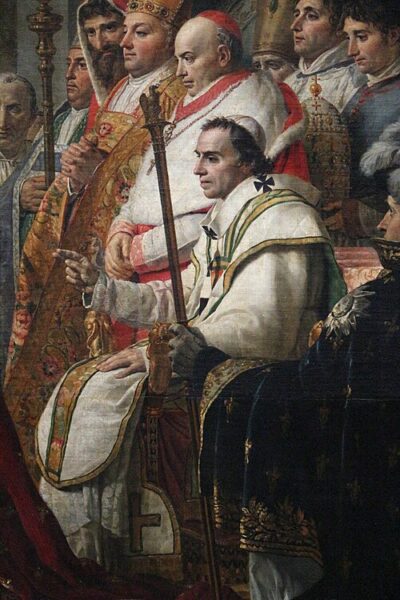
The Pontifical State resembles not a little a police state that moves between investigations outside all usual legality of everything that moves and the reports that accumulate in the feared personnel file of the Secretariat of State. The old tactic of being able to count on “discreet” personnel is common in the small state. In all departments, there are informants who report what happens behind closed doors, and profiles are sought to create the various teams that can facilitate having good information. No one escapes the police state, and even the Pope is observed 24 hours a day; everything counts and everything is taken into account. Let us not forget that the images of the reigning Pope guarded by Vatican security remind us of Napoleon’s famous order in 1809 when he decided to kidnap Pius VII and hold him prisoner for more than five years. The Pope was kidnapped, but the order was that the soldiers guarding him should appear as an honor guard.
John Paul I in Romania.
Grateful devotion to the figure of Pope Albino Luciani remains alive in Romania. Mass celebrated yesterday in the Church of the Holy Redeemer. Known as the “Italian Church,” it was built between 1915 and 1916 for the pastoral care of the growing community of immigrants. Romanian and Italian Catholics participated in the celebration, sharing for the first time a solemn liturgy as part of the initiatives promoted by the “Pope Luciani Association,” which spreads the teachings and example of holiness of Blessed John Paul I in Romania. Lina Petri, niece of Pope Luciani, and the Italian ambassador to Romania attended the Mass. During the Mass, a relic “ex indumentis” and an image of Pope Luciani were brought to the “Italian Church” in Bucharest by a delegation from Rome, led by Stefania Falasca, vice president of the Vatican Foundation John Paul I and postulator of the cause of canonization of the Pontiff, beatified by Pope Francis on September 4, 2022. In his homily, delivered in Romanian, Archbishop Gloder, a native of Asiago, drew on personal memories that connect him to Pope Luciani, beginning with the day of his papal election, which he attended as a young seminarian in St. Peter’s Square.
Relations between the Holy See and the Holy Land.
Luis Badilla offers us an exhaustive study of relations between the Holy See and the Holy Land. Vatican media headlined after the Angelus on Sunday, August 16: “Two peoples and two states, the unchanging line of the Popes and the Holy See.” The editorial on the Vatican website: “it is the latest in a long series of pronouncements presented over the last eighty years by the Pontiffs and the Holy See. A position rooted in time, indicated as the only path to a ‘just and lasting’ peace for Israel and Palestine.” The Holy See has supported the formula “Two States – Two Peoples” since 1984, with the seal of John Paul II.
The proposal for “Two States, Two Peoples” was first formulated in 1937 ( Peel Report, also known as the Report of the Royal Commission on Palestine) by Great Britain on the occasion of the so-called “Great Arab Revolt” in the territories of the British Mandate of Palestine. This same proposal was later promoted and formalized by the UN in 1947. In the Oslo Accords (1993), the State of Israel and the Palestine Liberation Organization (PLO) initiated a process of mutual recognition and negotiation that was to lead to a political solution to the conflict
The Holy See’s adherence took place on April 20, 1984, forty-two years ago, with a document from Pope Saint John Paul II (Apostolic Letter Redemptionis anno). This illustrated document had as its central theme “the city of Jerusalem, sacred heritage of all believers and crossroads of peace desired for the peoples of the Middle East.” The document states: “In this context, it is natural to recall that in the region two peoples, Israelis and Palestinians, have faced each other for decades in an apparently irreconcilable antagonism. The Church, which looks to Christ the Redeemer and recognizes His image in the face of every man, advocates for peace and reconciliation for the peoples of the land that belonged to Him. For the Jewish people living in the State of Israel, who in that land preserve such valuable testimonies of their history and faith, we must invoke the security and just tranquility that every nation possesses and that are a condition of life and progress for every society. The Palestinian people, whose historical roots are in that land and who have lived scattered for decades, have the natural right, by justice, to rediscover a homeland and to live in peace and tranquility with the other peoples of the region.”
More than half a century ago, on December 22, 1975, Pope Saint Paul VI, in a Christmas address to the then Sacred College and the Roman Prelature, reviewing the Holy Year, referred to international issues and the spirit of Helsinki, whose agreements had also been signed by the Holy See (August 1, 1975). On that occasion, he explicitly recognized the Palestinians as a people, going beyond the mere term “refugees” and exhorting the Jewish people to respect their legitimate aspirations. “And although we are aware of the not-so-distant tragedies that have led the Jewish people to seek safe and protected refuge in their own sovereign and independent State, precisely because we are aware of this, we would like to invite the children of this people to recognize the rights and legitimate aspirations of another people who have also suffered for a long time: the Palestinian people.”
During the first Arab-Israeli conflict of 1948, the Bishop of Rome was Pope Pius XII, who maintained a firm stance of equidistance and diplomatic impartiality three years after the end of the Second World War. In the encyclical In Multiplicibus Curis of October 24, 1948, the Pope called for prayer for peace in Palestine and, at the same time, condemned any recourse to violence, clearly affirming the impartiality of the Holy See, regardless of the parties involved. Months later, Pope Pius XII again called for special international legal protections for Jerusalem and its surroundings in the encyclical Redemptoris nostri cruciatus of 1949. The Holy See officially recognized the State of Israel on December 30, 1993, with the signing of the Fundamental Agreement between the Holy See and the State of Israel, thus establishing formal bilateral diplomatic relations.
During his visit to the Holy Land (May 8–16, 2009), Pope Benedict XVI reiterated on several occasions the urgent need to achieve the two-state, two-peoples solution. “May there be true reconciliation and healing. May it be universally recognized that the State of Israel has the right to exist and to enjoy peace and security within internationally recognized borders. May it be equally recognized that the Palestinian people have the right to a sovereign and independent homeland, to live with dignity and to travel freely. May the two-state solution become a reality and not remain a dream. And may peace extend from these lands; may they be a ‘light to the nations’ (Is 42:6), bringing hope to the many other regions affected by conflict.”
During the pontificate of Francis, the Holy See and Israel maintained positive relations, even in critical moments, which were not lacking. Although tensions arose after the Pontiff’s statements, he strove to strengthen relations with the Palestinians. During his pontificate, in 2015, the Comprehensive Agreement between the Holy See and the State of Palestine was signed. Behind this Agreement lay intense bilateral work that had been carried out for decades, including the relationship between Palestinian leader Yasser Arafat and John Paul II. They met 12 times: 11 in the Vatican and Castel Gandolfo, and once in Bethlehem. On several occasions, moments of tension have arisen in relation to the Pope’s use of critical expressions such as “cruelty” when referring to Israeli military operations and repression in Gaza. In the meeting at the Vatican after the trip to the Holy Land, none of the attendees mentioned the political formula of “Two States, Two Peoples.” In Israeli domestic politics, the issue of “Two States, Two Peoples” generated deep division. To avoid a last-minute absence by Peres, both the Pontiff and the Palestinian President decided not to make any reference to the topic.
«…no prophet is accepted in his hometown.»
Enjoy your reading.