


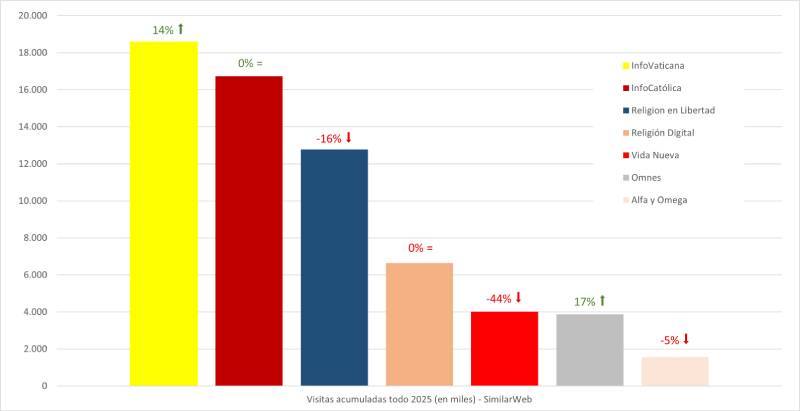
It is Sunday, we enter the warm summer in Rome, and we begin with enormous gratitude to our readers, and rightly so. Many are those who each day approach the ‘enigmatic’ Specola to find out what winds are blowing through Rome and its surroundings. Here we have been punctual for 3,490 days; today’s entry makes 3,491, and we continue with the intention of persevering as long as God, in His infinite goodness, allows. Thank you again, and let us move on to another day—Sunday, but intense.
Thanks to our readers.
Pope Leo XIV in the city of St. Augustine.
«We find ourselves among monuments that speak of you and, therefore, speak to you. I refer not only to the ancient ones, but also to homes, schools, universities, hospitals and parish centers. All of them are significant places, structures with their own meaning, which bear witness to hospitality, education and culture. In different ways, they demonstrate the same care for the individual in the community, with his dignity and values, those that unite you as a people and that are also the foundation of the Italian Constitution».
This is what St. Augustine teaches: «In this context, the figure of St. Augustine shines with a precious light. His thought, the story of his conversion and his spirituality remind us of the value and primacy of interiority: “Do not go away from yourself, return to yourself: the truth dwells within you”. The need to rediscover ourselves, to avoid losing ourselves in external fragmentation, to seek and find a meaning that guides our lives and animates our relationships, is a need common to all: today it resurfaces in different ways even in the haste and dispersion of daily life, especially in the questions of the youngest».
The omnipresent synodality.
One day they will explain to us what this topic, so present yet so incomprehensible, consists of. Pope Leo encouraged young people to read the writings, letters and travel diaries of Cabrini. And he offered a wish to the Church of Lodi in the form of a program: to live «an effective synodality, walking together and striving together for holiness, in the variety of gifts and ministries». It is true that Leo XIV addressed this topic in a decidedly more Christological and less procedural way than had been the norm in the previous pontificate.
The Pope arrived at the Convent of the Augustinian Fathers, a place he knows well: he has visited it frequently, even during the years when he led the Order as Prior General. Upon arrival, he greeted many with his gaze, recognizing several of those present. He met with the Augustinian community, which he knew well. Upon entering the Basilica of San Pietro in Ciel d’Oro, Father Gabriele Pedicino, prior of the Italian province of the Order, offered him the crucifix to kiss. The Pope then entered in procession into the basilica, where the Liturgy of the Word was celebrated before the remains of Augustine, preserved in the marble sarcophagus. The Prior General of the Augustinians, Father Joseph Farrell, welcomed Leo XIV with the same words that Robert Prevost—now Pope—had spoken to receive Benedict XVI during his visit to Pavia in 2007, when he led the Order as Prior General.
The complex ‘migration’.
Speech at the parish of Saints Anthony Abbot and Frances Cabrini, after adoration of the Blessed Sacrament and veneration of the Heart of St. Frances Cabrini. «The phenomenon of migration has entered a different phase, undoubtedly more complex, but no less capable of challenging the Church». «I am here to pay homage to Mother Cabrini, patroness of migrants, the first saint of the United States of America, born here, in Sant’Angelo Lodigiano, in 1850, and died in Chicago, my hometown, in 1917»,
«Mother Cabrini interpreted the signs of the times and understood that the dream of going to China, emulating St. Francis Xavier, had to be realized where, at that moment, the need was greatest». «If Mother Frances were alive today, what would her missionary soul tell her?», «Or rather, what would the Heart of Christ say to her heart as a woman consecrated to Him and to the service of His Kingdom? And what would a Pope like Francis, son of Italian emigrants, have asked of her? He has made service to migrants a key aspect of his pontificate».
Message to the Steubenville youth conferences.
«Peace is a gift of God, a gift we receive when we invite the Lord into our hearts». This is how Pope Leo XIV expressed it in his video message—in English—sent to the participants of the Steubenville Summer Youth Conferences, on the occasion of the 50th anniversary of these summer gatherings in the United States. He presented to the young people the figure of St. Francis of Assisi, recalling that this year also marks the 800th anniversary of his death and the greeting with which the saint used to receive people. He recounted the episode in which St. Francis explained to Brother Leo the meaning of perfect joy: not material goods, nor health, nor fame, but the ability to face even the most difficult trials with patience, without complaining and with love for God: «This is perfect joy». The Pope warned that true joy is not found «in electronic devices, spending hours in front of a screen or browsing social networks daily», nor in drug use, alcohol abuse or superficial relationships. «Many of you have felt since childhood that God loves you. But do you really believe it? You are precious in God’s eyes! He loves you unconditionally!» The Pontiff concluded with a call to vocations: «If you feel that the Lord is calling you, do not close yourself off or turn away out of fear, but draw near and say to the Lord: “Here I am, send me” (Is 6:8)».
Religion and Global Politics.
This Monday, June 22, the Pontifical Gregorian University will host the inaugural session of the «Rome Summer Seminars on Religion and Global Politics 2026». The program, promoted by the collaboration between the Gregorian University, the University of Notre Dame and the Sinderesi Foundation, brings together students, researchers and experts to reflect on the great dilemmas of the contemporary world. The public session will focus on the keynote lecture by Professor Massimo Faggioli, of Trinity College Dublin, entitled «Pope Leo XIV and Global Politics: From the 2025 Conclave to the Magnifica Humanitas». His intervention seeks to offer a reflection on the place of the Holy See in the current international context, with special emphasis on its vocation to the service of peace, dialogue and multilateralism.
Faggioli’s contribution aims to help highlight the role of the Holy See as a potential «guardian of multilateralism» and as one of the «neutral bridges» at the service of reconciliation, at a historical moment marked by deep geopolitical tensions. The reflection will also examine the specific nature of the Holy See’s action, distinct from the logic of power, as well as the Vatican City’s own contribution to the peace mission of the pontificate, in view of the centenary of its foundation in 2029.
European Catechetical Team.
Peace, encounter, differences… these three words describe the work of the European Catechetical Team; here are the materials of the European Congress 2026. The European Team celebrates the 75th anniversary of its foundation; its president, Carl-Mario Sultana, at the opening of the congress, shared the desire to be a laboratory of peace and to promote the «conviviality of differences» as an active management of diversity. To celebrate the 75th anniversary of the European Team, Sister Thérèse Kanacry (from Damascus and with missionary experience in Russia), André Fossion (from Belgium, former president of the CEE between 1998 and 2006) and Karl Heinz Schmitt (from Germany) shared their experience of belonging to the Team, highlighting the value of dialogue and fraternal research among people of different origins. Very happy to meet each other and, by their own confession, the meeting showed that differences can become spaces of conviviality. We are sure that for many this ‘team’ is completely unknown. If we have to know it by its works, there are few. It would not be a bad idea for them to learn from their catechist colleagues in Africa, for example, where Catholicism is growing while in Europe it is dedicated to encounters with differences.
The mariologist of the Co-redemptrix.
Father Gabriele Roschini, the principal mariologist trusted by Pius XII, identified five key principles of the Church’s Magisterium regarding Marian co-redemption. The first point: Mary is the cause of universal salvation, «secondary and subordinate» to Christ. Roschini was founder of the journal Marianum (1939) and of the Faculty of Theology of the same name (1950), author of more than 900 publications, both monographs and articles, and expert at Vatican II, to which he contributed with the expansion of chapter VIII of the dogmatic constitution Lumen Gentium.
And it is precisely from the Council that Roschini draws his inspiration to highlight that the Magisterium teaches the «principle of association» of Mary with Christ throughout the work of redemption. By virtue of this association, established by God with His free will, Mary is truly the cause of universal salvation, «secondary and subordinate to Christ». This principle completes—although it is distinguished from it—the association with the person of Christ that we find in the divine maternity.
Leo XIII affirms this same association on several occasions. In the encyclical Supremi Apostolatus he relates it to the divine maternity: «Indeed, the Immaculate Virgin, chosen Mother of God and, therefore, co-redemptrix of the human race, enjoys in her Son a power and a grace so great that no creature, neither human nor angelic, has ever been able to attain anything greater». The Latin text contains the expression « consors facta », which literally indicates the principle of association in the redemption, translated into Italian as «coredentrice».
The teaching of St. Pius X in the encyclical Ad diem illum lætissimum is well known, where he stated that the intimate communion of feelings and sufferings between the Son and the Mother made the latter the mediatrix of all grace, since «she was associated by Jesus Christ in the work of redemption», obtaining for us « de congruo, as theologians say, what Jesus Christ obtained for us de condigno ».
The rebel nuns.
Reduced to the lay state. The rebel nuns of the diocese of Vittorio Veneto, protagonists of what was called a «flight from the convent», are no longer subject to the ecclesiastical restrictions derived from the vows they made when entering the Cistercian order. Therefore, they are no longer required to obey, chastity or poverty, nor respect for internal norms, including the cloistered life. They are no longer nuns, although after leaving the convent of Saints Gervasius and Protase, they found a home in a private residence, where they have organized a new communal life. The reason: a climate of “unbearable tensions” after the dismissal of the mother superior, Aline Pereira. In mid-May, the Cistercian Order issued a statement explaining the situation, as published by Vatican News.
The nuns, some with more than 25 years in the convent, denounced “strong psychological pressure” after “the intervention” of the monastery, ordered by the Dicastery for Institutes of Consecrated Life and Societies of Apostolic Life on April 7, 2025. The conflict originated in January 2023, when four nuns sent a letter to Pope Francis accusing Mother Aline Pereira of alleged abuses of authority and emotional manipulation. Two ecclesiastical inspections dismissed the accusations, describing them as “slanders”, and the complainants were transferred to other monasteries. Despite this, the monastery received eight additional canonical visits, which, according to the fugitive nuns, intensified the oppressive atmosphere.
The five nuns presented themselves before the Carabinieri of Vittorio Veneto, informing of their decision to leave the convent and their need to “recover in a safe place”, whose location they keep secret. No criminal or civil motives have been reported behind the flight, but the case has sparked a debate on mental health and management in religious communities. The diocese of Vittorio Veneto acknowledged the conflict, but clarified that it has no direct competence, since management corresponds to the Cistercian Order and the Vatican Dicastery.
Exorcisms in Fatima.
In the basement of a small shopping center, a few steps from the wide esplanade of the Fatima shrine, one of the most visited pilgrimage sites of the Catholic Church. The meeting is part of a series of so-called monthly «exorcism retreats» held in Fatima that have raised concern among Catholic authorities, who say they operate outside official Church supervision, led by self-proclaimed religious. Recently, more than 100 people were waiting for the moment when Francisco Marques, 27, would begin to lay his hands on the participants one by one. Dressed in a black cassock and Roman collar, Marques has the appearance of a traditional Catholic cleric.
McElroy and Cupich with Martin.
No surprise, God creates them and as we know… The archbishops of Washington, DC and Chicago, as well as Eduardo Peñalver, the new pro-LGBT president of Georgetown Jesuit University, sent greetings to attendees at Father James Martin’s Outreach Conference this weekend. In an X post, Outreach shared three letters dated June 19 written by McElroy, who will speak at the conference, Cupich and Peñalver, offering encouragement and prayers to conference attendees, some of whom probably do not live according to Catholic teaching, and emphasizing the «new ministry» toward «LGBT Catholics» under Popes Francis and Leo. Father James Martin’s 2026 Outreach Community Conference, titled «Walking Side by Side: Celebrating Five Years of Outreach Ministries», will take place June 19–21 at Georgetown University.
McElroy: «I am pleased to welcome you to the 2026 Evangelization Conference here in Washington». «Because I know that the Holy Spirit will be deeply present in our gatherings and discussions at this crucial moment in the history of our Church and our nation». The cardinal noted that the conference is held after Pope Francis laid the foundations for an “authentic ministry” toward the so-called “LGBT community”, a work that, he said, has been continued by Pope Leo XIV. “We gather at a time when the pastoral foundations laid by Pope Francis for an authentic ministry to and with the LGBT community are being deepened and perfected by Pope Leo”.
Pope Leo XIV, nor the official Vatican media, deny anything and seem to continue with the ambiguity of Pope Francis on the issue. Last fall, he allowed thousands of so-called «LGBT Catholics» to enter procession into St. Peter’s Basilica, led by a rainbow cross, many accompanied by their homosexual «partners», dressed in rainbow colors, and some waving «LGBT pride» flags. Father Martin also stated in an interview in February that Leo assured him that he plans to continue Francis’s pro-LGBT agenda during a private audience. In addition to McElroy, other prominent speakers at this year’s conference include Father Martin; Kerry A. Robinson, president and CEO of Catholic Charities USA, and dissenting theologian Father James Keenan, SJ.
«…fear above all Him who can destroy both soul and body in hell».
Happy reading.