


We have followed this journey with great attention, considering that for Pope Leo XIV it was an effort many deemed impossible. We do not doubt that the test was heavy, but we have seen the Pope grow, relaxed, in his element; all of this has undoubtedly compensated for any other possible limitations. Medical attention was constant, and we believe that Leo is docile and has followed the advice on rest and proper nutrition, and that helps a great deal. Peru is over and the Pope is already in Rome; he arrived almost at the same time we published today’s information. Let us hope his recovery continues successfully.
From the last day remains the Mass at Las Palmas with a million and a half people, some phrases from the Pope, some he did not say but were published, and a rosary that struck him in the face from the crowd. The pontifical commissioner of the Sodalicio finally explains how the six victims from Lima were chosen, and answers only half the question; and the journalist who brought the Vatican a dossier on Opus Dei now recounts what the Pope told him when he received it. We have the first two assessments of the trip, the chasuble woven with an indigenous cross and the two chairs carved in a prison, what his former secretary recounts, a cardinal who asks the Pope to replace the prefect of the Doctrine of the Faith, the death of the nuncio who was the Holy See’s eyes in Jerusalem, and the accounts of the Austrian Church. Another very dense day that we try to present. Enjoy your reading.
The Mass at Las Palmas and the phrase he did not say
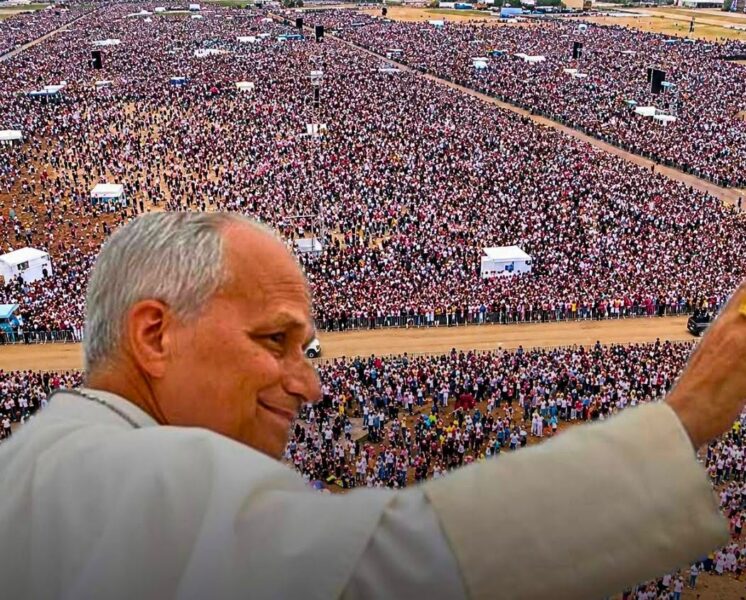
The day is recorded with a clock. The Bollettino notes the arrival at Las Palmas Air Base at 10:06, the drive in an open car among the faithful, the Mass at 10:53, the words of thanks from the archbishop of Lima, Cardinal Carlos Gustavo Castillo Mattasoglio, and the transfer at 13:07 to Callao Air Base for the farewell ceremony. The figure, and this matters after the week we have had, is attributed: around a million and a half faithful, according to local authorities. Peru is a great country and has taken to the streets with its Pope, days for history.
The official text says: “Here they taught me to be a ‘bishop’ and now I have learned, a little more, to serve as the Successor of Peter”. It is not a stylistic nuance: the Pope put “bishop” in quotation marks and avoided saying “to be pope,” which is precisely what the headlines make him say. The EFE dispatch carries the correct version in the body and the rewritten one in the headline, and from there it has passed identically to half a dozen newspapers in Spain, Mexico, Panama, Bolivia, El Salvador and the Dominican Republic.
Two other phrases from the homily are remembered. “My journey ends, but the time of mission continues!” and “the Peruvian people are also my people!” Ariana Pernía Paolini concludes in Vatican News with the final sending, “go and announce the true God”. And there is a phrase about Saint Turibius that no one has carried and that closes the jubilee better than any gloss: “He would not accept even the smallest gift from anyone.”
The rosary that struck him in the face
Before the Mass, during the drive in the popemobile across the Las Palmas esplanade, a faithful threw a rosary from the crowd and it hit him in the face. The broadcast images show him bringing his hand to his face while greeting and collecting objects; he immediately resumed the route and presided over the Mass without the program being altered. Vatican News reported on X that he is unharmed, and EWTN asked the faithful not to throw objects at the Holy Father. Much of the European and Latin American press headlined placing the impact in the eye. The in-house note stays with the face, which is what is seen, and there is no medical report or communiqué from the Press Office: the only official statement is that he is unharmed. It is best not to construct an injury from a video frame, especially with a Pope operated on five weeks ago.
Who chose the six victims from Lima
This is the news. Since Wednesday we have been asking what criteria were used to choose the six victims the Pope received at the nunciature in Lima, and why the others were not there. Jordi Bertomeu, pontifical commissioner for the Sodalicio case and official of the Dicastery for the Doctrine of the Faith, answers in an interview with Cristina Sánchez Aguilar published on 14 November in Alfa y Omega: “I was asked to make suggestions on the criteria to be followed,” he proposed some names, and “afterwards it was other Vatican instances that took the final decision”. He adds that the selection was influenced by “numerous factors that I do not know in their entirety.”
Half an answer, then. We already know who proposed the criteria and some of the names; we still do not know which instances decided, and he himself says he does not know all the factors. That is exactly what the victims who were not included in the trip were asking, and what the letter we collected yesterday requested. And in the same interview there are two data points that stand on their own. The recognized victims number more than two hundred and fifty. And Bertomeu asks those responsible to make available to the liquidation commissioner the assets necessary to compensate them, points out that there are alleged economic irregularities to investigate, and acknowledges that he cannot be more explicit about the steps he is taking to obtain resources. Listening that does not translate into concrete decisions runs the risk of becoming a new disappointment.
The Opus Dei dossier and what Gore says the Pope told him
And the most serious matter of the day, which requires careful writing because these are accusations. Antonio Romano collects in Stilum Curiae, Marco Tosatti’s blog, the messages that British journalist Gareth Gore published on 13 November about his meeting with the Pope. Gore is the author of Opus, published in 2024, and was received at the Vatican on 16 March through the mediation of Peruvian journalist Pedro Salinas, who is the one who exposed the Sodalicio case: the same thread we are dealing with in the previous section. He brought a dossier with internal documentation, testimonies and the Argentine prosecutors’ file. What Gore now recounts, and must be read as what it is—the account of a private conversation, not confirmed by the Holy See—are two phrases he attributes to the Pope. That upon receiving the papers he said: “thank you for bringing them,” and then that he would keep them under lock and key in his room “because, if I hand them over to anyone around here, they will simply disappear.” And that he commented he had personally decided to make the meeting public, before adding: “you know, these people are very powerful around here.” Gore says he offered to put the Vatican in contact with victims willing to testify and that there has been silence since then, and ends by posing the question in his own terms: whether the Pope has chosen not to act or whether his efforts are being obstructed.
How the case stands with verifiable data. The Argentine investigation is federal, for alleged human trafficking, affects 43 women over four decades, and the prosecutors have formally requested that Monsignor Mariano Fazio, auxiliary vicar of the prelature, be summoned to testify. Opus Dei categorically denies the charge of trafficking, asks that the judicial investigation run its course and places the denounced facts in the time of the former auxiliary numeraries, especially in the seventies and eighties. Both things are on record and both are written. Romano closes by saying that in Argentina the Pope did not receive the victims of the Próvolo Institute or the Opus Dei complainants who had asked to be heard, but five women chosen by the local Church who were not on the program. Five in Argentina and six in Lima, distinct acts and distinct countries, so they should not be added or confused. What does repeat is the form: someone decides the list, the criterion is not on record, and those left out find out through the press. It is exactly what Bertomeu describes from within when he says he suggested criteria and names and that others decided.
The geopolitical accounts of the trip
With the Pope already in Rome the assessment begins, and the first to arrive is one of geopolitical accounting. Piero Schiavazzi signs in the Italian HuffPost “La cura ricostituente dello yankee latino. Leone si riprende il Perù e restituisce l’Argentina a Francesco”, and his thesis is in the title: in a South America that, he writes, has been left emotionally orphaned of the stepfather Trump after the repudiation of Brazil and the midterms, the Pope has recovered Peru from the Andean peaks to the Pacific coast and has returned Argentina to Pope Francis and the original maternity of the Church, putting his doctrine back into circulation on avenues traversed by an unbridled and one-way liberalism. And he adds a judgment: never has a Yankee personality aroused such overwhelming attraction in Latin American peoples nor such evident attention in the ruling classes, instinctively wary of gringos.
What lies beneath is verifiable, and it is what we have been writing for nine days: in Argentina the Pope cited his predecessor and reformulated his slogans, and in Peru he did the opposite, speaking in the first person of his own years in Chiclayo. That this means returning one country and recovering another is Schiavazzi’s reading; that both things happened is the fact.
The cardinals did not know he was Peruvian
And a Peruvian piece that explains the trip from behind. Cardinal Carlos Castillo, archbishop of Lima, tells RPP that in the meetings prior to the conclave Prevost intervened briefly and that of him “it was only known that he was North American”; and adds that “although it is true he came from Peru, we would say that not much attention was paid to him”. La República recalls the data: he obtained Peruvian nationality in 2015, while bishop of Chiclayo, and was at the head of the diocese until Pope Francis called him to Rome in 2023 for the Dicastery for Bishops.
The other two voices in the piece are from the days following the conclave, not from now: Cardinal Robert McElroy, archbishop of Washington, then described that being American turned out to be “almost irrelevant” in the deliberations, and Cardinal Timothy Dolan, of New York, recounted that some colleagues asked him who “this Roberto Prevost” was. What is new is the contrast, and it is what we have been writing for nine days: the condition to which in May 2025 little attention was paid is the one that has sustained the entire record of the trip, from the return “also to my homeland” upon landing in Lima to the “may God bless you, my Peru” of the farewell.
The shipibo-konibo chasuble and the two chairs from the prison
What remains to be told is what the act in Pucallpa was made of. The chasuble was designed by the Ucayali artist Chonon Bensho together with Vilca Gonzales and Pedro Favaron, and the motifs come from shipibo-konibo kené, which represents rivers, forests, medicinal plants and the spiritual; the mitre, white, bore the insignia of the Ecclesial Conference of the Amazon. Chonon Bensho was born in 1992 in the native community of Santa Clara de Yarinacocha and in 2022 was the first indigenous woman to win the National Painting Contest of the Central Reserve Bank, with Inin Paro; she has work in the Museum of Art of Lima. She has also hand-embroidered another chasuble for him, which is the gift.
The koros kené is a shipibo-konibo drawing in the form of a cross, and the chasuble was green with golden details; the designs were not only for the Pope, but for the vestments of all the priests and bishops at the Mass, and the vessels and liturgical objects were local craftsmanship instead of the usual metal ones. That is: not a liturgical ornament decorated with indigenous motifs, but an indigenous motif that was already a cross before anyone asked for it. After an entire trip of discussions about syncretism, the answer was woven into the chasuble. It was presented days earlier by Father Luca Zanta, coordinator of the visit in Pucallpa, and EFE presents the act as the first Mass of a Pope in the Peruvian Amazon. The altar, in the Villa Deportiva Regional de Ucayali that they call there La Videnita, was presided over by a simple wooden cross, with kené in blue, white, black and brown on the sides and the roof covered with dry palm leaves, like Amazonian houses.
And the chair. It was carved by inmates of the Pucallpa penitentiary establishment, in the workshops of the Cárceles Productivas program, and they made not one but two: one the Pope takes with him and the other remains in Pucallpa for a cultural space the Church projects. Senator Jorge Velásquez Portocarrero explained it this way: “we made two because one has to be taken by the pope and the other remains for the exhibition”. They bear vegetal details and a cross carved on the arms and back, and a padded seat; in that prison the inmates are trained in carpentry and carving as part of reintegration. The cross, again: woven in the chasuble and carved in the arms of the chair.
What the one who kept his schedule recounts
And the best portrait of the trip is signed by the one who has the least reason to embellish it. Antonella Palermo interviews in Vatican News, from Chiclayo, Father Jasson Sempertegui, who was personal secretary to Bishop Prevost and today is parish vicar of Eten. She first collects the Pope’s words at the bishopric on Sunday, before saying goodbye: that Chiclayo always be the capital of friendship, but also “a city, a province, a land of faith, of devotion and of fidelity.” And he explains what that diocese consisted of: natural disasters, the consequences of the pandemic, immigration, transport, the most intense poverty in the peripheries, people who sometimes do not even have the basics. “People would come to knock on the bishop’s door and he always, always kept the door open.” Of the rest we keep three things, because all three are data and not pictures. One: what moved him most was the crowning of the Virgin, because he saw the Pope pray before the image and speak with her before the ceremony. Two: “he is a solemn man, very solemn. He likes the liturgy very much,” and in the celebrations he immerses himself in it. And three: he taught him to drive when he was ordained, he likes cars, he got a bit nervous giving the lesson, and they played tennis at a school or in the seminary, where the bishop won. To a lady who arrived with problems he gave a cross he had received from Pope Francis and blessed her with it. Sempertegui sums it up by saying he has found him the same and at the same time changed, and that now “his heart is bigger.”
Antonio Franco, nuncio in Jerusalem, has died
Monsignor Antonio Franco, apostolic nuncio emeritus, born in Puglianello, in the province of Benevento, in 1937, ordained priest on 10 July 1960 for the diocese of Cerreto Sannita-Telese-Sant’Agata de’ Goti and made bishop by John Paul II in 1992, with the title of archbishop of Gallese, has died at the age of 89. The death was announced by the bishop of Cerreto, Monsignor Giuseppe Mazzafaro. The lying in state, in the parish of San Giacomo Apostolo in his town; the funeral, in the church of Sant’Alfonso Maria de’ Liguori in Telese Terme. His service record explains why his name appears today and not another day. He was the first apostolic nuncio in Ukraine after the fall of the Soviet Union, and on 21 January 2006 Benedict XVI appointed him nuncio in Israel and Cyprus and apostolic delegate in Jerusalem and Palestine. That is, the man who was the eyes and voice of the Holy See in the Holy Land dies on the same day Cardinal Gugerotti lands there in the name of the Pope. It has no more meaning than that of coincidence, but the coincidence is there.
Viganò writes to the European nobility
And to end with yesterday’s, a text that it is best to date before discussing. Tosatti publishes the video message that Carlo Maria Viganò sent on 14 November to the Congress for Peace of Artstetten, addressed to the European nobility, to parliamentarians and to the military. He maintains that what is happening are not accidental crises but a planned dissolution; that the UN and the European Union fuel conflicts to weaken nations; that the crisis is anthropological; and that the conciliar and synodal church “of Robert Francis Prevost, who occupies the Chair of Peter” is an active collaborator in a globalist plan and is in “a capital schism.” He lists Poitiers in 732, Lepanto in 1571 and Vienna in 1683, invokes Leo XIII and Pius XII speaking to the patriciate, and ends by asking for money: that those present finance the formation of seminarians outside the structures of the official Church through the Exsurge Domine Foundation, of which he is patron.
The World Day of the Poor, without the Pope and with a sponsor
While the Pope was in Pucallpa, the tenth World Day of the Poor was celebrated in Rome. Isabel Barry recounts in EWTN that the Mass on the 15th in St. Peter’s, of the Dicastery for Evangelization, was presided over at the Pope’s request by Monsignor Luis Marín de San Martín, and that the lunch has been moved to the 22nd, after the trip: some 1,300 people living on the street, in the Paul VI Hall, with ice cream donated by an ice-cream parlor, the National Fanfare of the Italian Red Cross providing musical accompaniment and, on the way out, a personal hygiene kit donated by Procter & Gamble. The sponsor is listed in the Vatican note, so we write it as it is.
Marín de San Martín is papal almoner and prefect of the Dicastery for the Service of Charity since 12 March, when Leo XIV appointed him in substitution of Cardinal Krajewski. He is Augustinian, like the Pope: for the Mass for the poor, the Augustinian Pope sent an Augustinian. The two Vatican outpatient clinics, Madre de la Misericordia, from 2015, and San Martino, from 2025, extend their hours that week for general and specialized medicine consultations, oncological screenings, flu vaccination and blood tests. They are attended by 120 volunteers among doctors, pharmacists, technicians and nurses, cover 26 specialties, and are designed for those who have no documents and cannot enter the Italian health system. Massimo Ralli, undersecretary of the dicastery, explains it to EWTN News without rhetoric: “these people do not know where to go, so they come here and can access specialists in cardiology, ophthalmology or gastroenterology.” They also pay for dental prostheses and glasses, and Ralli points out that with bad teeth it is more difficult for someone to be given a job in an interview.
Duverger leaves the FSSPX and the Priestly Fraternity of St. Peter draws distances
Two small movements that, together, say something about the aftermath of the Écône consecrations. The first we recounted on the 13th: Father Patrick Duverger, ordained in 1993 and superior of the Benelux district of the FSSPX for six years, until 2022, joins a community of the Priestly Fraternity of St. Peter in Viry-Châtillon, in the diocese of Évry. The detail that makes it news is who succeeded him in that district: Michel Poinsinet de Sivry, one of the bishops consecrated in Écône this year. The predecessor leaves by the path the successor did not want to take.
Father Benoît de Giacomoni, superior of the French district of the Priestly Fraternity of St. Peter, spoke with the Pope on 28 October at the end of a general audience and handed him several gifts, including his June letter to friends and benefactors. That letter, written in the wake of the consecrations, compares 1988 with 2026 and presents the Priestly Fraternity of St. Peter as the alternative: it accepts number 25 of Lumen gentium, the legitimacy of the Novus Ordo and the 1983 Code, and avoids controversy with the Council. The Fraternity says the Pope blessed the French province. The datum is that the Dicastery for the Doctrine of the Faith declared by decree of 2 July the excommunication of the six bishops involved, and that the canonical appeal of the FSSPX remains without known novelty.
Zen asks the Pope to replace the prefect of the Doctrine of the Faith
And a request from a cardinal that deserves its own headline. La Nuova Bussola Quotidiana glosses a post of 6 November on the blog of Cardinal Joseph Zen, bishop emeritus of Hong Kong, with a triple appeal: that an end be put to the “so-called ‘Synod on Synodality’”; that the Pope not entrust the government of the Church to the Secretariat of the Synods and instead seek a closer communion with the bishops and with the cardinals; and that “the Holy Father should also replace the head of the Dicastery for the Doctrine of the Faith”. The prefect continues to be Cardinal Víctor Manuel Fernández, whom this Pope has kept in the post and whom he sent in February to halt the challenge of the Lefebvrians, the same matter as in the previous section. Zen also maintains that the objectives of the synod are to modify the hierarchical constitution of the Church, to ordain women beginning with the diaconate, to leave celibacy to the choice of the Latin clergy and a “radically updated” sexual morality, and reproaches that the final report of Group 9 concludes that the sexual act of a homosexual couple is a gift of God, which he calls a blasphemy. That last is a quotation we have not been able to check against the document, so it remains as what it is, what the cardinal affirms. The rest of the editorial is an exegesis of Hegel applied to the synod, thesis, antithesis and synthesis, which is the author’s apparatus and not Zen’s.
Germany and the Synodal Conference that did not meet
The other reading of the trip looks north. Matteo Matzuzzi titles in Il Foglio “L’abisso tra il messaggio del Papa e le rivendicazioni delle decadenti Chiese europee”, and maintains that it is not difficult to see the distance between those words and the claims of the Church in Germany: that the rails on which the German bishops and the Pope move are diametrically opposed. The image is a good one. It is worth placing beside it what the Pope has said about Germany when asked, which is less categorical.
On the return flight from Beirut, answering a journalist from ARD, he said he expects “some adjustments on both sides in Germany” and that things will be resolved in a positive way; that the synodal path “is not a peculiarity of Germany,” because the whole Church has celebrated a synod; and that inculturation is acceptable, provided the dialogue does not exclude anyone’s voice. Giacomo König recounts it in ACI Stampa, and it must be dated: December 2025, not the day before yesterday.
And between that response and today are the facts. In February the German bishops elected Heiner Wilmer president; in February they approved the statutes of the Synodal Conference and on 31 March took them to Rome. The first assembly of the body, convened for 6 and 7 November in Stuttgart, was canceled without the delegates receiving official notification; the statutes remain under study in Rome, there is no new date and the Vatican has not authorized the body. Four bishops declined to join the provisional committee. That Roman silence is a halt on the way is interpretation and so we present it; the datum is that the assembly was not held and that Rome has said neither yes nor no. What we did publish in August is that not depending on Germany was one of the keys to the Pope’s dinner with American donors.
Austria, the Church that pays off for the State
And a datum for the series of accounts. The study Wirtschaftsfaktor Kirche 2026, carried out by Joanneum Research at the request of the Austrian Church itself with 2023 data, calculates that the Church leaves the State some 890 million euros net: it pays in taxes and contributions more than it receives. In 2012 the same calculation gave a net deficit of 130 million, so the turnaround is a thousand million in eleven years. The rest of the figures: 7.3 billion in gross value added, one of every 59 euros in Austria; 85,200 full-time equivalent jobs, one of every 45; and 462.4 million in volunteering, valued at the average hourly wage, with 270,000 people in parishes. The study itself incorporates and what the press that has collected it does not always convey. What the Church receives from the Austrian State is some 2.89 billion between purchases of services and subsidies, with the salaries of teachers in Catholic schools included and the gross profit of 12.8 billion includes value added abroad, and subtracting imports and external aid it drops to some 10.17 billion.
The Vatican Library opens on Saturdays
And one that is a service to the reader. The Apostolic Vatican Library, normally closed to anyone who does not come to consult, can be visited thanks to an exhibition. It is AQVA, open from 25 September to 14 May 2027, Saturdays from 10:00 to 18:45 with audio guide and special visits on Friday afternoons, with mandatory reservation 48 hours in advance and tickets from 10 to 15 euros; it is curated by Giacomo Cardinali, Simona De Crescenzo, Francesca Giannetto and Delio Proverbio. It is the first chapter of a five-year cycle entitled Catastrofe e Meraviglia, on the historical threats to the written word—fire, water, light, insects and man—made with the Fondazione Roma and with the support of Intesa Sanpaolo: second private sponsor of today’s edition, in case anyone is keeping count. There is a room dedicated to the sixty years of the 1966 Florence flood, a JR wave on the façade inspired by an engraving by Doré, and two copies of the Aquatilium animalium historiae by Ippolito Salviani, printed in Rome in 1557 at the initiative of the Library itself. The Sistine Hall, some seventy meters long, commissioned by Sixtus V between 1587 and 1589 and frescoed among others by Cesare Nebbia and Giovanni Guerra, is the largest room with frescoes in the world if churches are left out. The Library was founded by Sixtus IV in 1475 on an idea of Nicholas V from 1451, and holds 180,000 manuscripts.
Today the memorial of Saint Elizabeth of Hungary, the gospel is that of Zacchaeus.
“If I have defrauded anyone, I will repay it four times over.”