


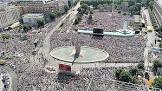
We begin the week and Pope Leo is in Spain. Inevitably, we must look toward the Pope’s activities these days in the homeland of Catholicism for half the world. In America, Spain is often called the mother country, to which the continent owes, above all, the Catholic faith, European culture, and a language that marks the New World. The response of Spanish Catholics could not be more spectacular; it does not reach the numbers of the visits by the two previous popes who have visited us, but it is undoubtedly very respectable, to the point of making one think that mainstream media always lie to us and prefer not to speak of the vitality of Catholicism, which they consider dead. The high clergy, almost all the bishops and those around them—with very glorious exceptions—believe the official narrative and devote themselves to negotiating with a Woke world that smells of death and has long been buried. What would have happened if, on this trip, all speeches had been canceled and we had limited ourselves to praying with the Pope? Possibly everything would have improved: “Seek first the Kingdom of God, and the rest will be given to you as well.” The media are full of a thousand reports that we do not intend to repeat.
Looking Upward and Weaving Networks.
“It is a pleasure to meet you in this place, a space that not only hosts sporting, artistic, and cultural activities, but also the deepest human emotions: joy and admiration, enthusiasm and hope, as well as sadness and frustration. In this splendid country, it is impossible not to admire the imprint of creativity that runs through its history and shapes its identity.” Leo XIV urged not to reject the value of eternity, the cornerstone of European identity, and to integrate it into everyday life. “A beauty visible in its cities, its streets and monuments, its squares and gardens, its universities and churches, in its music, painting, and dance, its gastronomy. Here we also perceive the soul of the generations that have transformed the landscape and given it a unique face, and this reveals to us in every feature the intelligence and will that reside in the human soul.”
“I listened with great interest to each of the speakers’ interventions; I agree with you. Our society, in fact, has an extraordinary capacity to produce, innovate, and communicate; however, it seems we still need to learn to care for the soul of what it generates.” “The Church shares with humility but also with firmness what it has discovered in the experience of faith: that Jesus Christ answers the great questions about human life and its fulfillment, already in this world and until its culmination in eternity… And therefore, it cannot ignore culture, because through it, man as man ‘is’ more.”
Hence the challenge for a Europe that is losing its faith, through the invitation to throw wide open the doors to Jesus: “This is not a provocation, but an invitation to reflect on whether eternity, which broke into time and space through the incarnation of Jesus Christ, can be reconciled with everyday life. Is it really possible to believe that Europe (which we love so much) would be the same without the mark of faith? Why fear that eternity might permeate everyday life? The cry of my predecessors still resounds: Do not be afraid! Throw wide open the doors to Christ! Jesus Christ takes nothing from us and gives us everything.”
Banderas’s Speech.
The intense and contemporary staging contrasted with the absolute silence that, minutes later, would accompany the Eucharistic adoration presided over by the Pope. Two distinct languages—art and prayer—were united for one night before six hundred thousand young people. “Godspell conveys a message more than two thousand years old, but it does so in a novel way,” Banderas explained. Originally premiered on the Off-Broadway circuit in 1971 with music by Stephen Schwartz and lyrics by John-Michael Tebelak, the work reinterprets the Gospel of Matthew in a contemporary key, entrusting music and parables with the task of connecting with new generations.
Professor of Nonverbal Communication and Public Speaking José Luis Martín Ovejero was one of the first to analyze his speech: “One single word to define Antonio Banderas’s speech before the Pope, both in content and in form: exemplary.” “I’m taking it to my Public Speaking courses: he is reading and yet he gestures, looks at the protagonist, plays with words and silences. If you haven’t seen it, I recommend you do.” “It has been one of the best things I have seen and heard in a long time. For a moment I thought he was losing his voice—moving, emotional, and very measured word by word.”
“Holy Father, authorities, friends: there are encounters that are not measured by how long they last, but by what they mean, and your presence today in Madrid is not only a visit, but a gesture of closeness, listening, and dialogue with civil society. That dialogue often finds in art a common language, a historic bridge between the Church and the human being. The relationship between the Catholic Church and art has not only been fruitful, but decisive for the cultural history of humanity, with Jesus Christ as the figure most represented through the centuries, a permanent symbol of love, peace, sacrifice, and mystery.
And it is precisely from my own personal experience that I want to share a reflection: I must go back to Holy Week in my Málaga of the 1960s, to those streets full of faith, music, beauty, and emotion where, as a mere child, a simple but immense question was born in me: ‘God?’ Little by little I found answers in my mother’s moved gaze before the Virgin of Hope, in the heartrending voice of the saetas, in the humble devotion of those who carried images also seeking to find themselves. Because art is not only beauty: it is question, reflection, denunciation, conscience, and also hope. Art must serve to look the human soul in the face, to point out injustice, and to become an alternative to any form of violence. Like Christ, the artist must always keep the courage to be a critical conscience before society, before religion, and before himself.
All human beings share the great questions of existence—who we are, what meaning pain has, what it truly means to love our neighbor, or what exists beyond us—and in that search we inevitably draw near to the transcendent. In an accelerated and fragmented world, art helps us recover depth and humanity in the face of the risk that technologies and artificial intelligences may displace what truly makes us human. We need to keep creating, questioning, and seeking not only beauty, but also truth, because every deep question opens a path toward the spiritual, toward that fraternity that beats both in the human heart and in the mysterious heart of God. As Saint Augustine said: ‘Be better yourselves and the times will be better. You are the time.’ And today I am here precisely because of ‘Godspell,’ whose meaning is ‘The Spell of God,’ humbly confessing that I too have been a victim of that spell. Thank you very much.”
Corpus Christi Mass in Cibeles.
Massive, some say up to two million, more than one for sure. At the end of the Mass, the Pope personally carried the monstrance in a brief procession. Nothing like what processions usually are in Spain—more like one in a humble village than those of Toledo or Seville, or Madrid’s own every year—but very significant for seeing the Pope carrying the Blessed Sacrament through the streets of Madrid.
“It is not an external display, a folkloric survival, or a mere aesthetic ornament: it is faith in the presence of the Risen Lord, who is alive and continues to be among us, who becomes bread for our hunger for life and visits the corners of our hearts and our history, even the darkest ones.” “It is not only about carrying a monstrance, but rather about allowing ourselves to be guided beyond selfishness, indifference, and a comfortable, private faith, to respond to his call to conversion, to change our perspective, welcoming his presence that transforms us and makes us builders of a new world.”
The Pope entrusted Spain with “a mission for today and for tomorrow: that the religiosity that has animated this country for centuries not become a museum of the past to be visited, but a school of faith from which we can draw nourishment even today.” “A school,” he stressed, “that teaches us to kneel before God and before our neighbor, because no one can kneel before the Lord and despise his brother ; a school that teaches us the gratuity of love that becomes a gift, so that it may circulate among us and break the chains of all selfishness; a school from which we learn that God is a real presence and that we too are called to be present in the situations and challenges of society, not to flee, but to commit ourselves personally to building the common good.”
Criticism of Pope Leo’s Visit to Spain.
A very followed Spanish journalist, Federico Jiménez, offers us a commentary that is not to be missed. “Pope Leo XIV’s trip has already begun with signs worthy of comment, both regarding the progressive drift of the Church in Spain, whose symbol is the red Cobo, and the confusion in the Vatican over Bergoglio’s legacy, the so-called synodality, a word without tradition but with a clear meaning: assembly-like, the Protestant-style replacement of ecclesial hierarchy by a kind of meeting in which laypeople vote, on the same level as cardinals and bishops, what could be called the politics of dogma, Revelation put to a vote.” “A Third by Cobo in ABC, mediocre in literary terms and devoid of any evangelical reference, insisted on the first day of the papal visit that the future of the Church is synodal, a phrase of Bergoglio’s against which the elderly Chinese Cardinal Zen, a victim of communist prisons, rose in the presence of Leo XIV, saying that it liquidated hierarchy and dogma and reduced the divine character of the Church to a matter of opinion. He has not been the only cardinal to point this out, and it is said that Leo XIV, in the last synodal session, seated at round tables like those at a wedding, did not endorse the direction marked by Bergoglio as a testament. That has given hope to the enemies of the tumultuous church, but the truth is that the new Pope did not shelve the dangerous invention either. And Bergoglians like Cobo maintain that it is the line to follow.” “The Pope’s first visit, with Cobo, was to a Caritas center, those red Christians, breeding ground of Podemos, who never say Charity but Justice, in a poor neighborhood, and he met illegal immigrants who call themselves migrants, and they gave him a residence card and some sandals, as an apostolic symbol.
“Bergoglio hated Spain (that is why he never came), both for its historical significance, from the Reconquista to the evangelization of America, and for the triumph of Franco’s Catholic army and the martyrs of the Civil War, the Church Triumphant that Rome condemned to an ominous silence. Cobo, the soapy altar boy whom the Argentine made cardinal, made a pact with Bolaños for his new burial by resignifying, that is, profaning, the Valley of the Fallen. And the first steps of the Pope’s visit have been overwhelmingly Cobian. He has not gone to Compostela—the mention of Santiago in his first speech did not fix it, quite the opposite—nor to pray before the highest cross in the world, that of the Valley, condemned to demolition by Cobo.”
“The worst, however, was not the truth of the persecuted church that he hid, nor the mess he made commenting on Saint John of the Cross, without the ‘saint,’ but the genuflection before Islam, disguised with the lie of the coexistence of the three cultures during the centuries of Muslim rule, which never existed. What there was was a contract of translators by Alfonso X the Wise, who, at the same time, waged relentless war on Islam, conquered the Guadalquivir Valley with his father Ferdinand III the Saint, as well as the kingdom of Murcia. The School of Translators of Toledo is not a symbol of coexistence, but of Christian tolerance, of the recovery, via Baghdad, of the Greek root of Western thought and of the sacred Hebrew and Latin texts. Catholic means universal, and that was the design of Alfonso X, as it was of the Catholic Monarchs when, after conquering Granada after ten years of war, they left the Alhambra, today with the Palace of Charles V, as Bernini-like as the Vatican.”
“Leo XIV intends to be the pacifist anti-Trump, not anti-Iran, nor anti-Hamas, nor anti-Boko Haram, nor anti-Xi Jinping. The massacres of Christians concern him less than those of Islamist terrorists and their social environment. But Spain, which is to say the history of Catholicism, poses a problem for him: our nation is born or reborn with the Reconquista, always defended the Faith of Christ. Faithful to Rome, it has fought against all heresies. The Catholicism that survives today is Spanish work with Cross and Sword. And the last time the faith of our people was put to the test was in the Civil War, where in the end, after thousands of martyrs, the Catholic side, that of Franco, triumphed. Is the Church with Leo XIV, with Cobo we already know it is, going to continue spitting, like socialists and communists, on the tomb of the one who saved it?” “It is very possible that the beauty of the rites, the elegance of the Royal Palace, the charm of Gaudí, and the joy of the faithful may be a sowing of faith and a harvest of love for Spain, on the threshold of a re-Christianization that would mean a national recovery. Let us hope so. In the meantime, watch Cobo, watch Sánchez, and watch the Vatican cayucos.”
The Revolution in Vatican Communications.
That is what the arrival of Alvarado points to, a figure trained in the United States who will direct the Holy See’s communications network. Bisigniani is always attentive to changes in power. “Leo XVI has just made one of the most significant moves of his pontificate: entrusting the communications of the Holy See to María Montserrat Alvarado, an executive trained at EWTN, the largest Catholic media network in the world, founded by Mother Angelica, the cloistered nun who, like Steve Jobs, started in a garage to build an empire.” “The figures were impressive: one hundred ninety-one publications, one hundred fifty-seven publishing houses, hundreds of thousands of copies distributed, and millions of readers. A statistical declaration of faith that today resembles above all a prelude to a ‘de profundis’ of the long stage of Italian ecclesiastical communication, written by the trio Ruffini, Tornielli, and Bruni: the first already retired, the other two about to do so.
A choice that brings back to the Vatican the American school of Catholic communication and recalls Greg Burke, the man of Opus Dei who, between Benedict XVI and Francis, was appointed head of papal communications. Some will call it a coincidence, others a supply chain. The new prefect comes from an organization that measures results, a kind of Monica Mondardini who, together with Francesco Dini, made the Espresso Group great in its golden age. In recent years, the Holy See’s communications have survived thanks to multimillion-dollar budgets, modest oversight, and a surprising capacity for self-preservation. But now, Alvarado’s arrival risks bringing to light some uncomfortable questions that, for too long, partly due to Bergoglio’s lack of attention, no one had raised. Questions that also concern the effectiveness of the apparatus.
For years, the Vatican Dicastery for Communication has had a staff of nearly six hundred people and resources that many observers consider greater than those allocated to the entire diplomatic network of the Holy See. This imposing structure was conceived as a laboratory for the new digital evangelization, but it seems to have specialized mainly in managing existing structures and seeking administrative sustainability.
The paradox is that, despite the resources, structures, personnel, networks, and funding, it has not managed to evangelize or build a Catholic media community, but belonging, influence, and community were born elsewhere: in Alabama.
Congress of Mercy.
Pope Leo XIV sent a video message to the participants of the sixth edition of the World Apostolic Congress of Mercy, taking place in Vilnius from June 7 to 12. He greeted the participants of the congress, recalling Saint John Paul II’s desire to promote the spread of the message of Divine Mercy. The Vilnius Congress is held in the city that the tradition of Divine Mercy particularly links with Saint Faustina Kowalska and Blessed Michał Sopoćko. It was precisely in Vilnius that the message of mercy was renewed for our time through Saint Faustina. There, in 1934, the first image of Jesus the Merciful was painted, according to the saint’s visions, and since then devotion to Divine Mercy has spread throughout the world.
Preparing Lampedusa.
The Wine ‘Laudato Si’.
A 2023 vintage wine, made with Refosco dal Peduncolo Rosso, Pinot Noir, and Cabernet Sauvignon grapes, in a limited edition of 5,000 bottles by the Villa Russiz Foundation in the Collio area. Baptized “Laudato Si’,” it is destined for the Vatican for the celebration of special occasions. It will be the official wine of the Holy See, at least until production begins in the Borgo Laudato Si’ vineyard. “The wine ‘Laudato Si’’ represents a first production that is not yet possible in Borgo di Castel Gandolfo, but which is possible in Friuli-Venezia Giulia thanks to this twinning.”
The Church of the Future Is Already Here.
And we are finishing, a Church is being born and it is doing so with strength; another resists dying and tries to impose in a thousand ways on new generations what has been the cause of so much pain. In a few years, many of the young people who attended the meeting with Pope Leo will be our priests and our bishops. The change is already here, we only have to open our eyes; God’s times are not ours, but the footsteps are visible and go where they go. Everything else is dead leaves that the wind of history will sweep away much faster than we think. In Spain we are seeing a Catholic people proud of their history but shepherded by those who want to drag them to infamous pastures. Annoying the sheep is not a good path; they rear up and charge. The people of God have a heart, perhaps too much, but also a head: “What a good vassal he would be if he had a good lord to serve.”
“Blessed are those who hunger and thirst for righteousness, for they shall be satisfied.”
Good reading.