


On the third of August, the sky warms the day and the ground the night; we enter fully into August with the exodus of Romans toward the sea or the mountains. Pope Leo has begun it with great activity, and everything suggests we are entering a decisive phase of his pontificate. Only God knows how long it will last, but every Pope learns and shapes his intuitions, which may evolve—let us say, mature—over time. Things do not look the same from a press chronicle as from the papal throne.
A decisive August for Leo XIV?
At least that is how it seems; it has begun with vigor and with audiences for the heavyweights of the Curia. This morning he received Montserrat Alvarado, Prefect of the Dicastery for Communication, in audience—a significant signal. In more than a year of his pontificate, the Pope has met Paolo Ruffini only on a few occasions and has never held private conversations with other key figures in Vatican communications, such as Matteo Bruni, Andrea Tornielli, and Andrea Monda, whom he met only at public events. Official assumption of the Dicastery in November, but in recent days she has visited the various offices, spoken with staff, and begun to investigate directly a series of matters about which she had already received detailed information. Since her arrival at Palazzo Pio, she has requested clarifications and additional information, focusing on the most concrete and delicate issues facing the institution. Alvarado knows the internal mechanisms, has personally witnessed the events of recent years, and has been promptly informed of the main critical problems. The direct meeting with Leo XIV allows Alvarado to prepare the new direction of Vatican communications now, before officially assuming the post, scheduled for November.
To the youth of Ecuador.
Leo XIV, in the video message in Spanish sent to the Ecuadorian youth gathered in Ibarra from July 31 to August 2 for the VII National Youth Day, titled “Take courage, I have overcome the world.” “The Church today needs your joy, your courage, and your witness, so that many others may encounter Christ.” The Pope greeted them “with affection,” encouraging them to “listen to the Lord’s call and follow Him with determination.” “The encounter with Jesus Christ fills the heart with joy and gives us the strength to be witnesses of His love and mercy.” Addressing them as “friends,” the Pontiff invited them to let themselves be “transformed by His love” and to become “promoters of forgiveness, reconciliation, and peace.” Leo XIV entrusted all Ecuadorian youth to Our Lady of the Presentation, “so that Mary may be the model inspiring them to live the Gospel and to surrender themselves, as she did, to God’s plan for their lives.”
The steps to manage the case of the abusive Cardinal.
A calculated process so that the detonation has the least negative effects. It is no minor matter; a scandal of these dimensions is always serious, and dressed in purple, even more so. The Catholic Church in Morocco faces a delicate moment after the Vatican’s decision to temporarily entrust the governance of the Archdiocese of Rabat to an apostolic administrator, pending the conclusion of the Holy See’s investigation into Cardinal Cristóbal López Romero, Archbishop of Rabat, following accusations of sexual abuse and inappropriate behavior. «Father Mario León Dorado will provisionally lead the Moroccan archdiocese while the Holy See’s investigation continues. The cardinal retains his title of archbishop, but with his jurisdiction suspended. The Spanish missionary, apostolic prefect of Western Sahara, has been appointed to ensure pastoral continuity». He is not removed, but he is removed entirely—Vatican subtleties—because the apostolic administrator is «sede plena,» granting him the rights and faculties normally attributed to a residential bishop. López Romero, 74 years old, will turn 75 next May 19, a Salesian, Archbishop of Rabat since 2017 and created cardinal by Pope Francis in 2019. López Romero was considered a representative of a Church close to the peripheries, attentive to issues such as migration, poverty, and interreligious dialogue. Within the Moroccan Church, he defended the role of the Catholic community as a presence of service in a Muslim-majority country, with special emphasis on welcoming migrants from sub-Saharan Africa.
The sin of the liturgical war.
Interview granted to the director of Il Foglio, Matteo Matzuzzi, by Cardinal Sarah. Infovaticana has already reported on it in Cardinal Sarah describes the liturgical war as a “true sin” and calls for recovering Benedict XVI’s model. For Sarah, the division surrounding the traditional Mass constitutes “a drama, a true and authentic sin,” and he has defended the recovery of the model promoted by Benedict XVI, in which the Novus Ordo and the traditional liturgy coexisted within the Roman rite. The Church in the West is going through “a time of great difficulty, even confusion,” especially in doctrinal, moral, and disciplinary matters. “It is a drama, a true and authentic sin, that on an essential matter such as the liturgy there should be a kind of war.” “No one has authority over the rites, which are born of the Church’s secular history. Rites cannot be arbitrarily abolished, and no one can say that a rite ceases to exist overnight.” He calls for recovering the “balanced, pastoral, and theologically grounded position” of Benedict XVI, which allowed the coexistence of the two forms of the Roman rite so that they “enrich each other” and can be known by the people of God. He laments the “dramatic and widespread abuses” that continue to occur in numerous celebrations of the ordinary form of the Roman rite.
Roche and the traditional Mass.
The interview Roche gave to The Tablet continues to reverberate. Diane Montagna recalls that Roche was appointed prefect of the Dicastery barely six weeks before Traditionis Custodes came into force. The bishops themselves were compelled by the Dicastery—often through unsolicited letters—to apply a particularly restrictive interpretation of the motu proprio, with the active support of the Dicastery’s secretary, Archbishop Vittorio Viola. A key passage refers to the rescript Roche obtained from Pope Francis in February 2022, which established that any bishop intending to grant dispensations according to canon law must first inform the Dicastery, which could then confirm or revoke the decision. The author contrasts Roche’s view—that the liturgy must be adapted to make the Church more missionary—with the example of St. Ignatius of Loyola and his Jesuit companions, who set out for the most remote missions, where they suffered martyrdom for preaching the Gospel, sustained precisely by the ancient liturgy. The article concludes with a scathing critique: much work remains to be done in the liturgical sphere, but Cardinal Roche—who has said of himself that he “never felt capable of any task” entrusted to him—is not the right person to do it.
What is the “Vetus Ordo”?
Where did the 1962 Missal come from? Pope John knew of two things pressing in opposite directions in his ministry: on the one hand, he had inherited from Pius XII an already advanced work of reform of the Roman Missal, which with a little work could have become an important text for the life of the Church. But, on the other hand, he had already convoked a new Council, which would have among its objectives a more complete revision of all liturgical matters. Hence the hesitation: proceed immediately or wait for the outcome of the Council? The solution was intermediate and was announced by Pope John XXIII in Rubricarum Instructum (1960), from which the following can be deduced: A new edition of the Tridentine Missal, which would be the 1962 edition, and wait for the Council with the “altiora principia,” on a general reform of the liturgy. The expression used by John XXIII is the following: «Re itaque diu ac mature examinata, in sententiam devenimus, altiora Principia, generalem liturgicam instaurationem respicientia, in proximo Concilio Oecumenico Patribus esse proponenda; memoratam vero rubricarum Breviarii ac Missalis emendationem diutius non esse protrahendam». The 1962 Missal was born with the intention of being replaced. Its singular destiny is that, 45 years later, it has become the expression of an “immutable form” of Catholic worship.
Orthodox monastery attacked in Ethiopia.
Corporal penance.
It is not very fashionable. Peter Damian defended the discipline, specifically the penitential self-flagellation practiced in many monasteries as a sign of expiation, against those who considered it excessive or almost superstitious. His argument was: if a daily fast benefits the soul, two or three fasts would benefit it even more; if twenty blows purify, why should two hundred contaminate it rather than sanctify it? The early medieval penitentials included the possibility of substituting a day of fasting with a certain number of lashes: physical suffering was treated almost as a unit of measure, interchangeable with the renunciation of food when calculating guilt and its reparation.
Damian himself rectified about ten years later. In a later letter to the hermits of Fonte Avellana, he no longer speaks with the ardor of a polemicist, but with the prudence of one who has observed the concrete effects of his teaching: bodies exhausted by daily scourging, brothers who flagellate themselves reciting a complete psalter, sometimes two, every day, and above all, aspirants to the eremitic life who, upon hearing accounts of such practices, become frightened and renounce their vocation even before putting it to the test.
In 1966, St. Paul VI, in the apostolic constitution Paenitemini, reiterated that interior conversion always requires an external counterpart, since the human being is not only spirit: physical asceticism remains an integral part of Christian penance, not a residue that can be set aside. Twelve years later, in one of his last general audiences, Paul VI himself acknowledged, however, that this external practice had considerably diminished in the life of the faithful, and focused attention on penance lived in the domain of thoughts and the renunciation of dissipation. In 1995, John Paul II, addressing the confessors of the Apostolic Penitentiary, established the most balanced formula: corporal penance remains generally obligatory, even a sign of holiness, but must be used with “utmost caution before assigning or even simply permitting torturous penitential practices.”
The Catholic ascetic tradition has never denied the value of voluntary bodily suffering: from the earliest monastic centuries, it has considered it a path to purification and participation in the passion of Christ. Yet whenever someone has explored its limits to the maximum, the Church has had, sooner or later, to set a limit: forty psalms a day for an eleventh-century hermit, the caution recommended to a twentieth-century confessor.
Armenia is desacralized.
For the first time since Armenia regained its independence, the new National Assembly met without the presence of the Supreme Patriarch and Catholicos of All Armenians. His Holiness Karekin II was not invited to the inaugural session of the IX Legislature, held today in Yerevan, breaking a tradition that, since the founding of the post-Soviet Republic, had always seen the head of the Armenian Apostolic Church deliver a welcoming address and impart a blessing to the new parliamentarians before their oath. The Holy See of Etchmiadzin confirmed that it had not received an official invitation to the inaugural ceremony of the new Parliament. This exclusion is all the more significant given that Armenian law formally recognizes the Catholicos’s right to deliver a welcoming address at the opening of the first parliamentary session, alongside the President of the Republic. The absence of the Catholicos at the inauguration of the new National Assembly takes on an importance that goes far beyond mere institutional protocol.
The designer of papal fashion.
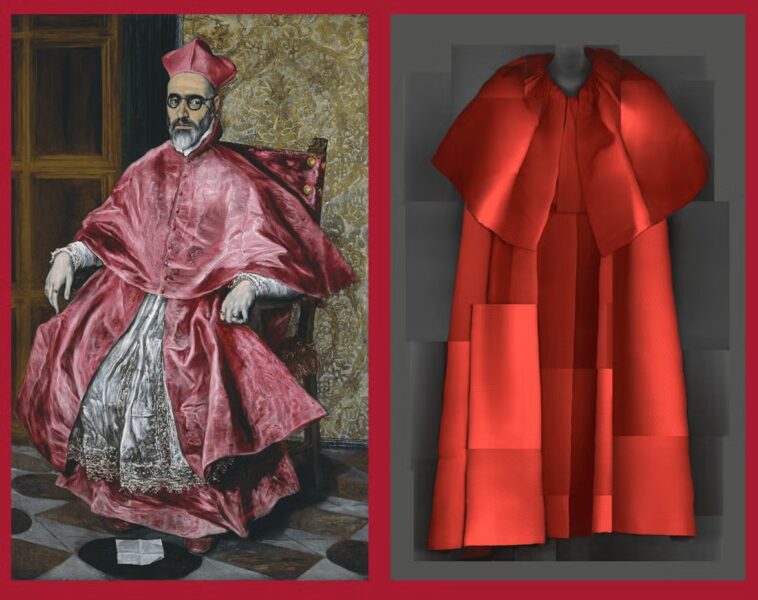
In December 2025, Vogue America, in compiling its annual ranking of the best-dressed people, included the current Pope, Leo XIV, for his distinctive style: “Breaking with the modest tastes of his predecessor, Pope Francis, while retaining his own tailor and perpetuating the papal legacy of perfectly fitting liturgical vestments.” So reads the mention. And the tailor who has been the stylistic link between three pontificates—Benedict, Francis, and Leo—is Sorcinelli. Benedict XVI, a man of profound culture, was perfectly aware of this, a figure perhaps not fully understood, as happened with another great Pontiff: Paul VI.
Vested and knew the three, but only Pope Prevost when he was a cardinal: “I had to try on the cardinal’s mitre, which his Augustinian confreres from Vienna gave him. I saw it reappear when he ascended the throne. His election helped me emerge from a deep crisis I was going through.” Religious? “More existential. In 2025, I was halfway through my fiftieth birthday.” Sorcinelli was born in Mondolfo, near Fano, in 1975.
“The relationship I had developed with Pope Bergoglio was solid. He had worn my vestments since the beginning of his pontificate. After a decade working at his side, I wondered whether I should continue to dedicate myself to this singular creative world, an inseparable part of my life, or focus almost exclusively on my other two great passions: organ music and perfumes, with my fragrance collections launched in 2013.” The death of Francis and the simultaneous beginning of Leo XIV’s pontificate were like a strong dose of reality for Sorcinelli. The Vatican Curia “asked” him to focus on the image of the future Pontiff. “It was like a summons, a call to order.”
Each project is conceived in close collaboration with the Office for the Liturgical Celebrations of the Supreme Pontiff. “I have just finished making the vestments that Pope Leo XIV will wear on August 6 and 22, 2026, for two important events in Assisi and Rimini.” The first will be inspired by the painting of the Porziuncola from the thirteenth and fourteenth centuries, while the other, for the celebration of Holy Mass at sea, will have lines simulating portholes to create an imaginary connection with the water, source of life. “When designing each vestment, we always consider where it will be used. We contextualize it.”
About fifteen years ago, a disoriented competitor, to discredit him in ecclesiastical circles, made his homosexuality public. Thus, despite confessing that he believes in the importance of protecting everyone’s privacy and sexuality, he decided to come out publicly: “I came out as gay, the Church welcomed me well and I have a tattoo of a broken mirror. It is a dramatic moment.”
Happy reading.
“… you give them something to eat.”
xxxxxx