


A bit of history.
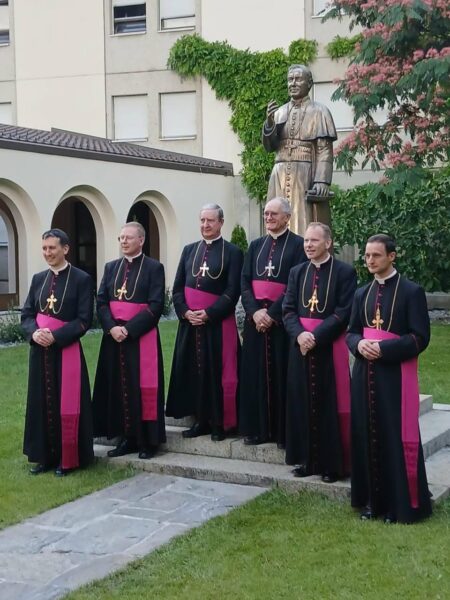
On June 30, 1988, in Écône, Switzerland, Archbishop Marcel Lefebvre consecrated four bishops without a papal mandate. Thirty-eight years later, on July 1, 2026, two of the four bishops consecrated at that time, Bishop Bernard Fellay and Bishop Alfonso de Galarreta, conferred the episcopate on four priests of the Priestly Society of Saint Pius X: Pascal Schreiber (Switzerland), Michael Goldade (United States), Michel Poinsinet de Sivry (France), and Marc Hanappier (France), once again against the will of the Roman Pontiff.
On the eve of today’s consecrations, June 29, Pope Leo XIV: «Consider carefully the spiritual well-being of the faithful », the Pontiff wrote, « because the schismatic act they would commit would deprive them of the licit and, in some cases, even valid reception of the Sacraments they love and seek for their sanctification ». In the final part of the letter, the Pope affirms the Holy See’s willingness for «a path of dialogue and understanding that the Holy Spirit can make possible and fruitful». «I pray for you, because tearing the immaculate garment of Christ is a sin of the utmost gravity. May the Lord enlighten your consciences and awaken your hearts». By the authority received from Christ, with a saddened but still hopeful heart, I feel the duty to ask you to desist from your intention and I entrust these intentions to the Immaculate Heart of Mary, Mother of Good Counsel».
Father Davide Pagliarani responded to Pope Leo XIV reiterating that the Society of Saint Pius X does not intend to separate from the Church, but to serve it in what he considers an exceptional situation. The Superior of the Society does not consider the consecrations a schismatic gesture, but on the contrary, they seek to « mend the garment of Christ », torn by the crisis of the Church.
For Archbishop Marcel Lefebvre, his decisive moment came on the night of May 5–6, 1988, when he made the decision that would definitively mark his life and the history of the Society of Saint Pius X: withdrawing the signature he had affixed only hours earlier to the memorandum of understanding with the Holy See and proceeding with the episcopal consecrations without a pontifical mandate. In November 1987, John Paul II sent Cardinal Édouard Gagnon to Écône as Apostolic Visitor. The visit concluded with a report of approximately thirty pages delivered to the Pope in January 1988, in which the Canadian cardinal expressed a substantially positive assessment of the situation of the Fraternity and suggested a canonical solution capable of fostering full reconciliation with Rome.
John Paul II did not abandon dialogue. On April 12 and 15, 1988, meetings were organized between representatives of the Holy See and the Society, attended by theologians and canonists from both sides. The favorable outcome of these conversations made possible a new meeting on May 5 between Cardinal Joseph Ratzinger, Prefect of the Congregation for the Doctrine of the Faith, and Archbishop Lefebvre. The meeting concluded with the signing of a memorandum of understanding destined to become one of the most important documents in recent ecclesiastical history.
Lefebvre, in his own name and that of the Society, declared his fidelity to the Catholic Church and to the Roman Pontiff; accepted the doctrine contained in no. 25 of the Constitution Lumen Gentium on the ecclesiastical Magisterium and the assent due to it; committed himself to maintaining an attitude of study and dialogue with the Holy See, avoiding polemics on controversial points of the Second Vatican Council and subsequent reforms; recognized the validity of the Mass and the sacraments celebrated according to the liturgical books promulgated by Paul VI and John Paul II; finally, promised to respect the general discipline of the Church, except for the special canonical discipline that would be recognized for the Society.
The Holy See offered a far-reaching canonical solution. The Society would be constituted as a Society of Apostolic Life of pontifical right, endowed with significant autonomy from diocesan bishops in matters of worship, formation, and apostolate. It would be granted the right to continue using the 1962 liturgical books. A joint commission, composed of representatives of the Holy See and the Society, would be created to resolve any controversy. It provided for the lifting of the suspension imposed on Archbishop Lefebvre, the rectification of any act committed without the necessary faculties, and the legal recognition of the houses and works of the Society. The protocol recognized the possibility of conferring the episcopate on a member of the Society, chosen from a list of three proposed by Archbishop Lefebvre.
Less than twenty-four hours after the signing, everything changed. On May 6, Archbishop Lefebvre sent a letter to Cardinal Ratzinger declaring that he did not consider the guarantees received sufficient. He requested that the consecration of the future bishop be scheduled for June 30, adding that, if he did not receive a positive response, he would feel morally obliged to proceed himself with the episcopal consecrations. The decision of May 6, 1988 marked a point of no return. On May 24 a final meeting between the parties took place, in which Cardinal Ratzinger, on behalf of John Paul II, raised the possibility of proceeding with the episcopal appointment before August 15, conditioning it on the restoration of a climate of trust and reconciliation with the Holy See, based on the protocol already signed. Archbishop Lefebvre, in a letter dated June 2, rejected this proposal, insisting on the date of June 30 and the appointment of three bishops to guarantee the life and activities of the Fraternity. In a final letter dated June 9, John Paul II implored Archbishop Lefebvre to reflect on the gravity of the consequences of the gesture he was about to make, inviting him to return “ with humility to full obedience to the Vicar of Christ «.
On June 30, 1988, with the assistance of Msgr. Antônio de Castro Mayer, Archbishop Marcel Lefebvre consecrated four bishops without a pontifical mandate: Bernard Fellay, Bernard Tissier de Mallerais, Richard Williamson, and Alfonso de Galarreta. John Paul II reacted with the motu proprio Ecclesia Dei adflicta of July 2, describing the act as « schismatic » and declaring that both the consecrators and the consecrated had incurred the latae sententiae excommunication provided for by canon law.
Tucho and the consecrations.
He stated in brief remarks on Wednesday that the Society of Saint Pius X (SSPX) did not consider «useful» the Vatican’s offer to discuss the documents of the Second Vatican Council before consecrating four bishops without a papal mandate. A communiqué from the General House of the FSSPX, published in February after the meeting between Pagliarani and Fernández, stated that the cardinal proposed a dialogue with the FSSPX to clarify the minimum requirements for the canonical status of the latter. The cardinal had already made clear that the documents of the Second Vatican Council had to be accepted in their entirety by the FSSPX to achieve that status: “The Cardinal stated verbally that, while it would be possible to enter into dialogue on the Council, its texts could not be corrected”.
Strickland and the consecrations.
What has motivated these priests and faithful over the past fifty years? Archbishop Marcel Lefebvre did not undertake this path for ease, nor because it brought him honor or peace. Regardless of one’s opinion on each of his decisions, few would deny that he suffered enormously on a personal level. He believed that the precious treasures Christ entrusted to his Church—the Holy Sacrifice of the Mass, the venerable celebration of the sacred mysteries, the formation of holy priests, and the perennial teachings of the Catholic faith—were in danger of being lost. His response arose from a deep desire to preserve and transmit what generations of Catholics had received with gratitude. This love for the sacred heritage of the Church has continued to inspire many priests, religious, and families of the faithful who have accepted misunderstandings and sacrifices because they believed these treasures deserved to be preserved for future generations.
Whether each decision made along the way was prudent is a question any reasonable Catholic can debate. In any case, it is difficult to deny the love that inspired countless sacrifices, vocations, families, and faithful souls who only wished to remain close to Our Lord and faithful to the deposit of faith. No Catholic should rejoice in division. Every faithful Catholic should pray for full and visible unity. But unity is not strengthened by suspicion or fear, but by mutual trust, humility, and the recognition of sincere love, wherever it may be found.
Valli and Catholic beauty.
Aldo María Valli also comments on yesterday’s consecrations. «The celebration in Écône for the consecration of the four new bishops of the FSSPX was a triumph of Catholic beauty. Beauty in the theological sense, not merely aesthetic. Although marred by a storm, the ceremony allowed those present to discover or rediscover a heritage of spirituality that the post-conciliar Church had incredibly relegated to oblivion, almost ashamed of it. Every detail was designed to highlight the vertical dimension: everything was directed to God. Without human protagonism, without «liturgical animation», without abuses, without extraordinary ministers of the Eucharist, without other aberrations. Not a single applause! The women veiled, the genuflections, the composure, the singing, the organ, the vestments made by nuns and not by some famous designer. It was impossible not to be impressed and fascinated».
Father Pagliarani focused on the theme of faith, and he did so very well, because that is what it is about: faith. It is not a question of liturgical preferences, it is not a question of the Second Vatican Council. The question is faith. What faith is professed in Rome? What faith does the post-conciliar Church express? And even more radically: has this Church preserved the faith?
«Prevost’s appeal to the Fraternity, just hours before the consecrations, turned out to be somewhat counterproductive. If it had been sincere and not motivated solely by concern for public image, it should have been made much earlier. Will there be excommunications? Probably, but no Roman seal can erase the beauty. They will be recognized by their fruits. And today everyone has seen that the fruits of the FSSPX are good and beautiful. To see the faithful kneeling as they pass before the Blessed Sacrament and receiving Holy Communion on the tongue, on their knees, is moving. Pure formality, say the usual experts. And we will let them have their say.»
Müller and the traditional Mass.
Müller called for a reevaluation of the restrictions on the Traditional Latin Mass and greater tolerance in liturgical practice after the Society of Saint Pius X carried out its episcopal consecrations today without a papal mandate. On July 1, the Italian newspaper Il Giornale published an interview with Müller who addressed the current restrictions on the Traditional Latin Mass, introduced in 2021 under the encyclical Traditionis Custodes , the previous reforms of Summorum Pontificum by Benedict XVI, and the broader issue of liturgical coexistence in the Catholic Church. The prelate argued that the current restrictive approach has not generated ecclesial unity and should be reconsidered in light of persistent tensions surrounding liturgical practice and the risk of divisions. «The Lefebvrians can turn these prohibitions into a symbol of dissent against Rome. The restrictive measures have practically served them as propaganda, which they can use instrumentally to promote their positions». Müller pointed out that Traditionis Custodes «has not had a positive effect», «using an authoritarian approach to demand blind obedience is not (…) the Christian way». «Only in matters of dogma should there be no concessions; in concrete pastoral practice, a certain tolerance is possible».
«To affirm that everyone who prefers the ancient rite does not accept the Second Vatican Council is false. By the same logic, one could say that not everyone who prefers the Novus Ordo accepts the Council: it is enough to see what is happening in Germany, where some bishops frequently invoke the Council, but then systematically deny its doctrine». «Benedict XVI had found a good solution with Summorum Pontificum , which fully embraced the ancient rite. That motu proprio brought great peace to the Church. Let us not forget that the Church has various rites, each with its own forms. The rite in its ancient form cannot be prohibited». “In the Church we already have associations and groups that legitimately celebrate the ancient form and fully recognize the Council, in union with the Pope and the episcopal college”.
Coordinating Benedict XIV with Francis.
Marco Invernizzi proposes updating the Compendium of the Social Doctrine of the Church of 2004 with the social teachings of Benedict XVI and Francis. In the case of Pope Francis this is a difficult task. John Paul II had requested the drafting of a Compendium of the Social Doctrine of the Church , which he even called a «catechism», on the occasion of the Great Jubilee of the year 2000. His desire and purpose was to leave the valuable legacy of his social doctrine to the Church of the third millennium. The Compendium was the fruit of this conviction, which later faded. Not so much with Benedict XVI, who, in his own way, remained faithful to it, but with Francis.
Ecumenical dialogue suspended.
The Vatican and the Communion of Protestant Churches of Europe have agreed to suspend their formal theological dialogue for approximately two years. This decision is the shared recognition that the search for Christian unity sometimes requires a period of careful reflection before it can move forward. The temporary moratorium, announced in a joint declaration on June 24, was discussed during a meeting between representatives of both delegations in Rome on December 9, 2025, and subsequently ratified by the Council of the Communion.
The dialogue was officially initiated after the General Assembly of the Protestant Communion held in Basel in 2018, whose objective was to present to the Catholic Church an ecumenical model that had already transformed relations within European Protestantism itself. This model arose from the Leuenberg Agreement of 1973, one of the most significant ecumenical achievements of the 20th century, which concluded that they no longer constituted grounds for ecclesial division and the member churches established full communion in pulpit and altar, allowing ministers to preach across denominational borders and believers to receive Holy Communion in each other’s congregations. The Communion of Protestant Churches in Europe brings together 96 Lutheran, Reformed, Methodist, and United churches in more than 30 countries in Europe and South America, representing approximately 40 million Protestant Christians. The Communion does not possess a unified confession of faith or a central governing authority. The Protestant body was created to demonstrate that Churches with different confessional traditions can maintain their own identity while sharing ecclesial communion.
Fernández and universal salvation.
An essay by Cardinal Fernández, recently discovered, reveals his belief that all are saved; it dates from 1995 and appears to support the universalist vision of salvation, condemned by the Church. In a 46-page essay from 1995 titled “Romans 9-11: grace and predestination”, first reported by The Wanderer . The future prefect of the Dicastery for the Doctrine of the Faith wrote extensively on the Church’s teaching on salvation and predestination, citing the works of Saint Augustine and Saint Thomas Aquinas, although the then-priest focused on his writings on the mercy of God, largely ignoring his justice. Finally, Fernández concluded his work by emphasizing his “firm confidence” that “all will be saved”, adding that this is not a “mere wish”, but is based on what “he knows about God and his specific plans”. The words of Fernández appear to support the universalist vision of salvation, according to which all men are saved. This vision has been condemned by the Church. The cardinal’s literary curiosities never cease to surprise and in 2023, a book of explicit sexual content written by Fernández in 1995 resurfaced, titled «Heal Me with Your Mouth: The Art of Kissing». In 2024 , another erotic book written by the future prefect in 1998 was also rediscovered, titled « Mystical Passion: Spirituality and Sensuality» . In it, the «peculiarities of the male and female orgasm, which also manifest themselves in some way in the mystical relationship with God», are analyzed, and the immoral nature of homosexuality is minimized.
Illegal immigration and Trump.
Illegal immigration is generating new tensions between the Trump administration and the Holy See. Vance: «I think some of the positions expressed by the Vatican, particularly on the issue of immigration, have been concerning and, ultimately, I do not share them». «I hope the Catholic hierarchy has learned from some of the things that Marco, the president, and I have said about immigration: that it is not only about the dignity of the immigrant, but also about the dignity of workers born here». «What I tell the Catholic leaders I speak with is that
they do not agree with our immigration policies. I do not treat them with hostility: I invite them to dialogue, but I also encourage them to remember that mass migration creates victims».
The U.S. bishops have repeatedly criticized Donald Trump’s hardline stance on this issue. In this regard, it is worth recalling that the Vice President of the United States, like Secretary of State Marco Rubio, is Catholic.
Vance in his latest book: «The Church’s invocation of the dignity of migrants requires reflection on moral concessions. And it is possible to believe that such concessions lead to favoring a rigorous immigration policy without dehumanizing anyone». He recounted his meeting in Rome during Easter last year. «There I was, the highest-ranking Catholic in the U.S. government, and the Vatican seemed reluctant to go beyond the banal phrases of its moral guide». According to a Pew Research Center poll published on June 18, 51% of U.S. Catholics believe that Trump has been too critical of the Pope. But compared to a year ago, the percentage of Americans who have a favorable opinion of Leo has slightly decreased from 84% to 78%.
Delpini’s birthday in Milan.
Delpini is approaching his birthday and thoughts are turning to his successor. From Pizzaballa to Pompili, from Napolioni to Costa, from Castellucci to Baturi, after three Ambrosian archbishops, the hypothesis of a non-Milanese and always in the running is Parolin. Mario Delpini will turn 75 on July 29 and, in a private audience with Pope Leo XIV, offered his resignation for the summer, allowing his successor to take office on September 8, the feast of the Nativity of Saint Mary, the beginning of the Milanese pastoral year. «The Pope listened attentively and kindly to my reflections and concluded by expressing his intention not to accept my resignation. Therefore, I must foresee that I will continue to exercise my ministry as Archbishop of Milan for some time». It seems that on his birthday, the extension will be granted, donec aliter provideatur, until further notice, probably within a year. The Pope currently has other pressing concerns in Lombardy: finding successors for the Bishop of Como, Oscar Cantoni (born in 1950), the Bishop of Bergamo, Francesco Beschi (1951), and the Bishop of Novara, Franco Giulio Brambilla (1949), matters he will address starting this autumn.
Prison for the chocolate nuns.
They are accused of mistreating and abandoning five elderly nuns, the group of nuns rejects all charges and denounces what they call a «witch hunt». the nuns of Belorado, the «chocolate nuns», face 12 years in prison. According to the ruling of the Investigating Court No. 5 of Bilbao, reported by Spanish media, the accused «manipulated, mistreated, and humiliated the older nuns», taking advantage of their particular vulnerability to persuade them to join the schism. The charges include coercion, degrading treatment, abandonment of incapacitated persons, omission of assistance, and crimes against ecclesiastical property. On June 18, the Spanish Supreme Court upheld the ruling confirming the eviction of the former Poor Clare nuns from the monastery of Belorado , declaring their appeal inadmissible and ordering them to pay court costs. At the same time, the Court of Briviesca transferred to the courts of Burgos another investigation concerning the sale of 1.73 kilograms of gold valued at approximately 130,000 euros.
The cardinals and the last consistory.
Very interesting and published on the site AdVaticanum on June 29: Behind the Scenes of the Extraordinary Consistory: What do the cardinals think of Pope Leo XIV’s second meeting? It is very extensive and complete and presents the unfiltered, behind-the-scenes reflections of the Princes of the Church on the debates that took place during the Extraordinary Consistory on Friday, June 26, and Saturday, June 27. Some of these cardinal comments we have already presented here; the article systematically collects all those known so far. Several cardinals, contacted privately by Vatican correspondents, sent cautious and almost identical responses even before the Consistory: «We will wait… we cannot comment even after the Consistory… we will wait for the press conference». Inadvertently, this media silence created an atmosphere of slight tension in which journalists resorted to informal conversations and anonymous reflections. These conversations often carried more weight than official statements and comments from the Holy See Press Office , precisely because the Vatican’s official channels had been deliberately limited. Looking ahead, attention is already focused on the next Extraordinary Consistory, scheduled for next year. After two Extraordinary Consistories, several cardinals have indicated that liturgical issues will likely be the next main point of debate, although plans could still change. The general impression was that the atmosphere within the College of Cardinals had changed: «I think with a new Pope, everyone feels free, and that is absolutely evident».
«Which is easier, to say: «Your sins are forgiven», or to say: «Rise, and walk»?»
Good reading.