


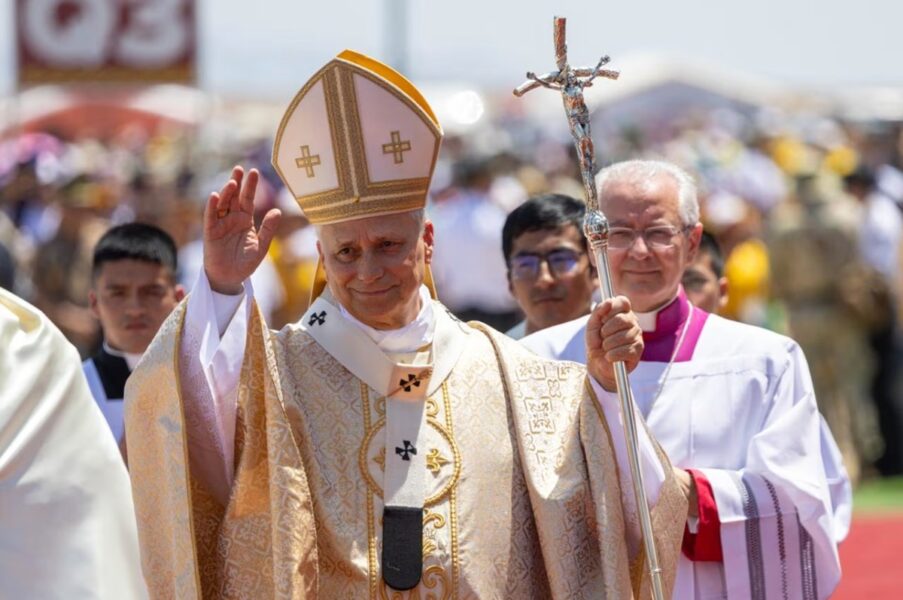
Pope Leo XIV opened his homily with a greeting filled with affection for the faithful of his former diocese. “What joy it is to return to Chiclayo! It is a blessing for me to be with you once again,” said the Pontiff, who expressly thanked the people of Chiclayo for their prayers “especially for my health in these moments of trial that, with God’s help, I am overcoming.” The allusion comes just weeks after his hospitalization at the Gemelli Polyclinic in Rome for a pulmonary condition.
The Pope asked those present to continue praying for him so that the Lord might grant him “the grace to continue confirming my brothers and sisters in the faith,” a formula that directly recalls the mission entrusted to Peter.
Evangelization, a duty for every baptized person
The core of the homily was the evangelizing mission, which Leo XIV described as “an urgent and inescapable duty for every baptized person,” whether ordained ministers or lay faithful. To support this, he drew on Paul VI’s exhortation Evangelii nuntiandi, according to which evangelization constitutes the essential mission of the Church, its deepest vocation and its reason for being, and on the dogmatic constitution Lumen gentium, which presents the Church “as a universal sacrament of salvation.”
In response to the question of how to proclaim Christ today, the Pope answered that the key is “the witness of an authentically Christian and coherent life,” with Jesus Christ at the center of both the proclamation and of existence. That coherence, he clarified, is not merely the fruit of the will, but “a grace we must implore from the Lord.”
Leo XIV placed the encounter with Christ at the Last Supper and pointed to the Eucharist and the Word as “the two tables from which we live and are nourished.” From this he drew one of the most significant phrases of the day: “To evangelize is not to impose doctrines or to rely on efficient structures, but to bear witness to that real encounter with Jesus Christ.” Citing Francis’s Evangelii gaudium, he insisted that the mission does not rest on persuasive speeches or on proselytism, and he encouraged the recovery of “shared prayer” in homes, which he referred to as “little domestic Churches.”
“Without truth, love falls into mere sentimentalism”
Drawing on the second letter of Saint John, proclaimed in the day’s liturgy, the Pontiff stressed that the proclamation of the faith is linked to charity and to helping those most in need. He also referred to the encyclical Magnifica humanitas to highlight the connection between the Gospel proclamation and the transformation of “the structures of human coexistence.”
The Pope then balanced that social emphasis with an explicit reference to truth. Truth, he affirmed, “does not consist in a theory, an abstract idea or a utopia, but in a person, Jesus Christ,” who invites us to conform our lives to his “in faithful obedience to his commandments.” He recalled a teaching of Benedict XVI in Caritas in veritate: “Without truth, love falls into mere sentimentalism, and truth without love becomes rigid and cold.”
Leo XIV also acknowledged the seriousness of the crisis in the transmission of the faith. “In some regions of the world, this transmission has been almost completely interrupted,” he warned, pointing to religious indifference, materialism and selfishness as challenges. In the face of these, he urged the faithful to bring the Gospel into the family, the workplace and the public sphere, “resisting the temptation to relegate faith to the individual sphere.”
In the final stretch, the Pontiff recalled that “mission is not improvised” and extended an invitation to the entire Peruvian Church: “The world awaits us and the mission is only beginning.” He concluded by entrusting the evangelizing task to the intercession of Our Lady of Evangelization.