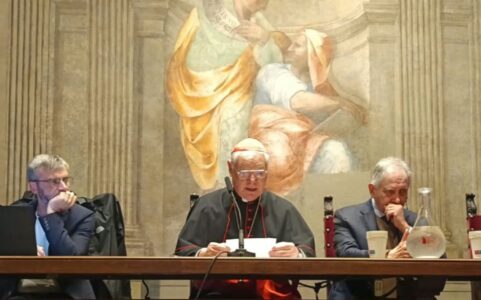
Cardinal Gerhard Ludwig Müller delivered a speech on Wednesday, November 11, at the Sturzo Institute in Rome on the occasion of the presentation of two works by American writer Robert Royal dedicated to the persecution and martyrdom of Christians. The text, whose transcription has been published by AdVaticanum, combines a theological reflection on the cross with a direct critique of certain cultural and ecclesial currents.
For the former prefect of the Congregation for the Doctrine of the Faith, persecution cannot be explained as mere hostility toward a religious community. It must be understood in light of the Church’s supernatural mission, which is to proclaim salvation in Jesus Christ. From this perspective, he traced a line of continuity between the martyrs of the early centuries and the ideologies that, in modern times, have sought to eradicate the faith.
“The martyrs of the first three centuries after Christ […] can undoubtedly be associated with the desire to destroy Christianity expressed by the atheistic and inhuman ideologies of National Socialism, as well as by the French Revolution, communism, and political Islamism, which is pseudoreligious, and by the neo-socialist activism of our times,” he stated.
Totalitarian regimes, “puppets” of the father of lies
Müller emphasized that martyrdom does not consist merely in suffering or dying for personal convictions, but in bearing witness to Christ, the incarnate Word, the sole Redeemer and sole Mediator between God and humanity. Referring to the Gospel of Saint John, he presented the devil as the father of lies and a murderer from the beginning, and maintained that ideologies opposed to Christianity ultimately serve that design. “And the ideas of totalitarian states have always been his puppets, his marionettes,” he said.
The cardinal acknowledged that faith does not eliminate the natural fear of torture, psychological violence, social exclusion, or violent death, but insisted that none of this can separate the Christian from Christ.
Against a Church turned into an NGO
The prelate lamented that some Christians in the West confuse their faith with the achievements of the Enlightenment and, to avoid the scandal of the cross, reduce Christianity to a phenomenon of bourgeois civilization with “humanistic and immanentist” ends. If that were the case, he warned, “the Church would only deserve recognition from any State or institution as a humanitarian aid organization,” an idea that, he said, is frequently promoted by “certain media outlets.”
In contrast to this view, he recalled that the Church’s sole objective is to follow Christ, “despised, persecuted, and shamefully executed as a criminal of the world.” His critique also extended to the Church’s internal life. Christian spirituality, he explained, consists in “living in Christ and for Christ,” in contrast to a religiosity of “narcissistic self-satisfaction” that, in his view, affects “many areas of ecclesial life.”
Kierkegaard, Saint Augustine, and the two cities
Müller cited Saint John Paul II’s homily at the canonization of Saint Teresa Benedicta of the Cross, Edith Stein: “Many of our contemporaries would like to touch the cross, but nothing is more eloquent than the cross that is allowed to touch us.” He also drew on Søren Kierkegaard to affirm that “one does not become a Christian by adapting to the world,” but by accepting the paradox of being one, and he listed seven paradoxes of the life and Passion of Christ, culminating in the scandal of the cross.
Following Saint Augustine’s De civitate Dei, he framed the current persecution within the conflict between the City of God, born of love for God to the point of contempt for oneself, and the earthly city, born of self-love to the point of contempt for God. “For me, this is the essence of these two books,” he noted, before describing them as “a great testimony to the future of Christianity in today’s world.”
The cardinal concluded his remarks with a reference to Pope Leo XIV’s apostolic journey to Latin America: “Our Pope is a great witness to the truth, who is Jesus Christ himself.”
Müller, born in Mainz in 1947, was bishop of Regensburg from 2002 and prefect of the Congregation for the Doctrine of the Faith from 2012 to 2017. Francis created him cardinal in 2014.