


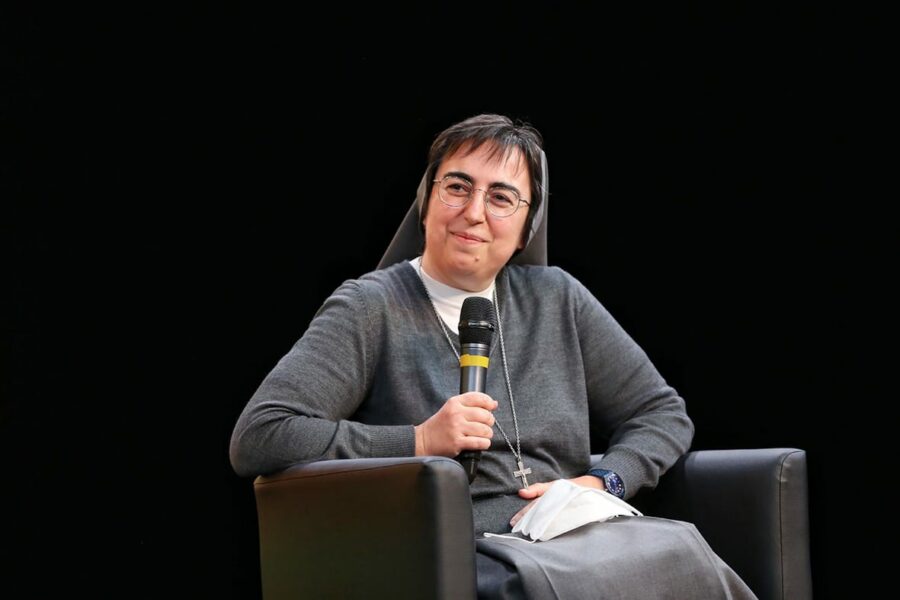
Rome has closed this week the events marking the fifth anniversary of the Laudato Si’ Action Platform, an initiative promoted by the Dicastery for Promoting Integral Human Development that goes far beyond merely raising awareness among the faithful. Its stated goal for the next five years is to make the so-called “ecological conversion” a stable management criterion within Catholic institutions, influencing their investments, properties, and governance decisions.
This was made clear during the presentation of the program’s fifth annual report, which featured contributions from Sr. Alessandra Smerilli, prefect of the dicastery; Bishop Allwyn D’Silva, auxiliary bishop emeritus of Bombay; Lorna Gold, executive director of the Laudato Si’ Movement; and Alonso de Llanes, director of the platform. According to the data presented, the initiative now brings together more than 13,000 participants, including over 6,200 institutions. After five years of voluntary commitments, its promoters aim to move toward a more systematic implementation of environmental objectives.
From voluntary commitment to the management of ecclesiastical assets
The most revealing intervention came from Lorna Gold. The head of the Laudato Si’ Movement, which serves as the platform’s operational partner in training, communication, and mobilization, called for the next phase to accelerate institutional changes and move beyond occasional initiatives. In her view, ecological conversion must influence decisions regarding investments, energy, education, properties, procurement, and governance of institutions. In other words, the environmental agenda seeks to fully enter the administration of the assets of dioceses, religious congregations, schools, and universities.
Gold also described a rather telling division of roles. Ecclesial structures would provide resources and continuity, while grassroots movements would maintain pressure to ensure that commitments translate into effective changes. In other words, an activist movement exerting pressure, with Vatican backing, on the Church’s own institutions. The director also called for greater weight of communities from the so-called Global South in setting priorities and making decisions in environmental programs.
It should be noted that none of this was presented as a canonical obligation for dioceses, but rather as a working horizon. Yet the horizon is unequivocal: integral ecology should cease to be an occasional activity and become a permanent guiding principle in Catholic institutional life.
An atlas to map the ecological plans of dioceses and parishes
Among the new initiatives announced, the Laudato Si’ Digital Atlas stands out. According to Alonso de Llanes, the tool will allow users to select countries or dioceses, locate participating institutions, and consult their ecological plans, provided the institutions have authorized their publication. This information will be cross-referenced with data on deforestation, emissions, and exposure to extreme events such as hurricanes, with the stated purpose of helping institutions identify risks and learn what other communities are doing.
The project represents, in practice, a new system for collecting and monitoring data on the environmental activity of Catholic entities worldwide. It will be complemented by a learning center for sharing experiences and printed materials for communities without easy internet access.
Artificial intelligence and “digital missionaries”
The platform is also considering incorporating artificial intelligence tools to recommend resources and actions based on the characteristics of each institution and its context. De Llanes argued that these technologies can help evaluate results and share knowledge, though he acknowledged that they cannot replace the judgment of communities or make decisions for them.
More striking is the expansion of a global network of so-called “digital missionaries”: communicators trained to spread experiences of integral ecology, connect communities, and promote the platform’s activities in digital media. Following an initial training experience this year, the intention is to extend it over the next five years to different countries, languages, and ecclesial contexts.
The choice of the term is not innocent. The word “missionary” has always referred to those who proclaim the Gospel, and here it is applied to specialists in spreading an environmental program. The new phase, therefore, is not limited to planning: it seeks to form agents who will disseminate and consolidate its objectives within Catholic communities themselves.
More participants, but no data on results
In contrast to the ambition of the announcements, the program’s director himself acknowledged that the platform’s growth says little about its effectiveness. Signing up is only a first step, De Llanes explained; drafting a plan does not guarantee its implementation, and declaring an activity completed does not prove it has produced lasting effects. As an example, he cited the case of a Nigerian diocese that refused to join a tree-planting campaign until it had a plan to ensure their maintenance.
This admission is significant. The figures on participants and registered institutions reflect the project’s organizational reach, not its environmental impact. Five years on, the platform knows how many have signed up, but it cannot say how much has been achieved. It is paradoxical that, without being able to demonstrate results, the next proposed step is to expand its influence over the management of institutions. Improving evaluation and monitoring is, however, among the objectives of the new phase.
Smerilli and continuity under Leo XIV
Sr. Alessandra Smerilli defended the continuity of a program born during the pontificate of Francis and recalled that the encyclical Laudato si’ was not conceived as a mere text for reflection, but as a call to transform personal and communal life. The prefect argued that care for creation is not a secondary matter in Christian life and linked it to humanity’s relationship with God, with others, and with the world.
Smerilli also recalled that Leo XIV has called for moving from environmentalist speeches to an ecological conversion that changes lifestyles, and presented as proof of continuity the Mass for the Care of Creation, incorporated into the Roman Missal during this pontificate. The Pope used the new formulary for the first time in July 2025 in Castel Gandolfo and again in September, on the occasion of the World Day of Prayer for the Care of Creation, when he linked care for creation with conversion of the heart and the need to direct resources toward life, peace, and the most needy.
The prefect also cited Leo XIV’s first encyclical, Magnifica humanitas, dedicated to human dignity in the face of the challenges of artificial intelligence, to argue that care for humanity and care for creation form a single responsibility. The reference is significant because it places the environmental question within a Christian anthropology, and not the other way around.
The “carbon fast” as a Lenten practice
Bishop D’Silva, for his part, presented the carbon fast or “carbon fast” promoted in the Archdiocese of Bombay: using Lent to review habits such as electricity and water consumption or the use of plastics. The prelate presented it as a way to unite Lenten penance with environmental responsibility, and encouraged his brother bishops to integrate care for creation in a lasting way into ordinary pastoral planning.
D’Silva did not propose replacing the fasting and abstinence prescribed by the Church. But transferring penitential language to a program of consumption reduction raises a fundamental question. Lenten penance is ordered toward the conversion of the sinner, prayer, and preparation for Easter. Sobriety in consumption can accompany that path, but it does not exhaust or replace the religious meaning of Christian fasting.
A permanent structure and an open question
Created in 2021 to put into practice the 2015 encyclical, the Laudato Si’ Action Platform has become a stable structure that has survived the pontificate that gave it birth and continues to grow under Leo XIV. The anniversary events, with training sessions, environmental planning, and new technologies, as well as a celebration of the Mass for the Care of Creation, confirm this consolidation.
What was once an invitation to environmental awareness now aspires to intervene in the planning, administration, formation, and communication of Catholic institutions. And this forces us to ask what place these programs should occupy in the Church’s mission. Responsible care for creation is part of humanity’s moral duties, but the essential mission of the Church remains to proclaim Jesus Christ, administer the sacraments, and lead souls to salvation. The coming years will show whether the environmental agenda is subordinated to that mission or whether it ends up competing with it for resources, structures, and priorities.