


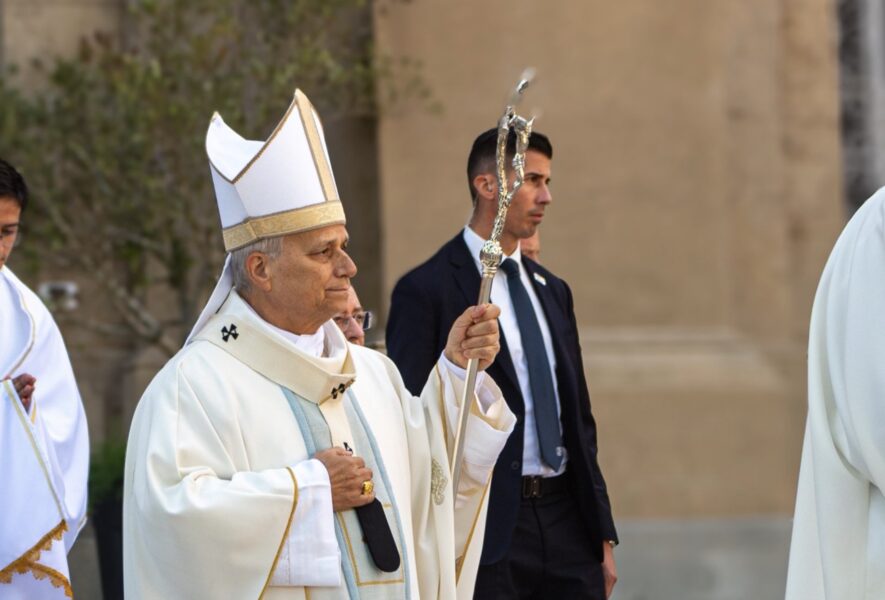
Florida bid farewell to Leo XIV this Sunday with the most profound and luminous Mass of his visit to Uruguay. Before the Basilica Cathedral that guards the Virgin of the Thirty-Three, patroness of the country, and on the very day of her feast, the Pope delivered a homily entirely dedicated to the faith that is learned at home. From it comes a phrase destined to endure, addressed to parents and grandparents and received with a standing ovation by the crowd that overflowed Assembly Square and the surrounding streets.
The celebration brought to a close three intense days in the most secularized country in Latin America, the one in which the Pontiff had wanted to celebrate Mass before the Virgin of the Thirty-Three as the central gesture of his visit.
Judith, Elizabeth and a small image from 1825
Leo XIV presented himself as a pilgrim and drew from the day’s readings, where two women separated by centuries receive almost the same blessing: Judith, after the liberation of her people, and Elizabeth, who welcomes Mary into her home. From there he moved to the nation’s history. The tiny image venerated in Florida is linked to 1825, when those fighting for the freedom of that land wished to place its beginnings under the Virgin’s protection. That gesture, the Pope explained, reminds us that the history of a people remains incomplete when God is set aside, and that Uruguay was bound to a Mother from its founding hours. Generations have changed and so has the relationship of many Uruguayans with the faith, he added, but she remains there.
The women who kept the faith
The longest part of the homily was a heartfelt thank-you to the mothers and grandmothers who taught the first prayers, brought their children to the baptismal font, kept an altar at home and prayed for the living and the dead. The Pope evoked Lois and Eunice, grandmother and mother of Timothy, and the women who mark Uruguay’s Catholic history: Saint María Francisca Rubatto and the blessed martyrs Dolores and Consuelo Aguiar-Mella, sisters born in Montevideo.
He spoke with delicacy of the pain of so many women whose children have stopped praying and entering the church. An Augustinian Pope could not fail to recall Saint Monica, who prayed for years for a son ever more distant without losing confidence in grace. “Mothers and grandmothers: do not tire of handing on the faith!” he exclaimed, before asking them for patience, persistence and no harshness. And he added a consoling certainty: “There are doors you cannot open, but God can.”
Fathers on their knees
Then he turned to the men. Sons and grandsons, he said, need to see that faith occupies a real place in the lives of the men of their family. They need to see them pray, approach the sacraments, treat their wives with respect, ask forgiveness and live honestly even when it costs sacrifices. And then came the phrase the square interrupted with applause: “A son learns much by seeing that his father can kneel before God without feeling any less a man for it.”
Rarely has something so contrary to the spirit of the age been said with such simplicity. In a culture that confuses manliness with self-sufficiency, the Pope presented kneeling as a manly lesson, the most eloquent one a father can give his son. He also recalled the command of Deuteronomy to speak of God’s words at home and on the way, when lying down and when rising, and asked bishops, priests and consecrated persons to support families with generous spiritual fatherhood and motherhood.
“Uruguay: we must set out on the road!”
The homily ended with a missionary call. All Mary’s greatness, the Pope recalled, citing Saint Paul, springs from her relationship with Christ, the one mediator between God and humanity, and every authentic Marian devotion leads to Him. Like Mary, who set out in haste to the house of Elizabeth, Uruguayan Catholics cannot wait for those who have drifted away to return on their own. “We must enter the homes again!” he proclaimed, and asked each person to think of that son, friend or neighbor who stopped believing long ago. He also invited prayer for those in government, that they may seek with integrity the good of all.
The Golden Rose and the consecration
At the end of the homily, Leo XIV placed the Golden Rose before the image and once again consecrated the nation to Mary, “Captain and Guide” of the Uruguayan people, imploring God to break the works of the devil and preserve the country from whatever would separate it from Christ. Before the final blessing he thanked the authorities, volunteers, families and communities, and entrusted himself to the prayers of the Uruguayans.
From Florida the Pope returned to Montevideo and said farewell to the country at Carrasco Airport, where President Yamandú Orsi, Foreign Minister Mario Lubetkin and Cardinal Daniel Sturla awaited him, on his way to Argentina. Behind him remain the Mass in Paysandú, where he asked the faithful to be bridge-builders, and his meeting with the educational world, in which he called for putting the person before the algorithm.
The full homily can be read on Vatican News.