


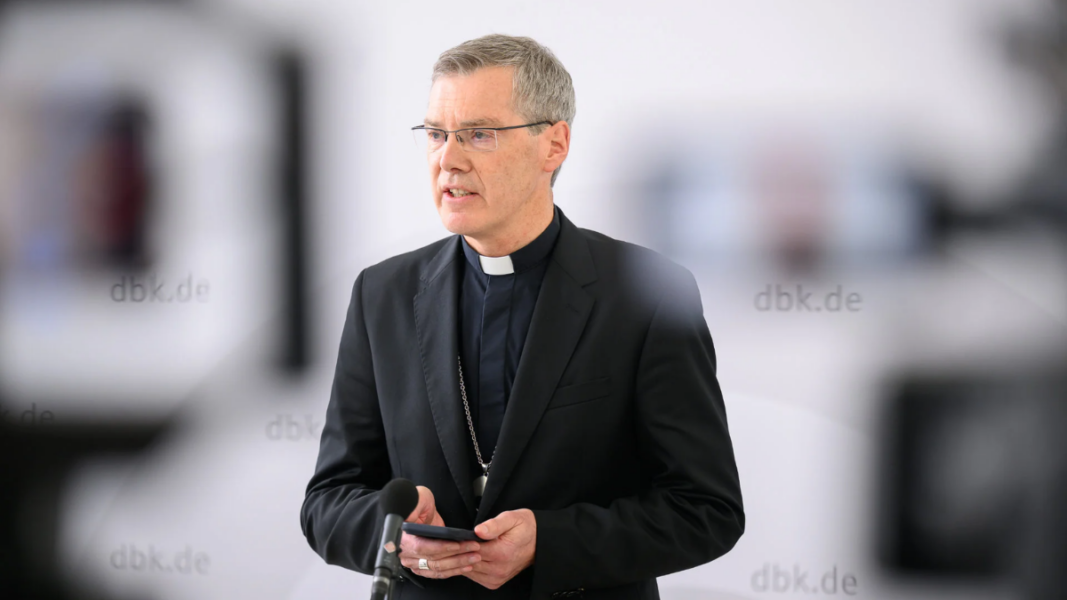
Heiner Wilmer, Bishop of Münster and president of the German Bishops’ Conference, stated on 30 October in Salzburg that the German bishops wish to follow their path “as the Catholic Church, in full communion with the Holy Father and in fidelity to the Church’s Magisterium.” He made this remark during a plenary session of the Council of European Bishops’ Conferences (CCEE); the text was published by the journal Communio on 2 November.
In his address, Wilmer listed three criteria for the Church’s next steps in Germany. The first is that every decision must fully respect canon law and ecclesial order; the second, that reflections and initiatives must be developed in close dialogue with Rome; and the third, which has drawn the most attention: “Wir wollen keinen spezifisch deutschen Weg, der uns von der Weltkirche entfernt,” that is, “we do not want a specifically German path that distances us from the universal Church.”
An acknowledgment of Rome’s and other episcopates’ concerns
The president of the German bishops admitted to his European colleagues that there are concerns in neighboring countries and in the Holy See regarding the direction of the Church in Germany, and he affirmed that he intends to take them seriously. In this regard, he recalled that the origin of the reform process was the wound opened by cases of sexual abuse and abuse of power within the Church.
Wilmer also acknowledged the loss of trust among the faithful. “We must humbly recognize that many people have lost confidence in us,” he said. In his view, the Synodal Way in its original form has concluded, and what must follow, he stated, is a process of conversion, accountability, and renewal.
The tone of the German hierarchy under Leo XIV
Wilmer’s words come at a time when the Holy See has expressed reservations about the so-called Synodal Conference, the body through which the German bishops and the laity intended to continue the Synodal Way. Wilmer himself, elected president of the Bishops’ Conference in February of this year, had already accepted on other occasions that it was right to heed Rome’s objections, as InfoVaticana reported in connection with his assessment of the Rome meeting on Amoris laetitia.
Among bishops from other countries, the German course has raised open questions. Two German auxiliary bishops admitted a few weeks ago that, during the course for new bishops held in Rome, some colleagues asked them whether what is happening in Germany “is still Catholic.”
Thus, the Salzburg address, delivered before the presidents of the episcopal conferences across the continent, offers Wilmer’s most explicit statement to date on the relationship between the German path and the universal Church since he began presiding over his country’s episcopate.