


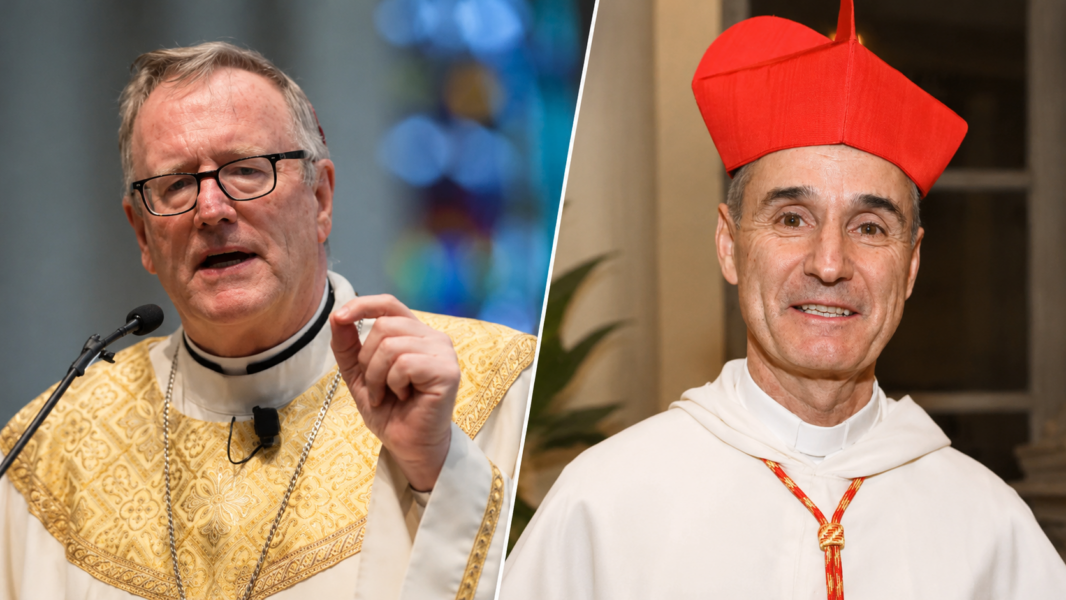
The controversy between Cardinal Jean-Paul Vesco, Archbishop of Algiers, and Bishop Robert Barron of Winona-Rochester (United States), regarding the Church’s evangelizing mission has added a new chapter. The Belgian Catholic outlet CathoBel, which published the original interview with the cardinal, has stated that some of his remarks were disseminated out of context. Nevertheless, in his subsequent response, Vesco has reaffirmed that believers of the three monotheistic religions have “something better to do than trying to convert one another,” thereby keeping the debate open on the relationship between evangelization, conversion, and interreligious dialogue.
The controversy began on October 29, when Cardinal Vesco’s statements on the Church’s presence in Algeria were made public. The archbishop maintained that the Catholic community in that country should not be conceived as a Church dedicated to converting Muslims, but rather as a presence integrated into Algerian society, based on witness and fraternity.
That same day, Bishop Barron publicly responded to the cardinal, recalling Christ’s mandate to make disciples of all nations and warning that rejecting proselytism must not lead to abandoning the evangelizing mission.
CathoBel denounces an out-of-context interpretation
In an article published on October 29 and updated on November 2, CathoBel has addressed the controversy to clarify the original meaning of the Archbishop of Algiers’ statements.
The Belgian outlet argues that the claim that the Church “is not here to convert” was taken from an interview in which Vesco was speaking specifically about the situation of the Catholic community in Algeria, a predominantly Muslim country.
In that context, the cardinal had stated:
“One of the challenges, since Algeria’s independence, is to be, as far as possible, a Church of citizens, integrated into the life of the country. Above all, we must not be a community closed in on itself. That would not be the Church. We are the Church of this people. Not a proselytizing Church, not a Church that exists to convert, but a Church that aspires to be one of the components of this people.”
CathoBel considers that presenting these words without explaining the particular circumstances of the Algerian Church may lead to the interpretation that the cardinal is questioning the evangelizing mission of the entire Church.
The outlet has also pointed out a second inaccuracy. The statement attributed to Vesco that Christians should approach other religions through fraternity rather than seeking conversions does not appear literally in the original interview.
According to CathoBel’s reconstruction, that formulation came from the lead paragraph of an article published by Ad Vaticanum, which summarized the cardinal’s statements. Subsequently, Bishop Barron reproduced it in quotation marks as if it were a verbatim quote.
This clarification is relevant for faithfully reconstructing the controversy: one of the statements was presented without its full context, and the other corresponded to a journalistic paraphrase, not words literally spoken by the archbishop.
Vesco reaffirms his position: “Believers have something better to do than trying to convert one another”
The correction regarding the origin of the quotes has not closed the discussion. Cardinal Vesco himself has intervened subsequently through a Facebook post, reported by CathoBel, in which he has defended his conception of interreligious dialogue.
The Archbishop of Algiers has appealed to the continuity of the pontificates of Saint John Paul II, Benedict XVI, Francis, and Leo XIV, mentioning various initiatives of rapprochement between the Catholic Church and the Muslim world.
Among them, he recalled the interreligious meetings in Assisi, the work carried out during Benedict XVI’s pontificate alongside Cardinal Jean-Louis Tauran, and the declaration on human fraternity signed in Abu Dhabi in 2019.
He also mentioned Leo XIV’s visit to Algeria and his silent prayer in the Great Mosque of Algiers.
Following these references, Vesco has reaffirmed his position:
“Yes, I believe that believers of the three monotheisms have something better to do than trying to convert one another; rather, they should accept a degree of unknowing regarding the other’s faith and respect one another in their respective beliefs.”
The cardinal added that the world needs believers rooted in their own faith and capable of recognizing one another as brothers within a shared humanity.
This response introduces an important element into the controversy. Although CathoBel considers that the initial statements were misinterpreted, the cardinal has once again expressed, now directly and in the first person, his preference for interreligious relations not oriented toward seeking reciprocal conversions.
Bishop Barron had defended conversion as part of the Church’s mission
Vesco’s response must be read in light of the objections raised by Bishop Barron, who had questioned whether the Church could renounce leading people to Jesus Christ.
In his October 29 intervention, previously reported, the American bishop invoked Christ’s missionary mandate as recorded in the Gospel of Saint Matthew: “Go, therefore, and make disciples of all nations, baptizing them in the name of the Father and of the Son and of the Holy Spirit” (Mt 28:19).
He also recalled Saint Paul’s preaching and his assertion: “Woe to me if I do not preach the Gospel!” (1 Cor 9:16).
Barron explicitly distinguished between evangelization and proselytism understood as intimidating, authoritarian, or disrespectful behavior. His argument was not to defend the imposition of faith, but to recall that the proclamation of Jesus Christ necessarily includes the possibility and invitation to conversion.
The bishop concluded his intervention with a particularly forceful statement: “If I really thought the Church did not exist to bring people to Christ, then I would resign and look for an honest job.”
To date, there is no record in the consulted sources of a new public response from Bishop Barron to Cardinal Vesco’s subsequent clarifications.
A debate that goes beyond the cardinal’s statements
The controversy is not new. As recalled in the first report published on Vesco’s statements, the Archbishop of Algiers had already defended similar positions in interviews given in 2018 and 2022, when he addressed the Christian presence in predominantly Muslim societies.
For his part, Bishop Barron has previously questioned other statements that seemed to separate evangelization from conversion, such as those made by Cardinal Américo Aguiar before World Youth Day in Lisbon in 2023.
The debate revolves around a fundamental distinction: the rejection of coercive proselytism does not, in Catholic doctrine, equate to renouncing the explicit proclamation of Jesus Christ.
The conciliar decree Ad gentes teaches that the pilgrim Church is missionary by her very nature. For its part, Saint John Paul II, in the encyclical Redemptoris missio, states in number 44 that the proclamation of Christ has permanent priority in the mission.
In number 46, the Pontiff expressly develops the meaning of Christian conversion as a personal adherence to Jesus Christ and a free decision to follow him.
The same encyclical, addressing interreligious dialogue in numbers 55 and 56, explains that it forms part of the evangelizing mission, but does not replace the proclamation of Christ. Both dimensions must remain linked, always respecting freedom of conscience.
This teaching allows for the distinction of two issues that appear intertwined in the controversy: the obligation to respect the religious freedom of Muslims and of any other person, and the Church’s responsibility to proclaim the Gospel without excluding the possibility that its interlocutors may freely embrace the Catholic faith.
CathoBel defends dialogue and questions the reaction on social media
The controversy has also prompted an editorial reflection from the Belgian outlet itself. In an article published on November 2, its director, Vincent Delcorps, has questioned the way the exchange between the two prelates unfolded.
The editorial notes that Bishop Barron and Cardinal Vesco did not engage in direct dialogue; rather, their positions clashed through publications disseminated on social media. Delcorps expresses his hope that both may meet, pray together, and converse in person.
The discussion therefore presents two different levels. The first is journalistic and concerns the need to reproduce the original statements accurately, respecting their context. The second is doctrinal and remains open after the clarifications: what place conversion holds in the Church’s evangelizing mission and how it should be articulated with interreligious dialogue.
The cardinal’s new words allow for a better clarification of his position, but they do not eliminate the underlying question raised by Bishop Barron: if the Church has received from Jesus Christ the mandate to make disciples of all nations, dialogue and fraternity cannot, by themselves, be considered substitutes for the proclamation of the Gospel.