


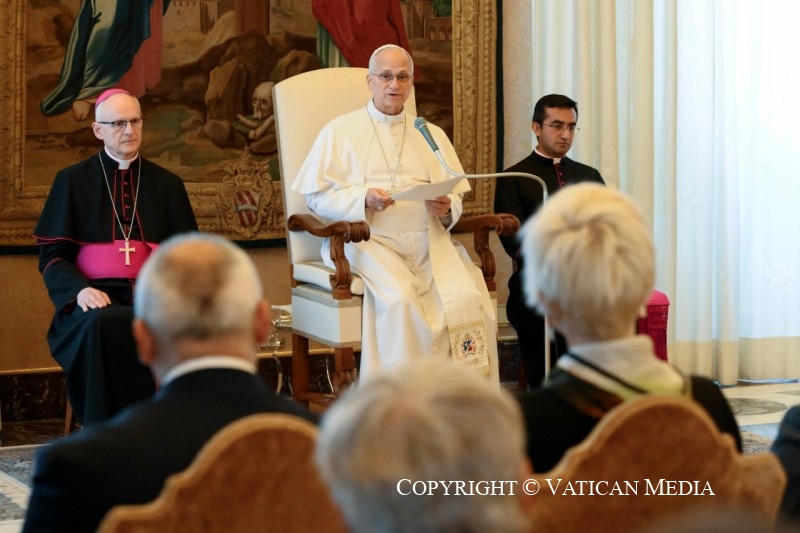
Pope Leo XIV warned this Friday, October 30, about the risks of attributing rights or legal personality to artificial intelligence systems and called for decisions related to human life, freedom, and the use of force to always remain under human control. During an audience at the Vatican Apostolic Palace, the Pontiff also urged progress toward the prohibition of lethal autonomous weapons and the establishment of international mechanisms to ensure technological development serves the common good.
The Holy Father received participants in the meeting “The Future of AI: A Dialogue between the Vatican and the Scientific World on the Developments and Applications of Intelligent Technologies,” organized by the Pontifical Academy for Life and the Future of Life Institute. In his address, Leo XIV outlined five considerations on human responsibility regarding these technologies, drawing on the teachings of his encyclical Magnifica humanitas and recalling that technical progress cannot take precedence over the dignity of the person.
Below, we offer the full speech of Pope Leo XIV:
Address of Leo XIV to the Participants in the Meeting on the Future of Artificial Intelligence
Vatican Apostolic Palace, Friday, October 30, 2026
In the name of the Father, and of the Son, and of the Holy Spirit.
Peace be with you.
I welcome you all and thank you for your presence this morning. You come from many countries, bringing with you a great variety of questions and visions. At the same time, I believe you share a certain sense of unease regarding the development of artificial intelligence. We recognize the direction we should take, but not enough is being done to move forward. I thank you for sharing your concerns, as well as your ideas and proposals for the future. These are the first fruits of a transdisciplinary approach, which is increasingly necessary if we are to address the complexity of the great challenges of our time.
The Pontifical Academy for Life, which has organized this meeting, is very aware of the challenges that arise wherever human dignity is threatened. In this regard, addressing the leaders of the G7, Pope Francis described artificial intelligence as “a fascinating and tremendous instrument at the same time” and stated that the decision to take a human life should never be entrusted to a machine (cf. Address at the G7 Session on Artificial Intelligence, June 14, 2024). Those words remain more relevant than ever. In the encyclical Magnifica humanitas I have sought to address these issues in greater depth. Today I would like to offer you five considerations in particular.
First, the future of artificial intelligence is not predetermined. As a technology developed by human beings, its future depends on the decisions we make. Therefore, we have the responsibility to guide, modify, and, when necessary, reject its applications (cf. nn. 97, 104). The decisive question, then, is not simply: “What can artificial intelligence do?”, but: “What should it serve?” Those who view its development merely as a race to be won risk focusing only on the finish line, forgetting those left behind. A reliable system that serves the human person is more valuable than an extraordinarily powerful system whose consequences cannot be adequately foreseen or controlled.
Second, machines are instruments, not persons. “So-called artificial intelligences do not live an experience, do not possess a body, do not go through joy and pain, do not mature in relationship, do not know from within what love, work, friendship, and responsibility mean” (n. 99). Today some propose granting rights to these systems, or even legal personality. Such an approach risks obscuring human responsibility and leaving those who suffer harm to confront a faceless entity.
Third, certain decisions must never be delegated. When a person is included in a list of suspicious subjects or registered in a border control database, there is a risk of being reduced to mere data. Decisions affecting human life, freedom, and the use of force must always remain subject to effective, informed, and responsible human control (cf. nn. 198-200). For this reason, artificial intelligence must be “disarmed” (n. 110), and I encourage the States that will meet in November in Geneva to take concrete steps toward the prohibition of lethal autonomous weapons.
Fourth, intelligent technologies must be oriented toward the common good. “Justice today also passes through access to the benefits of innovation: care, knowledge, tools, opportunities” (n. 161). Indeed, they must never become ends in themselves or serve merely the interests of a few privileged individuals. On the contrary, their development must promote solidarity and participation at the various levels of the global community, ensuring that the benefits of progress are shared equitably, especially with those most in need (cf. nn. 71-72).
Finally, I would like to highlight a challenge that may be the most urgent. We already know many of the ethical principles that should guide the development of artificial intelligence. What we need now are institutions capable of putting those principles into practice, especially effective international institutions that can safeguard the global common good (cf. n. 64). This requires shared norms, independent oversight, and clear mechanisms of accountability, so that decisions regarding the development and use of artificial intelligence can be examined, questioned when necessary, and accompanied by appropriate measures to repair any harm caused (cf. nn. 105, 107).
Dear friends, with these reflections I thank you once again for your valuable contributions in this field and encourage you to persevere in your commitment, working together in a spirit of dialogue and shared responsibility for the common good. I accompany you with my prayers and to each of you I impart my heartfelt blessing. Thank you.