


By: Msgr. Marian Eleganti
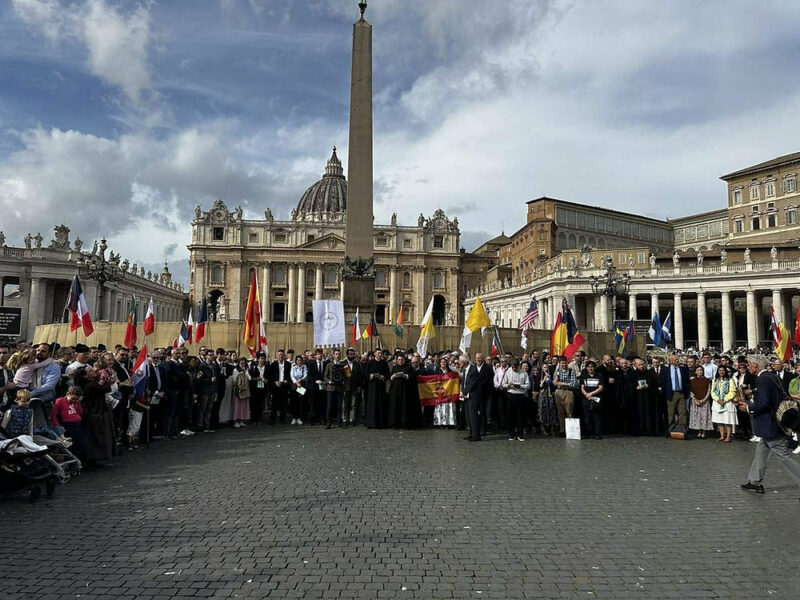
The ban on access to St. Peter’s Basilica imposed this year on pilgrims linked to the tradition of “Ad Petri Sedem,” on October 24, 2026, borders on hostility toward Catholics who are faithful to the Pope and to sound doctrine, and has nothing to do with concern for the unity of the Church or with operational difficulties in organizing liturgical celebrations in St. Peter’s Basilica.
The various rites existing in the Catholic Church demonstrate, through their peaceful coexistence with the Novus Ordo, that things can also be done differently. The Eastern Catholic Churches are even autonomous particular Churches (sui iuris) within the universal Catholic Church. No one considers them a threat to the unity of the Church. No one would deny them an altar or prevent them from entering a Catholic church. No one, except the Vatican, which bars access to conservative Catholics who are otherwise faithful to the Pope.
The synodal hypocrisy of “inclusivity” has thus been exposed. The pilgrims of “Ad Petri Sedem” are not the Priestly Fraternity of St. Pius X (FSSPX).
But we have known this for a long time: certain people are only inclusive when it serves their own objectives. They exclude, in a blunt and ruthless manner, those who think differently or follow other pastoral and spiritual approaches. That has been my constant experience. We recognize the same pattern in politics as well.
Well, the so-called synodality has thus shown its true face. It selects whom or what it includes. “Everyone, everyone, everyone” does not, in reality, mean everyone, but only some.
We know the efforts and demands of so-called reformist Catholicism since the 1970s. Its protagonists have succeeded one another across generations and have often changed their attire, but without ever abandoning their objectives, always the same.
The result is the current synodality, which is not the synodality of yesterday, that is, that of Tradition. Everything suggests that, ultimately, it is a structural reform of Protestantizing inspiration, carried out belatedly, and the annulment of Familiaris Consortio (1981) and Veritatis Splendor (1993). For converts from the Anglican Church, the similarities are very recognizable.
The intercultural learning and listening—intercultural learning and listening—I am a missionary Benedictine, are key concepts I have known since the early 1990s and which have paralyzed our missionary dynamism for decades.
The declaration Dominus Iesus, published by the Congregation for the Doctrine of the Faith on August 6, 2000, was already a reaction against this, but it was not welcomed. That is why today we have this synodal overdose of words and processes.
And yet, the truth is very simple: DOMINUS IESUS!
The SPIRIT already exhorted us more than twenty-five years ago to present (anew) CHRIST to the nations as the exclusive and absolute Truth, as the only door to the FATHER, as the universal and ever-valid Master, and as the sole Redeemer of the world.
Instead, we sit in circles and around tables to listen. To whom? But nothing comes out of it.
I mean: nothing new, except the gradual implementation of the demands of yesterday’s reformist Catholicism: democracy and participation in decision-making; control of power; laity in leadership positions; women in ecclesiastical offices; revision of sexual morality; normalization of divorce and remarriage; recognition of homosexual lifestyles and unions; transgenderism; protection of creation, that is, the climate; socialist-inspired universalism: open migration and universal fraternity; interreligious coexistence instead of mission.
The elephant in the room, the correlation between abuse and homosexuality in the Catholic clergy (Dariusz Oko; Paul Sullins), continues to be ignored.
Dialogue tables are directed. Commissions present heterodox proposals. From Rome, no valid responses arrive to the problems caused in the Church by liberal progressivism.
An honest and objective evaluation of the liturgical renewal has still not been carried out, without implying a desire to return to the period before 1965. Nor is there objective reflection on young people’s approach to conservative positions, also within the Church, as a sign of the times.
Meanwhile, we see Islamo-leftist, migratory, and chaotic forces acting in the streets of European cities, symptomatically showing what happens when the traditionally Christian order collapses and the secular, value-neutral State fails.
Its main political leaders lack both credibility and values and virtues; in their post-Christian condition, they simply have nothing to offer.
It is incomprehensible that, not long ago, a Pope even exhorted young people to provoke chaos.
Chaos has never been a category of the SPIRIT, but rather of demonic and revolutionary forces. As is well known, the SPIRIT is the One who, from the very beginning, brought order out of chaos. Where chaos prevails, the devil reigns.
The signs of decomposition in society and in the Church in our latitudes are evident.
The first (society), in my opinion, has no possibility of surviving without Christianity. The second (the Church), although sustained by God, is ceasing to proclaim the exclusivity of JESUS CHRIST (in the double sense of the word!), who is the Way, the Truth, and the Life.
Now He is used only as an instrument at the service of humanity, something that is often described with the term “openness.”
The category of sin is replaced by that of fragility. What matters, above all, is closeness. Neither heresy nor error is pointed out. Instead, dialogue flourishes.
For years, the Church has resembled an endless workshop of circles of chairs and dialogue tables, without offering solid results, except those which, both in fact and in language, undermine its doctrine, its preaching, and its hierarchical-sacramental structure.
To conclude, the hopeful part:
We are approaching 2033. It will be a special year, two thousand years later.
JESUS CHRIST is the same yesterday and today. HE remains the FATHER’S answer to all our problems and the expiation for our sins. It is especially the latter that we must remember.
Where HE enters a heart, everything is made new!
HE is the pearl that the Church has to offer to the nations. Whoever has recognized its value no longer desires anything else. Nor can he place JESUS CHRIST on the same level as others.
The joy of having found Him eclipses everything else.
The GOD made man is, simply, unique and unrepeatable!
For everyone!