


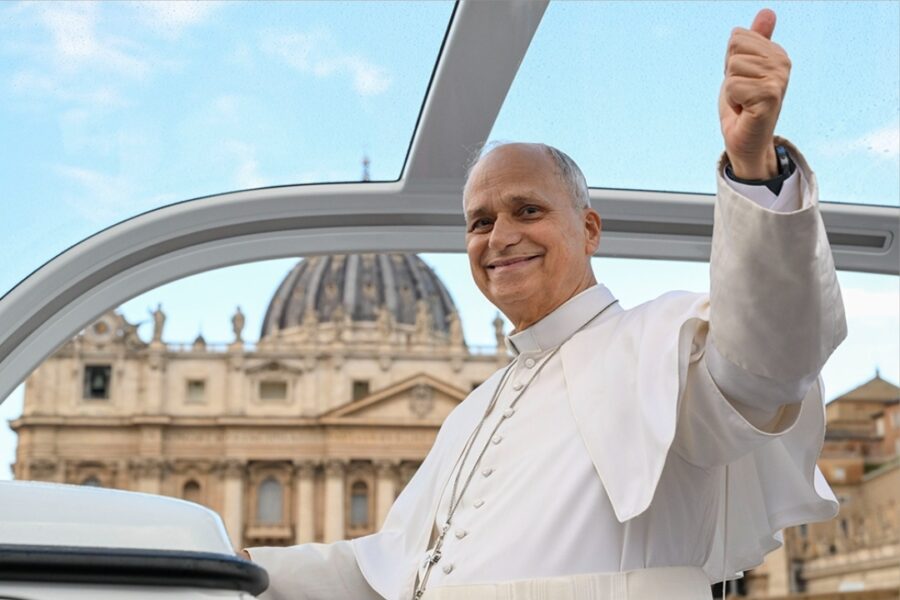
Pope Leo XIV has requested to vote by mail in the midterm elections taking place in the United States next Tuesday, November 3. The request was registered on October 3 at the Will County Clerk’s office in the Chicago metropolitan area, where the Pontiff is listed in the electoral roll under his civil name, Robert Francis Prevost, and with his brother John’s address in the town of New Lenox.
The information was first reported on October 23 by the WJOL radio station in Joliet, which attributed the request to a person close to the Pope and noted that the application had been verified and the ballot sent. On Thursday, Kim Fladhammer, chief of staff at the county office, confirmed to the Chicago Sun-Times that Prevost’s name appears on the list of voters who have requested a mail-in ballot.
It is not yet known whether the Pope has returned the ballot. If he does, he would be the first sitting pontiff on record to vote in an election. Neither the Holy See Press Office nor the family has made any statements. John Prevost was in Rome this week, along with about fifty parishioners from St. Jude Parish in New Lenox who were received by the Pope in St. Peter’s Square.
What is being voted on in Illinois
In addition to the renewal of the House of Representatives and part of the federal Senate, Illinois voters are electing a governor—incumbent Democrat JB Pritzker is seeking re-election—as well as judges and county officials. Since 2010, any voter in the state may vote by mail without needing to justify their absence, and federal law protects the voting rights of U.S. citizens living abroad as long as they maintain their electoral domicile.
Illinois election law stipulates that no one receives a mail-in ballot without first submitting an application, which is processed in the voter’s name and sent to their registered address. Once completed, the ballot can be returned by mail, deposited in one of the drop boxes provided by the county, or delivered in person—either by the voter or by someone expressly authorized by them. In the latter case, both must sign the authorization printed on the return envelope, and the law classifies it as an offense for any other person to collect or transport the ballot. Mail-in ballots are accepted up to fourteen days after the election, provided they bear a postmark dated no later than Election Day. Neither the Holy See nor the family has clarified which of these methods was used for the Pope’s vote.
His voting history
County records, released after the May 2025 conclave, show that Prevost voted by mail in the 2024 presidential election and in the general elections of 2012, 2014, and 2018. Illinois does not require party affiliation, and in primaries voters choose one party’s ballot each time: Prevost selected the Democratic ballot in 2008 and 2010, and the Republican ballot in 2012, 2014, and 2016. He did not participate in the primaries held last March.
The canonical and international framework
The uniqueness of the case lies in the voter’s status. The Pope is sovereign of the Vatican City State and head of the Holy See, a subject of international law that maintains diplomatic relations with the United States and which, under Article 24 of the Lateran Treaty, declared itself foreign to temporal disputes between states. There is no precedent of a head of state participating as a voter in another country’s elections, making the decision a matter that goes beyond the strictly personal.
The request comes at a time of strained relations between the Vatican and the Trump Administration. Leo XIV has publicly criticized the war with Iran, immigration policy, and the resumption of federal executions; the president once described him as “soft on crime,” and Vice President JD Vance asked the Holy See not to interfere in U.S. politics. There have also been gestures of rapprochement, such as the signed baseballs the Pope sent to Trump, Vance, and Rubio last summer.
Although the vote itself is secret, the news has already entered the campaign. Some U.S. Catholic publications have launched initiatives inviting the faithful to commit to voting following the Pope’s example—an use of his image that the Holy See, faithful to its tradition of neutrality, has historically sought to avoid.