


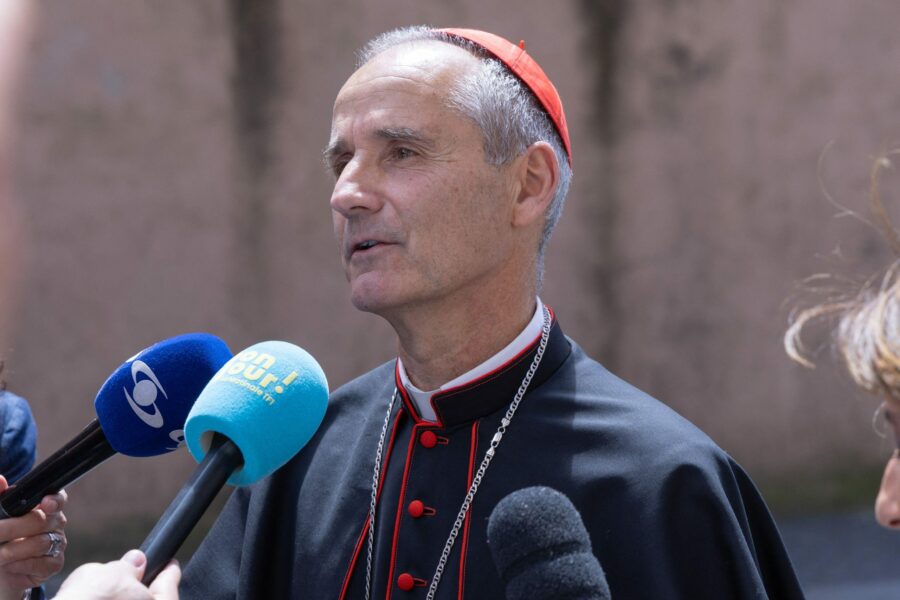
The cardinal Jean-Paul Vesco, Archbishop of Algiers, has stated that the Catholic Church in Algeria does not have the mission of converting Muslims, but rather of being part of Algerian society and bearing witness to the faith through coexistence and fraternity. He expressed this in an interview given to the Belgian Catholic media outlet CathoBel on October 23, in which he addressed the Christian presence in a Muslim-majority country and his understanding of interreligious dialogue.
The cardinal’s remarks once again bring to the fore a central question for the Church’s mission: the relationship between dialogue with other religions, the proclamation of Jesus Christ, and the call to conversion.
«We are not a Church that is there to convert»
During the interview, Vesco defended a Catholic presence integrated into Algerian society, based on witness, coexistence, and fraternity.
«We are the Church of this people. Not a proselytizing Church, not a Church that is there to convert, but a Church that aspires to be one of the components of this people», the archbishop affirmed.
The cardinal also rejected certain forms of religious proselytism, which he described as a poison for relations between monotheistic religions. In his view, discrediting the beliefs of one’s interlocutor hinders dialogue and mutual recognition.
Vesco stressed the importance of fraternity between Christians and Muslims and questioned aspirations to recover old political models of Christendom.
His claim that the Church is not there to convert, however, raises a different issue from the rejection of religious pressure: the place that the explicit proclamation of Jesus Christ occupies in the Church’s mission.
A position Vesco had already defended previously
This is not the first time the Archbishop of Algiers has spoken in these terms.
In April 2018, when he was Bishop of Oran, Vesco explained in an interview given to Le Point that the Gospel is transmitted through the witness of life, friendship, and participation in society, without necessarily implying that people change their religion.
On that occasion, he maintained that the Church’s mission did not consist in trying to convert Muslims, although he acknowledged that he welcomed those who freely decided to embrace the Catholic faith.
Later, in February 2022, already as Archbishop of Algiers, he again defended a similar position. In an interview published by Cath.ch, he raised the need to abandon the idea that evangelizing consists in leading others to one’s own religious truth.
The most recent statements, also reported by Ad Vaticanum, maintain the same line regarding the relationship between interreligious dialogue and the evangelizing mission.
The Church teaches that proclaiming Christ and calling to conversion are part of its mission
Catholic doctrine distinguishes between proselytism understood as religious pressure or imposition and evangelization, which includes the proclamation of Jesus Christ and the invitation to freely embrace the faith.
The foundation of this mission is found in Christ’s command to the apostles: «Go and make disciples of all nations» (Mt 28:19).
Saint John Paul II developed this teaching in the encyclical Redemptoris missio, published in 1990, in which he recalled that the Church cannot renounce the explicit proclamation of Jesus Christ.
In number 44, the pontiff states that «proclamation has permanent priority in the mission» and reminds us that the Church cannot evade the mandate received from Christ to announce the Gospel to all peoples.
The encyclical also explains that interreligious dialogue is part of the evangelizing mission, but does not replace the proclamation of Jesus Christ. In number 46, Saint John Paul II expressly addresses Christian conversion, understood as a personal and free adherence to Christ.
Thus, respect for religious freedom and for people who profess other beliefs does not eliminate the responsibility of proposing the Catholic faith to them.