


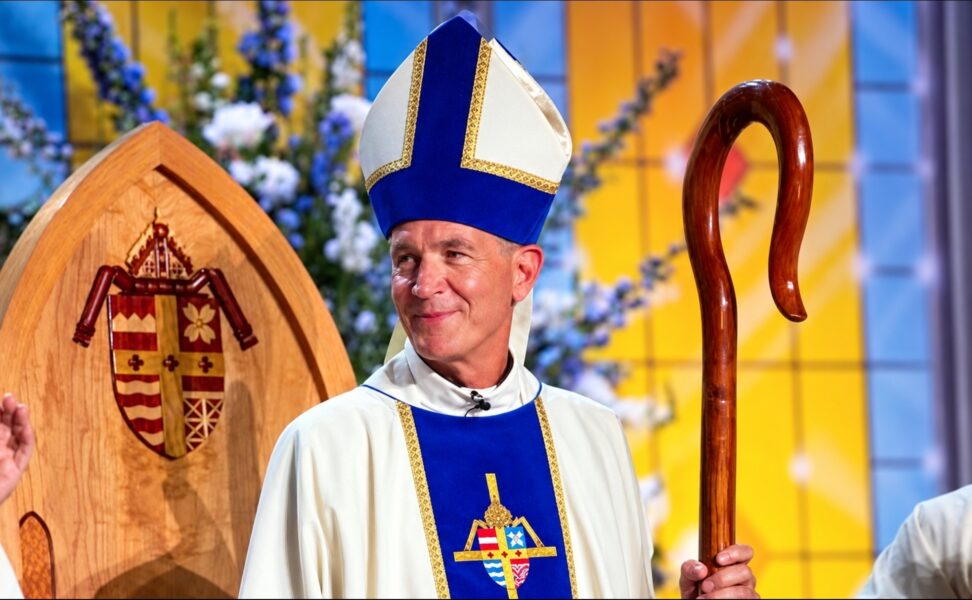
The Bishop of Knoxville (Tennessee, United States), Monsignor Mark Beckman, has published a seven-page memorandum in which he asks the faithful of his diocese not to attend the “San Francisco de Asís” mission, linked to the Priestly Fraternity of Saint Pius X (FSSPX). The prelate considers that participating in its activities constitutes a “proximate occasion of schism” and describes that decision as “gravely imprudent.”
The document, dated October 22, is titled “Instruction to the Faithful on the FSSPX” and includes questions, answers, and explanations about the canonical situation of the Fraternity and the reasons why the diocese does not authorize its presence in the territory.
The instruction directly affects Father David Mary Engo, a priest linked to the mission, from whom Beckman has withdrawn ministerial faculties and ordered to leave the diocese.
Beckman withdraws faculties from Father Engo and requires him to leave Knoxville
Father David Mary Engo is incardinated in the Diocese of Fort Wayne–South Bend, whose bishop has also suspended him from the exercise of holy orders.
For his part, Beckman has withdrawn the faculties and authorizations to exercise his ministry in Knoxville. He has also revoked the permission that allowed him to reside as a hermit in the diocese and has required him to arrange his departure from the territory.
The decision had been announced on October 2, when the diocese published a notice addressed to the faithful warning that it had not authorized the establishment of any priory, mission, chapel, or other apostolate linked to the Priestly Fraternity of Saint Pius X.
In the new memorandum, the bishop also addresses the priest’s canonical situation and recalls that any determination regarding possible sanctions falls to the competent ecclesiastical authority.
Participation in the mission, a “proximate occasion of schism”
The instruction relies on a declaration from the Dicastery for the Doctrine of the Faith dated July 2, 2026, according to which the sacred ministers of the FSSPX are in a state of schism and subject to the excommunication provided for in canon 1364 §1 of the Code of Canon Law.
Beckman distinguishes, however, between the canonical situation of the Fraternity’s priests and the individual responsibility of the faithful who participate in their celebrations.
The bishop clarifies that attending a Mass at the mission does not automatically incur excommunication, since determining any formal adherence to schism requires examining the intention, knowledge, and particular circumstances of each person.
Nevertheless, he expressly recommends that Catholics not participate in the Masses, sacraments, retreats, conferences, or other religious activities organized by the “San Francisco de Asís” mission. He also asks them to refrain from providing financial, material, or organizational support.
In his argument, Beckman acknowledges that attachment to the traditional Mass does not in itself constitute a schismatic act. However, he maintains that preference for a particular liturgical form cannot take precedence over communion with the Pope and the bishops united to him.
The bishop turns to the history of the Priestly Fraternity of Saint Pius X
The memorandum includes a review of the history of the FSSPX, founded by Archbishop Marcel Lefebvre in Switzerland in 1970.
Beckman recalls the withdrawal of its canonical approval in 1975, the priestly ordinations carried out by Lefebvre in 1976 despite the prohibitions received, and the episcopal consecrations of 1988 without a pontifical mandate, which led to the excommunications declared during the pontificate of Saint John Paul II.
He also cites Benedict XVI, who in his letter to the bishops of March 2009 noted that the Fraternity lacked canonical status in the Church. That year, the pontiff lifted the excommunications of the four bishops consecrated by Lefebvre, although that decision did not entail the regularization of the community’s legal situation.
The Bishop of Knoxville maintains that the differences between the Fraternity and the ecclesiastical authorities are not limited to the celebration of the traditional liturgy, but also affect issues of authority, obedience, and acceptance of the Second Vatican Council.
As an alternative for the faithful attached to the traditional Roman rite, the document recalls that the diocese maintains a monthly celebration of the Mass according to the 1962 Missal at the Christ Prince of Peace Retreat Center, located in Benton.
The instruction concludes with a call to Father Engo and those involved in organizing the mission to cease their activities and seek reconciliation with their ecclesiastical superiors.
A new measure in a diocese that has restricted the traditional Mass
The memorandum comes after other decisions by Beckman that have affected traditional liturgical and devotional practices in Knoxville.
In October 2025, the diocese eliminated the celebration of the traditional Mass in its parishes, limiting it to a retreat center on a monthly basis.
More recently, the bishop asked his priests to remove the prayer to Saint Michael the Archangel that the faithful recited before Mass, a provision that sparked criticism for the suppression of this devotional practice.
The new instruction, whose publication has been reported by AdVaticanum, expands the measures adopted at the beginning of October against the mission linked to the FSSPX and establishes an express warning to the faithful who wish to participate in its activities.