


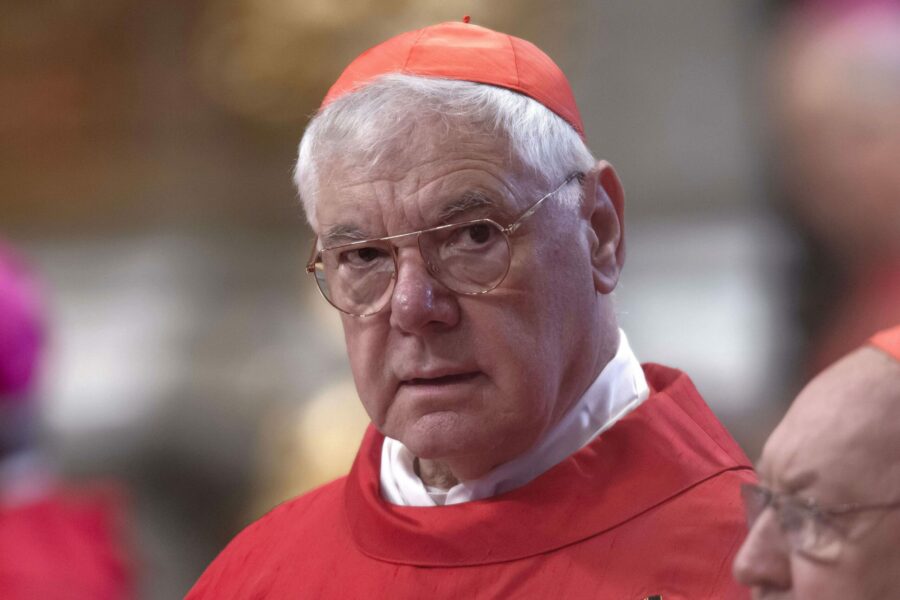
Cardinal Gerhard Ludwig Müller, prefectus emeritus of the Congregation for the Doctrine of the Faith, has recalled that the Church is not an institution that men can rebuild according to their own ideas, but a reality founded by Jesus Christ. “God is the one who reforms and renews us so that we may be good Christians,” he affirmed during a homily delivered on Sunday, October 25, in Poland.
The cardinal presided over the closing celebration of the centenary of the Diocese of Łomża, in the Cathedral of St. Michael the Archangel. In his preaching, reported by Kath.net, he insisted that authentic ecclesial renewal begins with personal conversion and fidelity to Christ.
“It is not our task to reform the Church of God, but to change our own life,” he noted.
The Church belongs to Christ
Müller invited the faithful, especially the young, to examine their personal relationship with God and to understand their belonging to the Church from faith, not from political or ideological categories.
He recalled that Christians are not defined by their adherence to a social class or an ideology, but by having been created and loved by God and called, through Baptism and Confirmation, to participate in the life of Christ.
The Church, he explained, accompanies man throughout his existence and leads him toward his definitive destiny, eternal life. Its mission does not consist in adapting to human projects, but in transmitting the salvation received from Jesus Christ.
From this perspective, the cardinal rejected the claim to dispose of the Church as if it were an organization created by its members and susceptible to being refounded according to their preferences.
Renewal begins with conversion
The homily took place at the conclusion of the celebrations for the one hundred years of the Diocese of Łomża, whose history was marked by the Second World War, the Nazi occupation, and the subsequent communist dictatorship.
Müller recalled the suffering of the Polish Church during those years and highlighted the role of Poland and St. John Paul II in the recovery of freedom in Eastern Europe.
Looking toward the future, he placed at the center fidelity to the faith received, sacramental life, and the conversion of Christians.
These statements are part of the repeated interventions of the prefectus emeritus on the nature of the Church and the limits of doctrinal reforms. In July, Müller warned against an interpretation of the development of dogma that sought to modify the substance of doctrine.
He had also questioned the proposals of the German Synodal Way to allow lay preaching during Mass, considering that they contradict the conciliar teaching on the unity of the Eucharistic celebration and the nature of ministerial priesthood.