


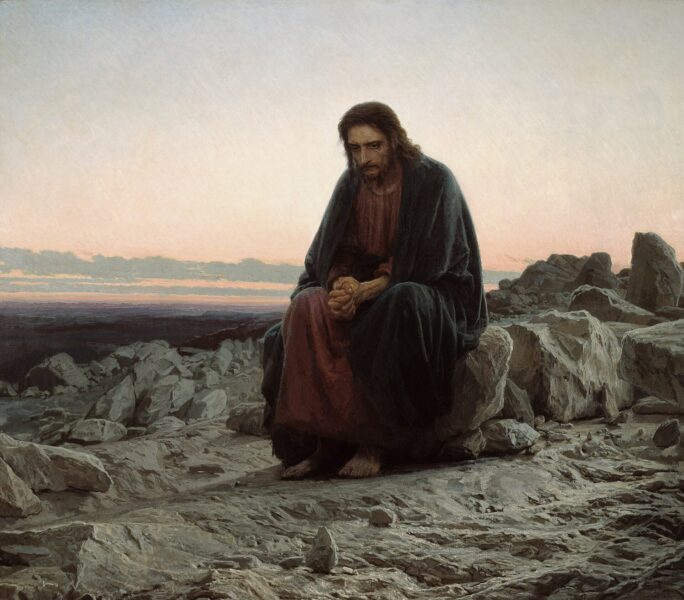
Why on earth did Christ have to proclaim that He was “the way, the truth, and the life”? How little inclusive! Did He not grasp the grave harm this would cause to interreligious dialogue? And that business about the gate being narrow, or that many are called but few are chosen… Did He not know that heaven is for everyone, everyone, everyone? As for poor Martha, a pioneer of NGOs, who wore herself out attending to her guests, why did He have to discourage her for being busy with the things of the world? What need was there to warn that all of that is useless if one loses one’s soul? Quite a way to foster social commitment.
And this despite the fact that Jesus had already been warned from the very beginning of His preaching, and by someone who knew perfectly well what was good for us. But even so: when the Prince of this World offered Him the chance to turn stones into bread, He paid no heed, though He could have ended hunger once and for all! His behavior in the other two temptations was even worse, utterly incomprehensible. What harm would there have been in throwing Himself from the pinnacle of the Temple and ridding us once and for all of uncertainty? How tiresome it is to live the mystery and always have to beg for the grace of faith. And then the cherry on top: why did He reject dominion over the kingdoms of the world? Kant saw it clearly, all the Freemasons who have ever lived have understood it, and yet He, so provident, failed to glimpse that having a world authority at the service of human fraternity would have allowed the immediate establishment of perpetual universal peace?
Fortunately, the ecclesiastical hierarchy has spent decades striving to correct such imprudences, with increasingly promising results. The conciliar aggiornamento opened perspectives that recent pontificates have explored with renewed enthusiasm. And although some recalcitrant faithful insist on recalling what Christ said, the adaptation of His message to the needs of modern man is advancing at a good pace. After all, what good is a two-thousand-year-old Church if it has not learned to improve upon the teachings of its founder?
The operation had an illustrious literary precedent. In The Brothers Karamazov, Dostoevsky imagined Christ’s return to sixteenth-century Seville. There the Grand Inquisitor orders His arrest and reproaches Him for His folly in rejecting Satan’s three offers: bread, miracle, and power. To impose on man a spiritual freedom that very few can bear? That is to overestimate him! Better acquainted with our weaknesses, the devil had offered Him the precise instruments to procure us an accessible happiness, and centuries later the Church had to accept those offers to remedy its Lord’s disorientation.
It would seem that the promoters of the versus populum Church read the Inquisitor’s speech with pencil in hand, taking as pastoral instructions what Dostoevsky had placed in the mouth of a man who confessed to serving Satan.
The first correction is obvious. If man needs bread, bread comes first. In a situation of need, it makes no sense to bother him with spiritual nourishment. The Church, traditionally committed to saving souls, has come to discover the advantages of devoting itself preferably to bodies. Charity is translated into solidarity; sin gradually yields prominence to social injustice, and redemption increasingly resembles a program of historical transformation. The distinction between the corporal and spiritual works of mercy is now a scholastic extravagance. But I already addressed this inversion of priorities in a previous column when examining the growing immanentization of Christian hope.
The second correction is more picturesque. After decades of demythologizing the supernatural, we are witnessing a progressive emotivist pentecostalization of Catholicism. Institutional support for the charismatic renewal, born under Protestant influence, culminated under Francis with the creation of CHARIS. Praise sessions, laying on of hands, trances, and proclaimed healings proliferate, while subjective experience gains the status of spiritual certification. We forget that emotion can be provoked without supernatural aid and that grace does not depend on the intensity of enthusiasm. Those who were suspicious of traditional ceremony discovered a special receptivity of the Holy Spirit to certain procedures of collective animation. With so much pop singing and so much emotion, the gesticulating fever has reached even the Our Father, which some of the faithful now pray with arms raised and hands outstretched. The Missal prescribes that gesture for the priest, not for the assembly, but “active participation” now includes a sort of priestly ordination by mime, for mimes and fools.
The third correction is of greater depth, for it affects the very identity of Christianity. The aspiration to a universal religion, so characteristic of Masonic naturalism, finds in human fraternity a principle capable of reconciling the most dissonant beliefs. Yet, lo and behold, there is a formidable obstacle: God Himself, Jesus Christ. A generic god admits numerous denominations, but the Word incarnate, crucified, and risen resists sharing with others the condition of Savior.
As recently as 2000, the declaration Dominus Iesus, signed by Ratzinger and approved by John Paul II, reaffirmed the uniqueness and universal salvific efficacy of Christ against theories that attributed a parallel redemptive efficacy to religions. But then Bergoglio arrived, and in 2019 he signed in Abu Dhabi a document that presented religious diversity as willed by God. Five years later, the same Pontiff declared in Singapore that all religions are paths to reach Him. They are, he said, like “different languages.” It is difficult to imagine a more expeditious way to alleviate the doctrinal discomforts of interreligious dialogue. The martyrs died for nothing, and the Catholic missions, which for centuries strove to convert pagans, must have suffered a lamentable problem of linguistic comprehension.
Vatican diplomacy seems to move with greater ease in this new horizon. Parolin, in his recent address to the United Nations, once again laid out the usual program of international concord, multilateral cooperation, and human fraternity.
It is now customary for the Church’s major public objectives to coincide with those of international organizations, agents of globalism. Robert Hugh Benson carried this temptation to its ultimate consequences in The Lord of the World. He presented a humanity unified under a world government that embraces a humanitarian religion which has even preserved the ceremonial of ancient cults. One of its organizers is an apostate priest who offers the services of other clerics to lead the new celebrations. When asked if they are all Freemasons, he answers affirmatively. Benson had the foresight to understand that the religion of Man would also need liturgists. The only thing truly incompatible with that universal cult was God made man. Of course, in his novel, the Catholics who remain faithful to Christ end up being persecuted.
Returning to Dostoevsky, one must tip one’s hat to his Grand Inquisitor. A perfect connoisseur of the price of his program, he confesses to Christ that he has accepted Satan’s offers and governs men according to his principles, convinced that this makes them happier. Christ listens to him in silence and finally kisses him. The old man, moved, opens the prison door and orders Him never to return.
But the great Russian master attributed to the Inquisitor a sincerity that today is out of place. He did not foresee post-truth. That man was aware that he had betrayed Christ, and he accepted it. Today he would have called his betrayal “pastoral discernment.”
Note: Articles published as Tribuna express the opinion of their authors and do not necessarily represent the editorial line of Infovaticana, which offers this space as a forum for reflection and dialogue.