


By Father Paul D. Scalia
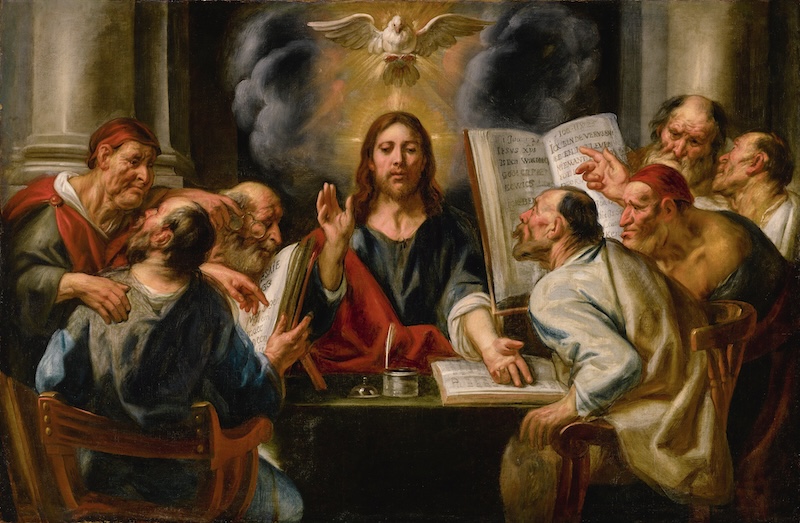
Well, he got more than he bargained for. In today’s Gospel (Matthew 22:34-40), all the lawyer wanted was a moment of Gotcha!, catching Jesus in some controversy. Yet, as in the other tests, our Lord not only overcomes his adversaries but rises above them and takes the discussion to a level they had not anticipated. Thus, the lawyer asks for a single commandment… but receives two… with a third inserted between them. And he wasn’t counting on that.
To appreciate this exchange, we should imagine ourselves in the lawyer’s place. For we are like him: we put our Lord to the test and want to prove that we are right. So, since we do what he does, we should also listen to our Lord’s answer as he listens to it.
The Pharisee begins on the wrong foot: “Teacher,” he says. Well, Jesus is more than a teacher. Yes, he teaches, but he does so with divine authority and like no one else. He is the only teacher whose teaching deserves our full trust. When we approach Him as a mere teacher, we make Him one among many. At that point, we are no longer seeking His truth. We are merely gathering input, asking for His opinion as we ask for so many others’.
“Which is the greatest commandment of the law?” The Pharisee had his own opinion on the matter. He had his favorite law in mind. Part of his test of Jesus consisted in seeing whether He agreed. Which is what we do. We focus on this, that, or the other aspect of the faith—our favorite—and make it everything. Maybe it’s doctrine, or liturgy, or service to the poor, or cultural transformation, or… well, whatever. But instead of having our own ideas about this, we should want our Lord to teach us what is greatest.
“You shall love the Lord your God with all your heart, with all your soul, and with all your mind.” This commandment is taken from the Shema (Deuteronomy 6:5), which pious Jews recited several times a day. It springs from Israel’s singular faith in the one God. Jesus calls this commandment not only the greatest but the first. It is not simply better than the others, but the source of them all, because it flows from the very being of God, who is Himself one, undivided, and loving.
The commandment has a beauty, simplicity, and grandeur that draw us. It also has an absolute character that often escapes us. It commands the Israelites—always tempted to divide themselves between the Lord and the more practical and indulgent gods around them—an undivided devotion.
Explicit polytheism is not a present reality for us as it was for them. But the commandment still holds. Like the Israelites, we divide our devotion and cover our bases. We diversify our spiritual portfolio (so to speak), spreading heart, mind, and soul, investing portions here and there, but never entirely in God. Sure, we place some trust in Him… but also in our own power, our résumé, our finances, etc. The one and undivided God deserves more: He has a right to a whole and undivided response.
And because He is love, the response to Him must be love. It cannot be—as the Pharisee and we might wish—a mere outward observance. It must be a response that springs from the very center of man, from his heart, the source of love. It is the first and greatest commandment also in this sense: it centers our love on Him and thus determines all other human acts. Let us recall St. Augustine’s phrase: Dilige et quod vis fac—Love and do what you will. If our love is rightly ordered—heart, soul, and mind given completely to God—all other loves will follow.
This brings us to the second commandment: “You shall love your neighbor as yourself.” Notice that this contains not one but two loves: neighbor and self, but not in that order. The formulation indicates that love of self stands between love of God and love of neighbor. In the right order of loves, we move from love of God to love of ourselves. We love ourselves because, in loving God, we must love what He loves. And since we are most immediate to ourselves, we are the first recipients of that love.
Love of self is delicate. Some struggle because they cannot believe that God loves them. Others struggle to believe that God loves them not for their perfections (He does not need them), but despite their imperfections. They think God loves them because they are good, when in reality they are good because God loves them.
All of which underscores the absolute priority of love for God. Until we are in that relationship with Him, we will not know how to love ourselves rightly. And that defect (or excess!) of self-love means we will not know how to love our neighbor. As God teaches St. Catherine of Siena in The Dialogue, we love others with the same love with which we know we are loved.
“You shall love your neighbor…”. Only now do we arrive at the commandment many believe is the first. The first two loves have priority because only by being in a right relationship with God can we know that we are loved and how to love others. Our neighbor is not lovable in himself. He is lovable because God loves him, and so we must love him. But until we love God, we will not know how to love our neighbor, just as we do not know how to love ourselves.
Imagine our Lord’s expression as He gives His answer. His words are more than a response and a rebuke. They are an invitation to look to Him and to contemplate in Him the God who claims our love, who has created us for His love, and whom we love in our neighbor.
About the Author
Father Paul Scalia is a priest of the Diocese of Arlington (Virginia), where he serves as episcopal vicar for clergy and pastor of Saint James in Falls Church. He is the author of That Nothing May Be Lost: Reflections on Catholic Doctrine and Devotion and editor of Sermons in Times of Crisis: Twelve Homilies to Stir Your Soul.