


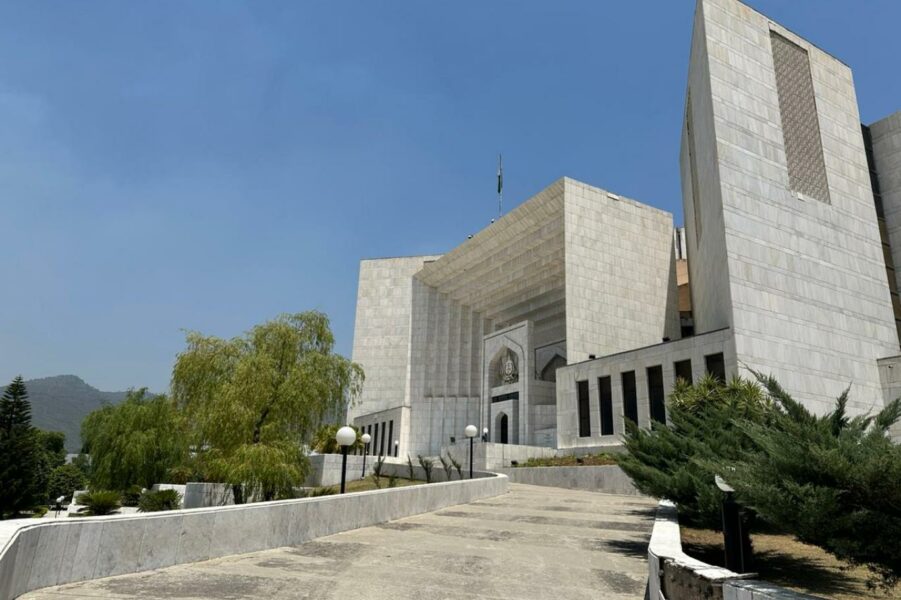
The Supreme Court of Pakistan has upheld the death sentence of Qaiser Ayub, a 49-year-old Christian and father of three, accused of posting content deemed offensive to the Prophet Muhammad online. In the same ruling, issued on October 7, the court acquitted his brother Amoon Ayub, 46, finding insufficient evidence to sustain his conviction.
Both brothers had been imprisoned for over a decade in a case dating back to 2011. The Christian organization CLAAS-UK, which has followed the proceedings, welcomed Amoon’s acquittal but expressed concern over Qaiser’s situation, as he remains detained in Sahiwal prison and still faces the possibility of execution.
An accusation over online posts dating back to 2011
The case began after reports of allegedly blasphemous content published on a website linked to Qaiser Ayub. The accused maintains that he had closed the site in 2009 and that another person later reactivated it, retaining his name in the copyright information.
According to CLAAS-UK, the accusations arose following a dispute with acquaintances from his workplace. In response to threats and concerns for their safety, the two brothers temporarily left Pakistan and traveled to Singapore and Thailand before returning to the country.
The arrests took place in 2014, and on December 13, 2018, a court sentenced them to death. For security reasons, the trial was held inside Jhelum prison. In June 2022, the Lahore High Court upheld both sentences.
The case against Qaiser relied, among other elements, on digital evidence related to the website and information obtained from electronic devices. The Supreme Court found sufficient grounds to uphold his conviction, while in Amoon’s case, it concluded that his responsibility for publishing the content had not been proven.
Nasir Saeed, director of CLAAS-UK, welcomed the release of the younger brother but lamented the years both had spent in prison.
“We welcome the acquittal of Amoon Ayub after so many years of imprisonment, but our relief is overshadowed by the devastating news that his brother Qaiser continues to face the death penalty,” he stated.
Saeed noted that Qaiser has a wife and three children and stressed that no family should remain under the threat of execution for so many years. He also expressed hope that all available legal avenues would be pursued to save his life.
The defense turns to the United Nations to try to prevent the execution
The American Center for Law and Justice (ACLJ), which is involved in the brothers’ defense through its Pakistani office, the Organization for Legal Aid (OLA), has submitted an urgent communication to the United Nations special procedures on human rights.
The organization considers the Supreme Court’s decision particularly serious and maintains that this is the first time Pakistan’s highest judicial body has upheld a death sentence for blasphemy.
The legal team has also announced that it is preparing a review petition before the Supreme Court itself in an attempt to overturn the sentence against Qaiser.
The case had already drawn the attention of the United Nations. In 2025, several independent human rights experts expressed concern over the sentences imposed on the Ayub brothers and the judicial safeguards in the proceedings.
In an official communication addressed to Pakistani authorities, the experts questioned the evaluation of the evidence and warned of the consequences of applying the death penalty in cases involving blasphemy accusations.
Blasphemy laws and the situation of Christians in Pakistan
Pakistan’s Penal Code provides for the death penalty for insulting the Prophet Muhammad under Article 295-C. These provisions have led to numerous proceedings against members of religious minorities, especially Christians, Hindus, and Ahmadis, although they also affect Muslim citizens.
Religious freedom advocacy groups denounce that blasphemy accusations can be used to settle personal disputes, intimidate certain communities, or provoke retaliation against the accused, even before courts examine the evidence.
Among recent cases is that of Shagufta Kiran, a Christian woman sentenced to death in September 2024 for a WhatsApp message deemed blasphemous.
CLAAS-UK has called for greater safeguards against false accusations, protection for the accused and their lawyers, and measures to prevent threats or external pressures from interfering in judicial proceedings.
While Amoon Ayub faces the return to freedom after years of imprisonment, his brother Qaiser remains under a death sentence in Sahiwal prison. His lawyers are preparing new legal actions and have requested United Nations intervention to try to prevent his execution.