


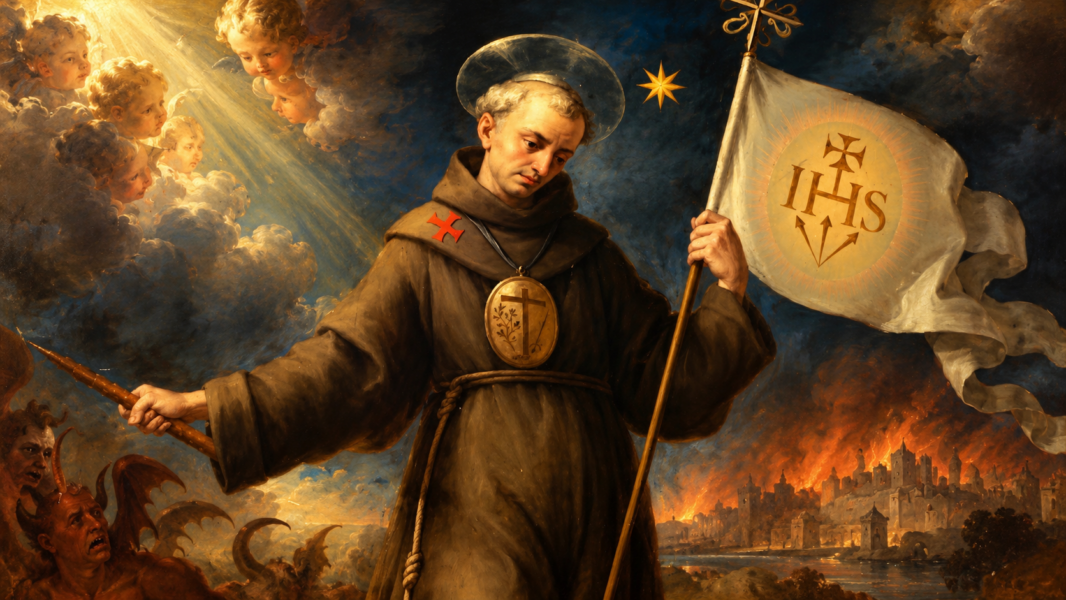
This Friday, October 23, marks 570 years since the death of St. John of Capistrano, the Franciscan priest who stood out for his preaching, his defense of Catholic doctrine, and his participation in the defense of Belgrade against the advance of the Ottoman Empire in 1456. His life was marked by intense apostolic activity that took him across numerous European territories and led him to intervene in some of the most important religious and political events of his time.
Born on June 24, 1386, in Capestrano, in the Italian region of Abruzzo, John studied Law in Perugia, where he developed a promising career as a jurist and came to hold positions of government. However, his path changed after being imprisoned during a political conflict. That experience led him to abandon his civil aspirations and join the Order of Friars Minor in 1416.
A preacher committed to the reform of the Church
After entering Franciscan life, John of Capistrano devoted himself especially to preaching, religious formation, and the reform of customs.
He was one of the main collaborators of St. Bernardino of Siena, with whom he shared the drive for Franciscan observance and the spread of devotion to the Most Holy Name of Jesus.
His sermons gathered large numbers of the faithful, especially during Advent and Lent. In addition to promoting personal conversion, he combated doctrines he considered contrary to the Catholic faith and defended the need to preserve religious discipline.
His activity was not limited to Italy. As a papal envoy, he traveled through various territories of Central Europe, including Austria, Bavaria, and Poland, where he preached and worked for the renewal of Christian life.
His trajectory, recorded by the Vatican City State, shows the importance he held in the religious reform movements prior to the Council of Trent.
The defense of Belgrade against the Ottoman Empire
The best-known episode of his life took place in 1456, three years after the fall of Constantinople into the hands of Sultan Mehmed II.
The Ottoman advance toward Central Europe at that time threatened the Kingdom of Hungary, whose position was fundamental for the defense of the Christian territories in the region.
During the siege of Belgrade, John of Capistrano participated in the mobilization of volunteers and spiritually accompanied the forces defending the city, which were under the military command of John Hunyadi.
The Franciscan, who was already seventy years old, encouraged the combatants through preaching and prayer. His presence helped strengthen the morale of those resisting the siege.
In July 1456, the Christian forces succeeded in repelling the Ottoman army and achieving a victory that temporarily halted their advance toward Central Europe.
The defense of Belgrade made John of Capistrano a figure especially remembered in Hungary and other territories of the region. Over the centuries, his participation in those events became linked to the historical memory of European Christendom.
He died a few months after the victory
The victory of Belgrade was the Franciscan’s last great mission. Weakened by the hardships of the campaign and affected by the plague, he died on October 23, 1456, in Ilok, a town located in present-day Croatia.
His reputation for holiness had already spread during his lifetime thanks to his preaching and apostolic activity. He was canonized in 1690 by Alexander VII and later recognized as patron of military chaplains.
The Church celebrates his memory on October 23, especially recalling his dedication to preaching, his defense of the Catholic faith, and his work to spiritually strengthen Christian communities.
Five centuries and seven decades after his death, St. John of Capistrano remains one of the most prominent figures of Franciscan observance and of the religious history of 15th-century Europe.