


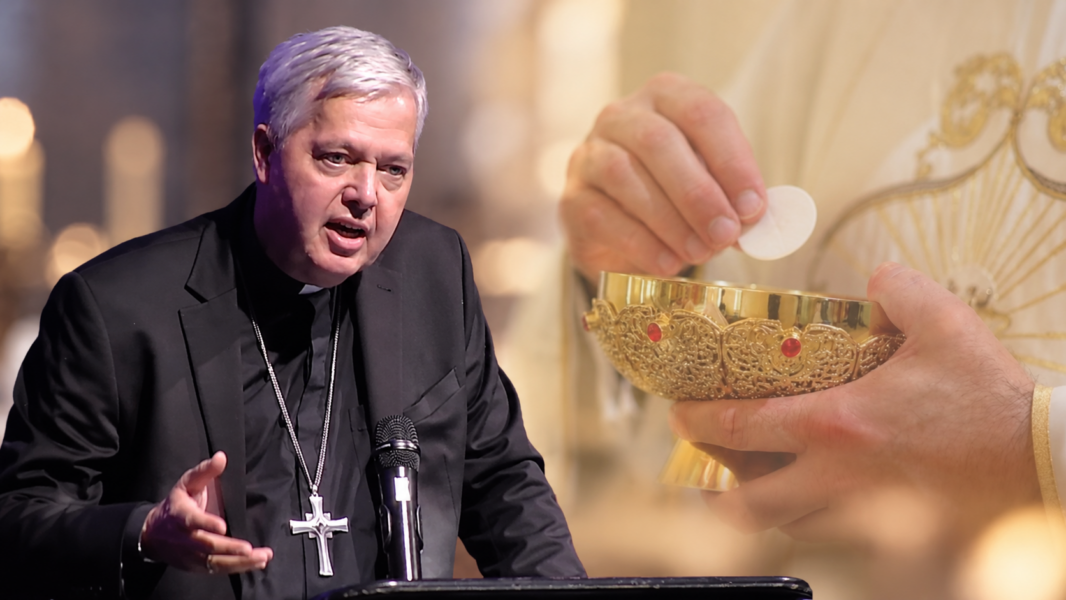
Auxiliary Bishop of ‘s-Hertogenbosch (Netherlands), Rob Mutsaerts, has warned against a conception of ecumenism that seeks to overcome the differences between Catholics and Protestants without taking into account the doctrine on the real presence of Christ in the Eucharist. In a reflection published on his personal blog, the prelate maintains that unity among Christians cannot be built by setting aside the truths of faith that still separate them and recalls that Eucharistic communion expresses a doctrinal unity that must exist beforehand.
“The solution to the division between Catholics and Protestants does not consist in now inviting each other everywhere and kindly sweeping the differences under the rug. That is not ecumenism. It is theological indifference accompanied by a kind gesture,” Mutsaerts states in his article, titled Bread for the Birds?.
The reflection responds to the complaints of some Protestants about not being able to receive communion in Catholic churches, reported on October 20 by the Dutch newspaper Nederlands Dagblad. The bishop considers their discomfort understandable, but warns that it stems from a fundamental misunderstanding: “The question is not who can sit at the table, but what is on the table.”
The Eucharist is not a mere commemoration
Mutsaerts explains that, for many Protestants, the Lord’s Supper is primarily a commemoration of the Last Supper, of Christ’s death, and of the communion among believers. The Catholic Church, on the other hand, teaches that the Eucharist is the true Body and Blood of Jesus Christ and that in the Holy Mass his sacrifice on the cross is sacramentally made present.
“The Catholic Church does not believe that the Eucharist is a meal in the form of a sacrifice, but that it is a sacrifice in the form of a meal,” the bishop writes. A distinction that may seem subtle, but which, he points out, represents “a world of difference.”
To support this teaching, he recalls Christ’s words during the Last Supper: “This is my Body” and “This is my Blood.” Jesus did not present the bread and wine as mere symbols, but affirmed their identity with his Body and his Blood.
The prelate also dwells on the sixth chapter of the Gospel of Saint John, when Christ declares that his flesh is true food and his blood true drink. At these words, several disciples are scandalized and leave Jesus, who neither softens his statement nor presents it as a metaphor.
“An excellent moment, one might think, to clear up the misunderstanding. To say: ‘Friends, of course you must not take it so literally. It is only a figure of speech.’ But Jesus does nothing of the sort,” Mutsaerts observes, recalling that Christ asks the Twelve if they also wish to leave.
A doctrine present from the earliest centuries
The bishop likewise rejects the claim that belief in the real presence of Christ in the Eucharist arose several centuries after the apostles, as the result of later theological elaboration.
To this end, he cites Saint Ignatius of Antioch, who at the beginning of the second century denounced those who abstained from the Eucharist because they did not recognize that it was the flesh of Jesus Christ. He also recalls the testimony of Saint Justin Martyr, who around the middle of the same century explained that Christians did not receive the Eucharistic gifts as ordinary bread and drink, but as the flesh and blood of the incarnate Word.
“Anyone who claims that faith in the real presence did not arise until centuries later must have a particularly selective interest in the early Christians,” he maintains.
Mutsaerts acknowledges that theological formulation developed over time and that the term transubstantiation later acquired its doctrinal precision. Nevertheless, he insists that this development did not involve the emergence of a new belief, but rather the more precise expression of a faith present from the origins of Christianity.
Communion cannot anticipate a unity that does not yet exist
The core of Mutsaerts’ reflection lies in the relationship between the Eucharist and the unity of the Church. The prelate responds to the argument that the Catholic Church lacks an ecumenical spirit because it does not ordinarily allow Protestants to receive communion, whereas certain Protestant communities do admit Catholics to their Lord’s Supper.
In his view, hospitality cannot become an excuse for ignoring fundamental doctrinal differences. Each community acts according to what it believes happens during its celebration.
“When a Protestant invites a Catholic to the Lord’s Supper, he does so from his own conception of what takes place there. When a Catholic does not simply admit a Protestant to communion, he also does so from his faith in what takes place there,” he explains.
He further recalls that, according to Catholic doctrine, the Eucharist is not merely a personal encounter with Christ, but also the sacrament of the Church’s unity. Whoever receives communion expresses adherence not only to Christ, but also to the faith of the Church that celebrates the sacrament.
“It is hardly possible to express sacramentally a unity that does not yet exist in essential points of faith,” he states.
Although he acknowledges that Catholic discipline provides for exceptions in certain circumstances, he insists that communion cannot be used to erase the doctrinal differences that still separate Catholics and Protestants.
“Communion is not the means by which existing differences of faith are simply erased. It is the fullest expression of a unity in faith that must truly be present. It is not a lack of love. It is a matter of truth,” he emphasizes.
“The Mass is Calvary sacramentally present among us”
Mutsaerts also devotes part of his reflection to recalling the sacrificial character of the Holy Mass. Against an interpretation that reduces the Eucharist to a communal commemoration, he explains that in it the one sacrifice of Christ on the cross is sacramentally made present.
“Jesus is not crucified again. His sacrifice is not repeated. It is the same sacrifice, the same High Priest, the same sacrificial Lamb, but made present in an unbloody manner,” he writes.
For this reason, he maintains that the Mass cannot be understood as a religious gathering that concludes with a symbolic gesture of sharing bread and wine.
“The Mass is Calvary sacramentally present among us,” he affirms, and recalls that at the center of a Catholic church stands an altar, not a simple dining table. In this context, he also defends the practice of the priest and the faithful preferably facing the same direction during the liturgical celebration.
The bishop insists that true unity among Christians cannot be achieved through concessions that relativize Eucharistic doctrine. “True unity does not arise from putting the truth in parentheses, but from seeking it together,” he states.
“The tabernacle is not a breadbox”
To illustrate the importance of these differences, Mutsaerts recalls that, in the Catholic Church, consecrated hosts that are not consumed during Mass are reverently reserved in the tabernacle because Christ remains truly present under the sacramental species.
Hence the genuflection before the tabernacle and adoration of the Blessed Sacrament, practices that respond directly to faith in the real presence of Christ.
In Protestant communities that interpret the Lord’s Supper in an exclusively symbolic manner, he explains, the bread left over after the celebration remains ordinary bread and may receive different treatment, even being given to feed the birds.
For the bishop, this difference helps to understand why the Catholic Church cannot treat communion as a mere expression of ecumenical courtesy.
“The Catholic Church does not deny communion because it does not wish to share Christ with its Protestant brothers and sisters. On the contrary. It takes Christ so seriously that it cannot pretend that his real presence, his sacrifice, and his Church are secondary matters,” he writes.
Mutsaerts concludes by posing the question that, in his view, determines the entire controversy: “Is it bread that points to Christ? Or is it Christ himself under the appearance of bread?”
“If the former is true, one can speak of a table open to all. But if the latter is true, everything changes. Then we are no longer speaking of hospitality, but of adoration.”
And he concludes: “The tabernacle is not a breadbox. And the consecrated host, certainly, is not food for the birds either.”