


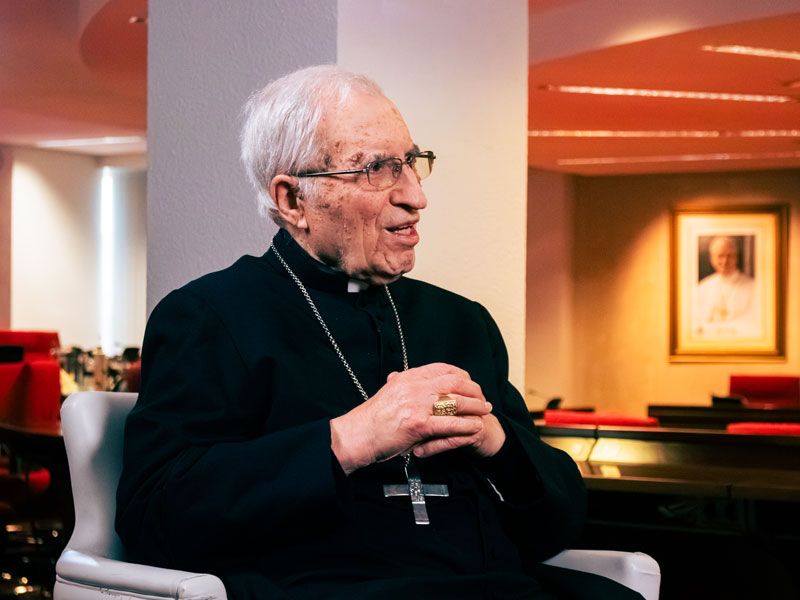
Cardinal Antonio María Rouco Varela considers that the main challenge facing the Church in Spain remains humanity’s response to God. He expressed this view in an interview published this Wednesday on the occasion of the 60th anniversary of the Spanish Episcopal Conference (CEE), in which he also addressed the decline in birth rates, the defense of the family, education, and the presence of Catholics in public life.
The Archbishop Emeritus of Madrid, who chaired the Episcopal Conference from 1999 to 2005 and again from 2008 to 2014, inaugurated a series of interviews dedicated to reviewing the recent history of the Spanish Church. During the conversation, led by Irene Pozo, Rouco reviewed some of the events that marked his years of episcopal responsibility and reflected on the challenges that remain open.
“The yes to God. That is the first challenge”
When asked about the current needs of the Spanish Church, Rouco Varela placed the question of faith above any other pastoral or social challenge.
“The yes of faith. The yes to God. Not only the Spanish Church, but throughout Europe. The yes to God. That is the first challenge,” the cardinal stated, adding that “all the others depend on whether that challenge is taken on well or not.”
For Rouco, the social and cultural transformations of recent decades have not changed the fundamental issue the Church must face. The Christian response, he explained, is not directed toward an abstract idea of divinity, but to God revealed in Jesus Christ.
“The Gospel is Him,” he noted, insisting on the centrality of Christ in understanding both the Church’s mission and its presence in society.
This concern for the transmission of the faith was also present during his years leading the Episcopal Conference, especially in debates related to education, the family, and the role of religion in public life.
The defense of life and the future of the family
Rouco recalled that during his presidencies, much of the bishops’ work was shaped by legislative changes related to abortion, marriage, and assisted reproduction.
The cardinal specifically mentioned issues linked to embryo manipulation and human reproductive techniques, matters that, in his view, have lost prominence in public debate despite retaining their moral importance.
“A problem that has moved to the background of media and public opinion attention and remains of enormous gravity,” he maintained.
In those years, he recalled, the Episcopal Conference promoted initiatives in defense of the right to life and marriage, while also paying special attention to family pastoral care. In this context, he placed the World Meeting of Families held in Valencia in 2006, with the participation of Benedict XVI.
Rouco considered that papal visit to be a reaffirmation of the Church’s teaching on marriage and the family. “If the family fails, it is very difficult for the faith to be maintained,” he stated, linking family stability with the transmission of Christian beliefs to new generations.
He also recalled the celebrations of the Holy Family later organized in Madrid’s Plaza de Colón and the work carried out to strengthen the relationship between parishes, families, and Catholic educational centers.
The decline in birth rates and the future of Europe
The demographic situation also occupied a prominent place in his reflections on the present. Rouco linked intergenerational solidarity with the willingness to welcome new lives and warned of the consequences of the drop in births.
“We talk a lot about solidarity, but the first sign of solidarity is giving life,” he stated.
He then expressed his concern about the aging of the European population: “A people, a society that has no children, is dying. It is not generous.”
The cardinal noted that a society needs new generations to sustain its future and fulfill its collective responsibilities. In this context, he also acknowledged the importance of addressing the reality of immigration, an issue that, he recalled, the Episcopal Conference has dealt with for decades.
However, he insisted that the sharp decline in birth rates in Europe constitutes a problem affecting both society and the Church’s own life.
The participation of Catholics in public life
Another issue that marked his presidencies was the Church’s relationship with political power, especially during a period of significant legislative reforms.
Rouco explained that the Episcopal Conference’s position was based on the defense of human dignity and fundamental rights, without implying identification with any particular political party.
“The Church does not identify with the political community or with any political system,” he recalled, citing the teaching of the Second Vatican Council.
That independence, he clarified, does not mean that Catholics should remain on the sidelines of public decisions. On the contrary, he defended their right to assume political and social responsibilities in accordance with their convictions and the principles of the Church’s social doctrine.
According to him, the Episcopal Conference has maintained this orientation throughout its history, promoting the participation of the faithful in public affairs without institutionally linking the Church to any party.
In his review of those years, he also referred to ETA terrorism, one of the issues that continuously occupied the Spanish bishops. Rouco recalled the Episcopal Conference’s concern about terrorist violence and the statements it made on the matter, including the episcopal document published in 2002.
The visit of John Paul II and the faith of the Spanish people
Recalling the changes Spain experienced during the Transition, Rouco evoked the first visit of Saint John Paul II in 1982, an event that, he said, allowed the bishops to see the religious vitality of a large part of Spanish society.
The cardinal recalled his arrival at Barajas Airport to receive the Pontiff and the surprise he felt upon initially finding some streets practically empty. However, the situation changed when the papal procession began and thousands of people came out to greet him.
That welcome, he explained, led the bishops to recognize that, despite the country’s political and cultural transformations, faith continued to have a significant presence among Spaniards.
Rouco also paused to reflect on the World Youth Day held in Madrid in 2011, during the pontificate of Benedict XVI, one of the most notable events of his second term leading the Episcopal Conference.
“We must come down from dreams and make realities”
In his reflection on the future of the Church, Rouco Varela defended the need to turn pastoral intentions into concrete actions.
“We must come down from dreams and make realities,” he stated when asked how he imagined the Spanish Church in the coming years.
The cardinal explained that the desire for improvement must translate into effective commitments to personal life, the family, and the common good. To this end, he highlighted the importance of hope, charity, and the responsibility of each Christian in their own environment.
The interview also allowed the former president of the CEE to clarify the scope of the functions of that position. Rouco recalled that whoever presides over the Episcopal Conference does not have executive authority over the other bishops, but rather carries out coordination and representation tasks.
As an example, he recalled a question he received after his first election in 1999, when a journalist wanted to know if he was going to become the head of the Spanish bishops. His response was: “The only head of the bishops is our Lord.”
The conversation is part of the programming prepared by the Spanish Episcopal Conference to celebrate the 60 years since its constitution in 1966. The series will continue with interviews with Cardinals Ricardo Blázquez on October 28, and Juan José Omella on November 4, and will conclude on November 10 with the current president of the CEE, Luis Argüello.
The celebrations will also include the documentary 60 years of the CEE: a shared history, whose presentation is scheduled for November, coinciding with the Plenary Assembly of the Spanish bishops.